
The bus stop method is a short written way to divide a big number by a one digit number, one digit at a time, working from left to right. It gets its name from the bracket drawn around the number being divided, because that bracket looks like a little bus shelter.
Bus Stop Method Worked Example: 2472 Divided by 4 Step by Step
Start with the layout. Write the dividend, 2472, in a row. Draw a bracket over it, with a short vertical line before the 2 and a long line above all four digits. Write the divisor, 4, outside on the left. The answer, called the quotient, goes on top, above the digit you have just divided.
- Look at the first digit, 2. How many 4s fit into 2? None, so write a small 0 above the 2. That 0 holds its place on the roof.
- The unused 2 joins the next digit, making 24. How many 4s fit into 24? Six, exactly. Write 6 above the 4. Nothing is left over.
- Move to the next digit, 7. How many 4s fit into 7? One, with 3 left over. Write 1 above the 7, then write the leftover 3 small, just in front of the final digit, the 2. That little 3 makes the last step 32, not just 2.
- How many 4s fit into 32? Eight, exactly. Write 8 above the final 2. The calculation is finished.
- Read the roof left to right. It says 0618, which we read as 618. So 2472 divided by 4 equals 618.
What Happens When There Is a Remainder? 3854 Divided by 6
Sometimes numbers refuse to split evenly. Try 3854 divided by 6 in the same shelter.
- Six does not fit into the first digit, 3, so write 0 above the 3 and carry the 3 across.
- Read the first two digits as 38. Six fits into 38 six times, with 2 left over. Write 6 above the 8 and carry the small 2 in front of the next digit, the 5, making 25.
- Six fits into 25 four times, with 1 left over. Write 4 above the 5 and carry the 1 in front of the final digit, the 4, making 14.
- Six fits into 14 twice, with 2 left over. Write 2 above the final 4. No digits remain, so that 2 stays as the remainder.
The answer is 642 remainder 2, written as 642 r 2.
Why Do Schools Teach the Bus Stop Method?
Children usually meet this method in Year 4 or Year 5 in the UK, once times tables feel secure. Schools like it because it turns one big, scary division into a string of tiny divisions a child can do in their head. You only ever ask one small question at a time, such as how many 4s fit into 7.
How Does the Bus Stop Method Link to Long Division?
The bus stop method is short division. Long division solves the same problems but writes out more working, with each multiply and subtract step on its own line. Think of the bus stop as the compact version, where most subtracting happens in your head. Once this rhythm feels automatic, long division later feels like a slower version of a dance your child already knows.
Common Mistakes With the Bus Stop Method
- Forgetting to carry the remainder. A child divides 7 by 4, writes 1 on the roof, then divides the next digit on its own. The leftover 3 never joins the next column, so later steps go wrong. Ask what was left over.
- Leaving out the 0 on the roof. When the divisor does not fit into the first digit, it still needs a 0 above it. Without it, 618 can collapse into 68.
- Carried digits written too big. They should sit small, in front of the next digit inside the shelter. A big one above the line gets read as part of the answer.
- Shaky times tables in disguise. If how many 6s fit into 38 feels like a guess, times table practice beats more division questions.
Try It: Build a Bus Stop with Counters
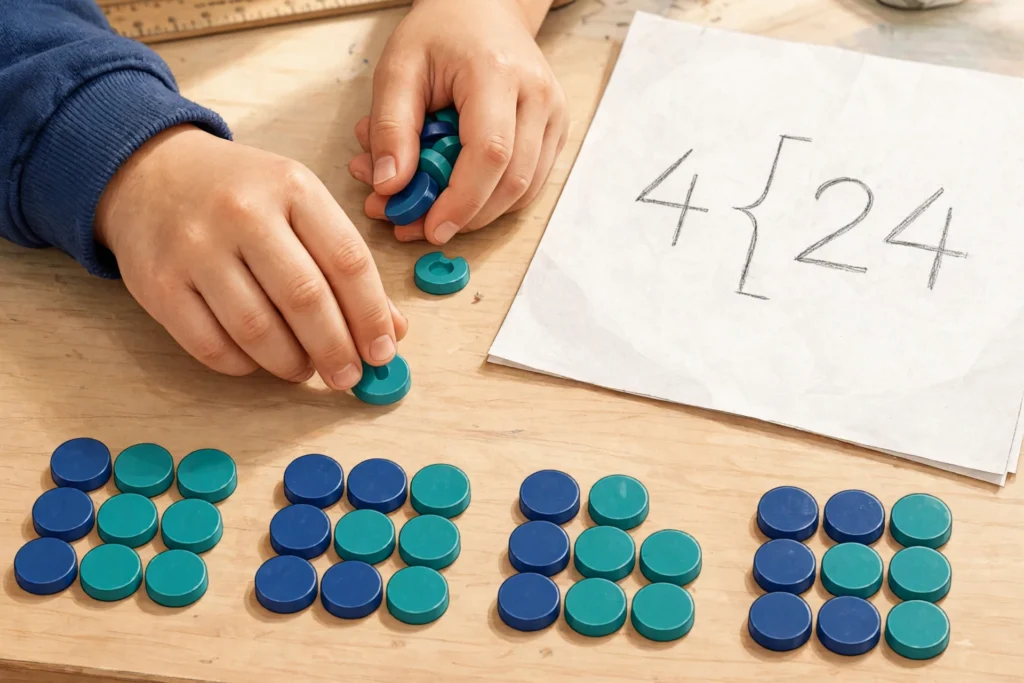
You need 24 counters or buttons, plus paper and a pencil. Draw a big bus stop bracket, write 4 outside it and 24 inside it, then deal the counters into 4 groups, like dealing cards. Each group should end with 6. Now do the written method beside your groups. The 6 on the roof should match the counters, and that click of agreement is the point. For a trickier round, use 26 counters. Two stay in your hand, and a child who has held a remainder rarely forgets it.
Printable Practice
The free MathClearGuide worksheet for this page gives graded practice, from exact divisions to remainders and a word problem. Each question has its own bracket with room for carried digits, and a full answer key sits on the final page. Print the Letter or A4 version.
Quick Practice
Question 1: Use the bus stop method to work out 936 divided by 3.
Answer 1: 312. Three fits into 9 three times, into 3 once and into 6 twice.
Question 2: Use the bus stop method to work out 527 divided by 5.
Answer 2: 105 remainder 2. Five fits into 5 once, into 2 zero times, and the carried 2 makes 27, which holds five 5s with 2 left over.
Question 3: A teacher shares 174 pencils equally into 6 pots. How many pencils go in each pot?
Answer 3: 29 pencils. Six fits into 17 twice with 5 left over, and the carried 5 makes 54, which is nine 6s.
Related Terms
- Long Division: The roomier method that shows every multiply and subtract step in full.
- Division: Splitting a number into equal groups, or finding how many groups fit inside it.
- Remainder: The amount left over when numbers do not split exactly evenly.
Frequently Asked Questions
What is the bus stop method in maths?
It is a formal written method for division, also called short division. The dividend goes inside a bracket shaped like a bus shelter, the divisor goes outside on the left, and you divide digit by digit from left to right, carrying remainders onward.
Why is it called the bus stop method?
Because of the bracket shape. Its short side and long top look like a bus shelter, with the dividend inside, the divisor outside and the answer on the roof.
How do you do the bus stop method with remainders?
Work in the same way, carrying each leftover in front of the next digit. If something is still left after the final digit, write it after the quotient as the remainder, as in 3854 divided by 6 equals 642 remainder 2.
What year group learns the bus stop method?
It is a Key Stage 2 method in the UK. Children usually meet it in Year 4 or Year 5, once the small times table steps feel quick, and they keep using it through Year 6.
What if the divisor is bigger than the first digit?
Write 0 above that digit, carry it across, then divide the first two digits together. In 2472 divided by 4, the 0 goes on the roof and you move on to 24 divided by 4.
What is the difference between short division and long division?
Short division is the bus stop method, where multiply and subtract steps happen mostly in your head and only carried remainders are written small. Long division writes those steps out in full underneath. Both give the same answer.
Every topic clicks faster with practice. Our Resource Library has free lesson packs with slides, printable worksheets and full answer keys, ready to download and teach.
Members unlock every lesson in the library, including the full Fractions, Multiplication, Place Value, Addition & Subtraction, Time & Money and Geometry & Shapes units. See the full library


