
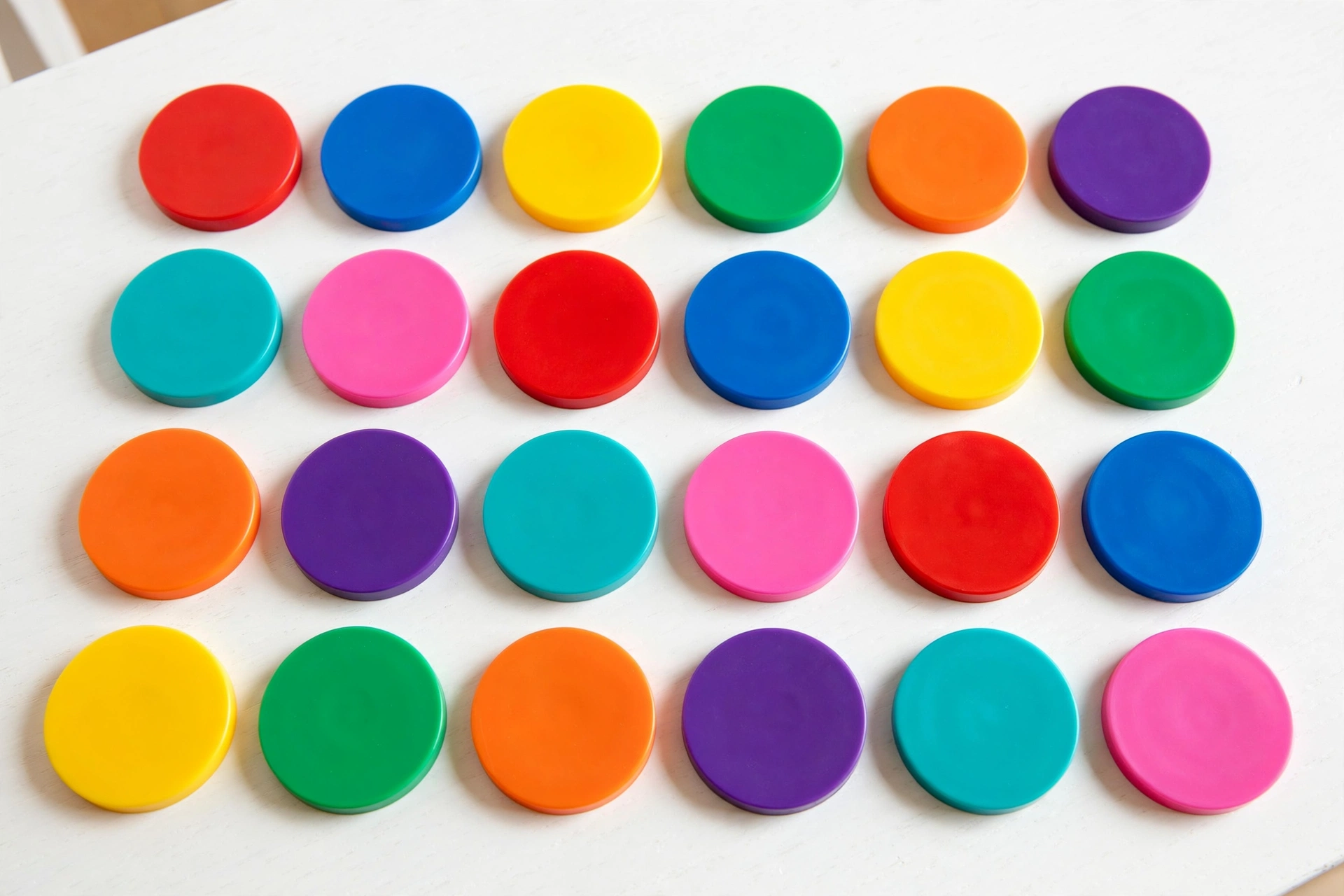
Line up six chairs in a row. Now make four identical rows. You have just built an array, and without realizing it, you have also built a multiplication problem. Count the chairs one by one and you get 24. Count by rows (6, 12, 18, 24) and you feel multiplication happening. That rectangle of chairs is what mathematicians call an array.
What Is an Array in Math?
An array is an arrangement of objects in equal rows and columns. The key word is equal: every row has the same number of items, and every column has the same number. A scattered pile of blocks is not an array. Three neat rows of four blocks is. That organization is what gives arrays their mathematical power.
Arrays show multiplication visually. A 4-by-6 array (4 rows, 6 columns) contains 24 items, which means 4 times 6 equals 24. Students who can see this do not need to memorize blindly. They can look at the rectangle and understand what the numbers mean.
Why Do Arrays Matter for Multiplication?
Arrays bridge the gap between adding and multiplying. A student who sees 4 rows of 6 can count 6 plus 6 plus 6 plus 6, which is repeated addition. Then they notice the shortcut: 4 times 6. The array makes both visible at once, so multiplication feels like a discovery rather than a rule.
Arrays also reveal properties that are hard to see in symbols. Rotate a 3-by-4 array and it becomes 4-by-3, but the total does not change. That is the commutative property, proven by turning paper. Break a 6-by-8 array into 6-by-5 and 6-by-3, and you have just demonstrated the distributive property. Arrays do not just show answers. They show why multiplication works.
How Do Arrays Connect to Division?
Cover part of an array and division appears. Show a 4-by-6 array with 24 dots, then cover one row. Ask: “If 24 dots make 4 equal rows, how many are in each row?” The student counts 6. That is 24 divided by 4. Arrays make the inverse relationship between multiplication and division visible, which is why teachers use them for both operations.
This connection is powerful for struggling learners. A student who cannot remember 24 divided by 6 can draw the array, count the rows, and find the answer. The picture holds the information that memory cannot yet retrieve. Over time, the repeated drawing builds the memory, and the array becomes unnecessary. But it is always there as a backup.
What Mistakes Do Students Make With Arrays?
The most common error is building unequal rows. A student making a “3 by 4” array creates rows of 4, 4, and 3, then wonders why skip-counting gives the wrong total. Insist on equal rows from the start. Have students check by counting each row before finding the total. Precision in building leads to accuracy in computing.
Another issue is confusing rows and columns. A student asked for 2 rows of 5 builds 5 rows of 2. The total is the same (thank the commutative property), but the confusion signals shaky vocabulary. Use consistent language: “rows go across, columns go down.” Have students label their arrays until the words stick.
How Can Families Use Arrays at Home?
Look for arrays everywhere. Egg cartons are 2-by-6 arrays. Muffin tins are 3-by-4. Ice cube trays, chocolate bars, and window panes all show rows and columns. Point them out and ask: “How many rows? How many in each row? What multiplication does this show?” The world is full of arrays once you start looking.
Build arrays with food. Arrange crackers, grapes, or cereal pieces in rows and columns before eating them. Ask your child to build 3 times 5, then rotate it to show 5 times 3. Edible math is memorable math, and the rotation trick never fails to delight.
Try It: Build Arrays With Tiles
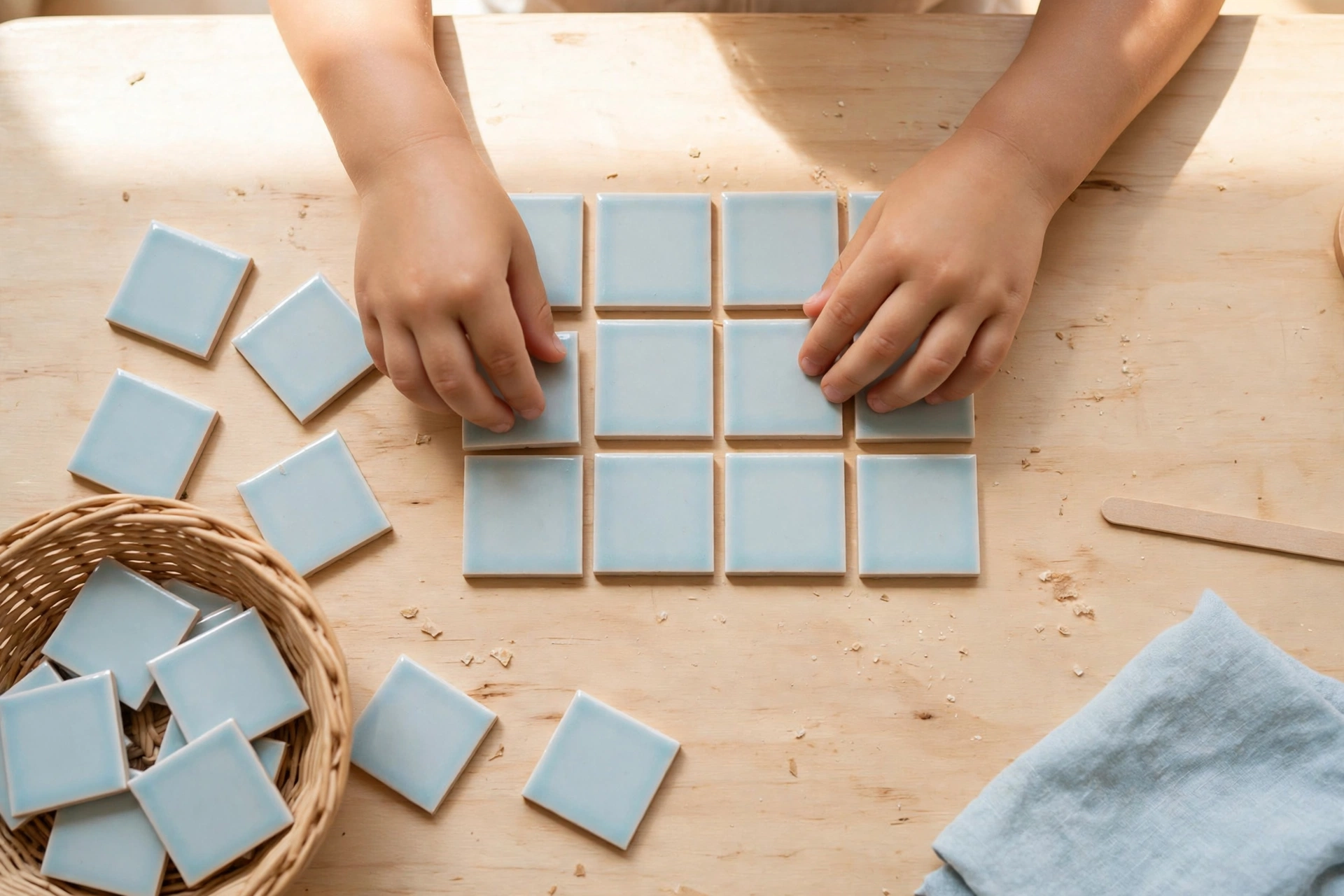
Step 1: Choose a number. Pick 12 tiles (or paper squares). Ask: how many different arrays can you build with 12?
Step 2: Build and record. Students build 1-by-12, 2-by-6, 3-by-4, and the rotations. For each, they write the multiplication: 3 times 4 equals 12.
Step 3: Compare. Lay all the arrays side by side. Which is longest? Which is most square? How are 2-by-6 and 6-by-2 related?
Step 4: Extend. Try 16, 20, and 24. Which numbers make the most arrays? Students discover that some numbers are “array-rich” and others are not, which is an early encounter with factors.
Quick Practice
Question: A student builds an array with 5 rows of 3. They write 5 plus 3 equals 8. What is wrong, and what should they write instead?
Answer: They added instead of multiplying. An array with 5 rows of 3 shows 5 times 3, which equals 15. They can verify by counting: 3, 6, 9, 12, 15.
Frequently Asked Questions
What is the difference between an array and a matrix?
In elementary math, they are the same idea: rows and columns of items. “Matrix” is the term used in higher mathematics, where arrays of numbers follow special rules. For K-5 purposes, “array” is the right word.
When do students learn arrays?
Arrays appear in second grade as a way to work with equal groups, then become central in third grade when multiplication is introduced. They remain useful through fifth grade for multi-digit multiplication and division.
Can arrays show fractions?
Yes. Shade part of an array to show fractions: shade 3 out of 8 squares in a 2-by-4 array to show 3/8. Arrays are versatile visual tools that grow with the student.