
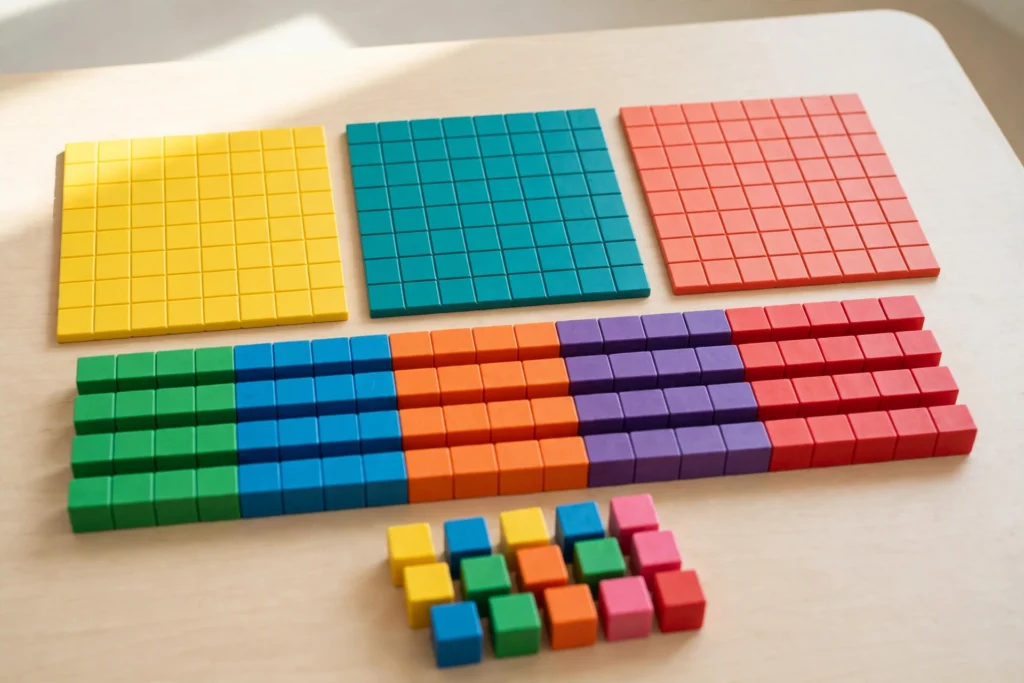
Hold up seven fingers. Now imagine holding up seventy. You cannot, because you only have ten fingers. That limitation is the reason our entire number system exists. Thousands of years ago, people started grouping things by tens because ten fingers made ten a natural bundle. That ancient choice became base ten, the system behind every number your child will ever meet.
What Does Base Ten Mean in Math?
Base ten means our number system is built on groups of ten. Ten ones make one ten. Ten tens make one hundred. Ten hundreds make one thousand. The pattern never stops. Each place in a number is worth exactly ten times the place to its right, which is why the 2 in 200 is worth one hundred times the 2 in 2.
This sounds simple, but it is one of humanity’s greatest inventions. Before place value, writing large numbers required entirely new symbols. Roman numerals needed V, X, L, C, D, and M just to reach one thousand. With base ten, ten digits (0 through 9) can write any number in the universe. The power is not in the digits. It is in the places.
Why Is Base Ten So Important for Young Learners?
Base ten is the foundation under almost all elementary math. Addition with regrouping only makes sense if you understand that ten ones become one ten. Subtraction with borrowing only works if you see that one ten can become ten ones. Place value, rounding, decimals, and even the metric system all rest on the base-ten idea.
Students who truly grasp base ten learn new topics faster because they recognize the same pattern everywhere. When they meet decimals in fourth grade, they see that tenths and hundredths continue the pattern to the right. When they meet the metric system, they notice that meters, centimeters, and millimeters are just base ten with new names. One idea, dozens of applications.
How Do Base-Ten Blocks Make It Concrete?
Base-ten blocks turn the abstract system into something children can hold. The tiny cube is one. The long rod is ten ones stuck together. The flat square is one hundred, ten rods fused into a plate. The large cube is one thousand. When a child trades ten ones for one rod, they are not memorizing a rule. They are feeling base ten in their hands.
The most powerful moment comes with regrouping. A student adding 28 and 35 builds both numbers with blocks, combines the ones, and discovers they have thirteen loose cubes. The teacher asks what to do, and the student trades ten cubes for a rod. That trade is base ten in action. No worksheet can create the understanding that one physical exchange builds.
What Mistakes Reveal Shaky Base-Ten Understanding?
Watch for the student who writes 307 as 37. They heard “three hundred seven” and wrote the digits they heard, skipping the zero that holds the tens place. This is not carelessness. It shows they do not yet see that each position must be filled, even with nothing. The zero is not empty. It is a placeholder with a job.
Another common error is reading 45 as “forty-five” but thinking the 4 means four. Ask “How many ones is this 4 worth?” If the student says four instead of forty, the base-ten idea has not landed yet. They see digits, not values. More time with blocks, trading games, and “what is it worth” questions will close the gap.
How Can Families Support Base-Ten Thinking at Home?
Bundle real objects. Give your child dried beans or buttons and rubber bands. Every time they count ten, they wrap a bundle. Then count the bundles and the leftovers: “We have 3 bundles and 4 leftovers. That is 34.” This is base ten without any fancy materials, and it works beautifully.
Play the trading game. Start with a pile of ones (pennies work well). Trade ten pennies for one dime, ten dimes for one dollar. Let your child be the banker. The physical exchange teaches more than any explanation, and handling real money adds motivation that blocks cannot match.
Try It: Build 247 With Base-Ten Blocks
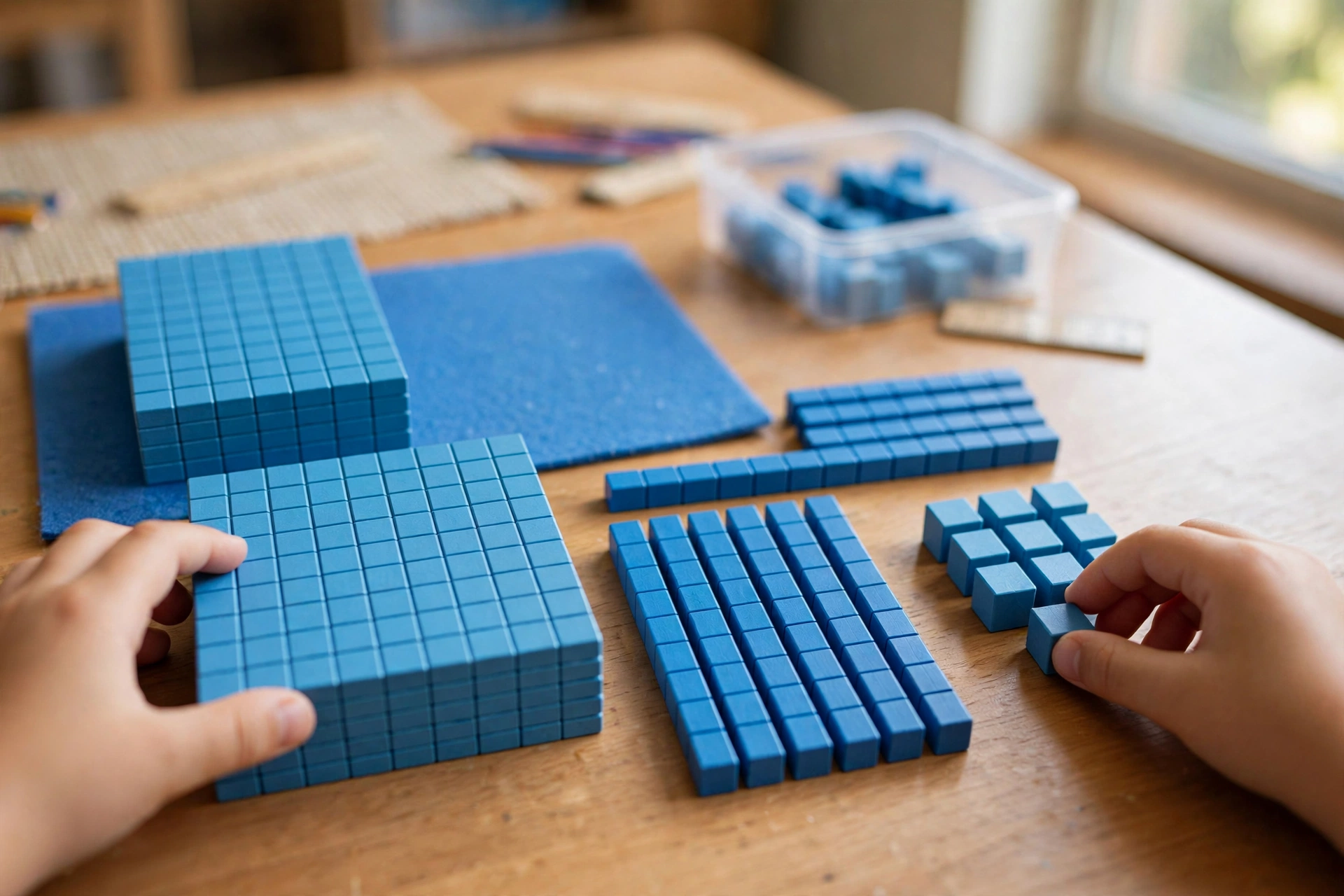
Step 1: Gather the pieces. You need 2 hundred-flats, 4 ten-rods, and 7 ones cubes.
Step 2: Build each place. Lay out the 2 flats, then the 4 rods, then the 7 cubes. Say each part aloud: “2 hundreds, 4 tens, 7 ones.”
Step 3: Name the whole. Push the pieces together and read the number: 247.
Step 4: Break it and rebuild. Scatter the pieces and rebuild 247 from memory. Then try 352, 180, and 409.
Quick Practice
Question: A student builds 56 with 5 ten-rods and 6 ones, then adds 7 more ones. What should they do next, and what number do they have now?
Answer: They have 13 ones, so trade 10 ones for 1 ten-rod. Now 6 tens and 3 ones = 63.
Frequently Asked Questions
Why is our number system base ten and not base twelve?
Most likely because humans have ten fingers. Base ten won because of anatomy, not mathematics.
When should children learn base ten?
Foundations start in kindergarten with grouping. Formal place value begins in first grade with tens and ones.
Is base ten the same as place value?
They are related but not identical. Base ten is the system (grouping by tens). Place value is the rule (position determines worth).