
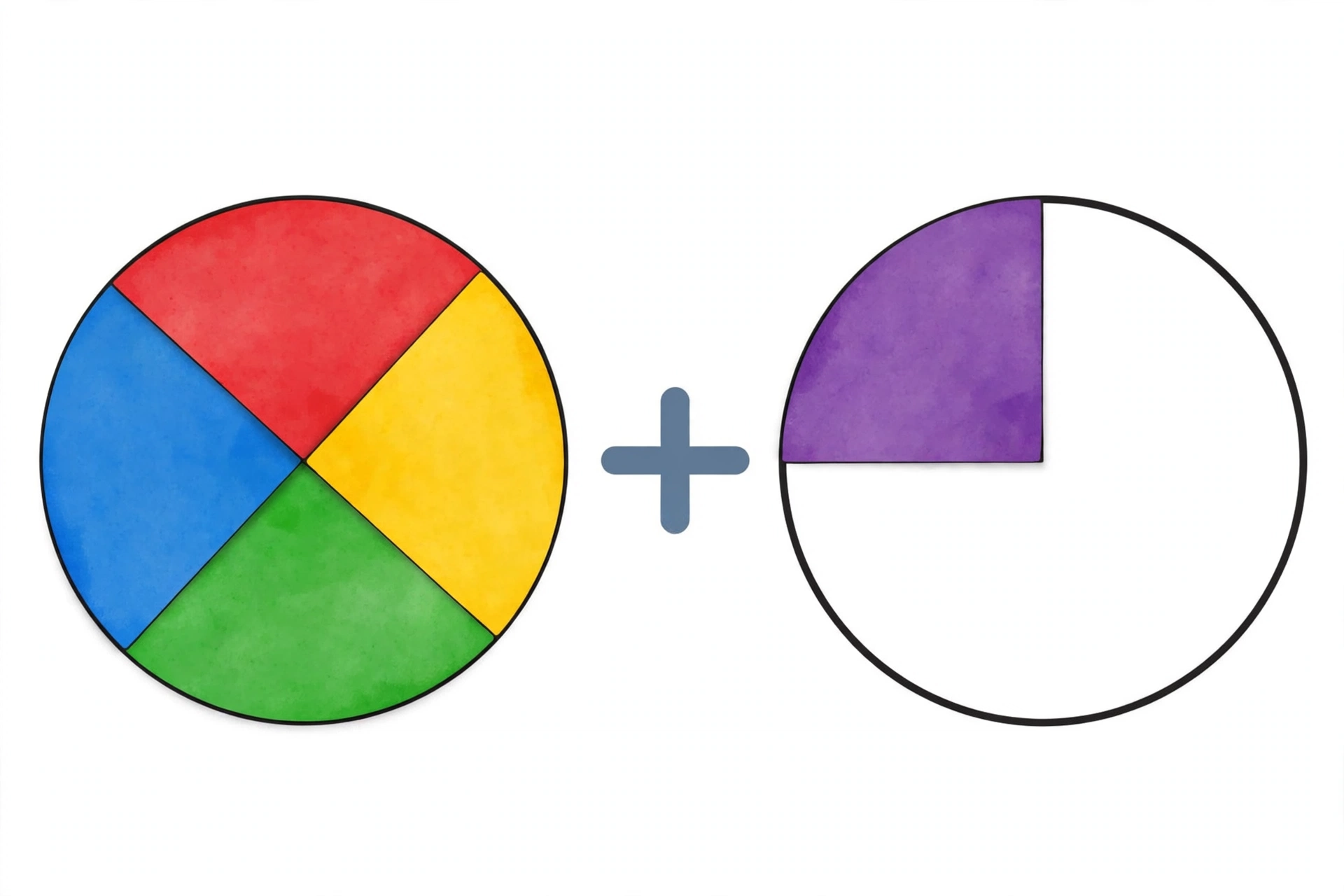
Eat a whole pizza, then eat one more slice from the next pizza. How much did you eat? More than one pizza, but less than two. Mathematicians write this as 5/4: five quarters. That is an improper fraction, and despite the name, there is nothing improper about it.
What Is an Improper Fraction?
An improper fraction is a fraction where the numerator (top number) is larger than the denominator (bottom number). Examples: 5/4, 7/3, 9/2. These fractions represent amounts greater than one whole. Five fourths means five quarter-pieces, which is one whole pizza plus one extra quarter.
The name confuses students. “Improper” sounds like “wrong” or “bad.” Reassure them: improper fractions are perfectly proper mathematics. The name just means the fraction does not follow the usual pattern of being less than one. It is top-heavy, and that is fine.
How Do Improper Fractions Relate to Mixed Numbers?
Every improper fraction can be rewritten as a mixed number (a whole number plus a proper fraction). Five fourths (5/4) equals 1 and 1/4. Seven thirds (7/3) equals 2 and 1/3. The conversion is simple: divide the numerator by the denominator. The quotient is the whole number, the remainder is the new numerator.
Show this visually. Build 5/4 with fraction circles: fill one whole circle with four quarters, then place a fifth quarter on a new circle. Students see one full circle and one quarter. Write both forms: 5/4 = 1 1/4. The picture makes the equivalence obvious.
When Do We Use Improper Fractions?
Improper fractions are essential for multiplication and division of fractions. To multiply 1 1/2 by 2/3, convert to improper fractions first: 3/2 times 2/3. The computation is cleaner. Students who avoid improper fractions struggle with fraction operations because they are working with clumsy forms.
They also appear in measurements and real life. A recipe calling for 5/2 cups of flour means two and a half cups. A runner completing 7/4 miles ran one and three-quarter miles. The improper form is often more useful for calculating, while the mixed number is friendlier for understanding.
What Mistakes Do Students Make?
Many students insist improper fractions are “impossible” because “you cannot have 5 parts of 4.” This shows they picture only one whole. Draw two wholes and shade five fourths across them. The visual proof that you can have more parts than one whole contains instantly resolves the confusion.
Another error is converting incorrectly: writing 5/4 as 1 1/2 instead of 1 1/4. Students divide 5 by 4, get 1 remainder 1, but then write the remainder over the wrong denominator. Emphasize: the denominator never changes when converting. It is still fourths.
Try It: Build Improper Fractions
Step 1: Gather pieces. You need several sets of fraction circles cut into thirds, fourths, or fifths.
Step 2: Build 7/3. Ask students to show seven thirds. They will fill two whole circles (6 thirds) and place one third on a third circle.
Step 3: Name it two ways. Write 7/3 and 2 1/3. Ask: which form tells you how many wholes? Which is easier to picture?
Step 4: Convert. Give more improper fractions: 9/4, 11/5, 8/3. Students build, then convert to mixed numbers.
Quick Practice
Question: Convert 11/4 to a mixed number. Then draw a picture to prove your answer.
Answer: 11 divided by 4 is 2 remainder 3, so 11/4 = 2 3/4. The picture shows two full circles (8 fourths) plus 3 fourths on a third circle.
Frequently Asked Questions
Why are they called improper fractions?
Historical naming. Early mathematicians thought fractions should be less than one (proper). Fractions greater than one seemed “improper.” The name stuck, but the math is perfectly valid.
Should students use improper fractions or mixed numbers?
Both. Use improper fractions for computing (multiplication, division). Use mixed numbers for understanding and real-world contexts. Fluency means moving comfortably between them.
Can proper fractions become improper?
When you add or multiply, yes. One half plus three fourths equals five fourths. The result is improper, which is fine. Convert to a mixed number if you want, but the improper form is mathematically correct.