
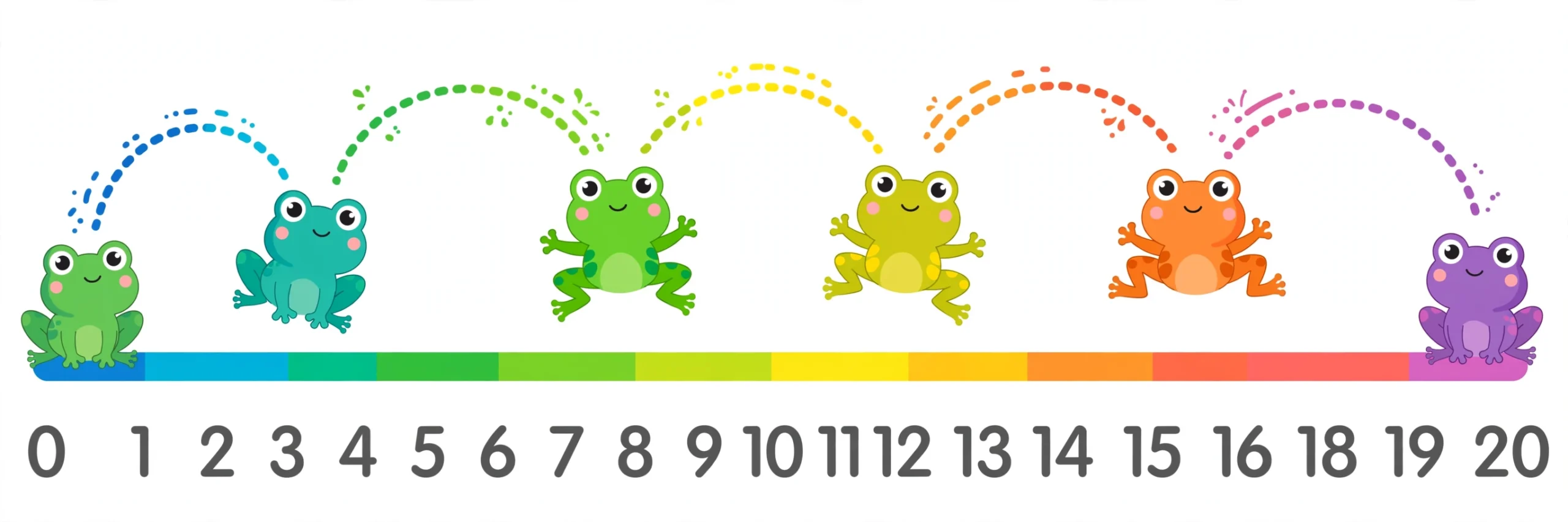
Draw a straight line. Mark 0, then 1, 2, 3, all evenly spaced. You have just created one of the most powerful tools in elementary mathematics. That simple line helps children count, add, subtract, compare, and eventually understand fractions and negative numbers. It is called a number line.
What Is a Number Line?
A number line is a straight line with numbers placed at equal intervals in order. The numbers increase from left to right. The distance between numbers represents their difference. Zero is the starting point, though number lines can extend into negatives to the left.
The power is in the spacing. Because the intervals are equal, the line shows not just order but magnitude. The jump from 3 to 7 is visibly larger than from 3 to 4. Students see size, not just sequence, which builds true number sense.
How Do Number Lines Show Operations?
Addition is hopping forward. To solve 5 plus 3, start at 5 and hop 3 spaces right: 6, 7, 8. The answer is where you land. Subtraction is hopping backward. For 9 minus 4, start at 9 and hop 4 left: 8, 7, 6, 5. The movements make the operations physical and intuitive.
Number lines also show comparison. Which is bigger, 47 or 74? Find both on the line. Seventy-four is further right, so it is larger. The visual makes “greater than” obvious in a way that digit-comparing rules cannot.
Why Are Number Lines So Versatile?
They grow with the student. In kindergarten, number lines to 10 support counting. In first grade, they show addition and subtraction. In third grade, they display fractions: partition the space between 0 and 1 into fourths. In fifth grade, they extend left to show negative numbers. One tool, years of use.
They also connect to measurement. Rulers are number lines. Thermometers are number lines. Timelines are number lines. Students who understand the abstract tool recognize it in concrete forms, which deepens both.
What Mistakes Do Students Make?
Counting the marks instead of the jumps is classic. Asked to show 3 plus 2, a student starts at 3 and counts “3, 4, 5” landing on 5 instead of hopping to 5. Teach them: start at 3, then hop 2: “4, 5.” The hops are the added number, not the starting point.
Unequal spacing is another issue. Students draw number lines with random gaps, destroying the magnitude information. Insist on equal intervals from the start. Use grid paper if needed. Precision matters because the visual is the math.
Try It: Walk the Number Line
Step 1: Make a floor line. Use tape to create a large number line from 0 to 20 on the floor.
Step 2: Hop the addition. Call out “7 plus 5.” A student stands on 7, hops 5 forward, lands on 12. The class counts the hops aloud.
Step 3: Hop the subtraction. “15 minus 6.” Start at 15, hop 6 back. Where do you land?
Step 4: Compare. Two students stand on different numbers. Who is further right? That number is greater.
Quick Practice
Question: Show 8 plus 4 on a number line. Where do you start, how many hops, and where do you land?
Answer: Start at 8. Hop 4 spaces right: 9, 10, 11, 12. Land on 12. So 8 + 4 = 12.
Frequently Asked Questions
When should children start using number lines?
As early as kindergarten for counting. Formal use for operations begins in first grade. The key is to start with physical, large lines before moving to paper.
Are number lines better than counters?
They serve different purposes. Counters show quantity. Number lines show order, distance, and relationships. Use both; they complement each other.
How do number lines help with fractions?
Partition the interval between whole numbers. The space from 0 to 1 divided into 4 equal parts shows fourths. Students see that 3/4 is three jumps of 1/4, which builds fraction sense.