
Two, four, six, eight. Who do we appreciate? That chant is skip counting: counting by twos instead of ones. It feels like a game, but it is secretly building the foundation for multiplication, division, and number patterns.
What Is Skip Counting?
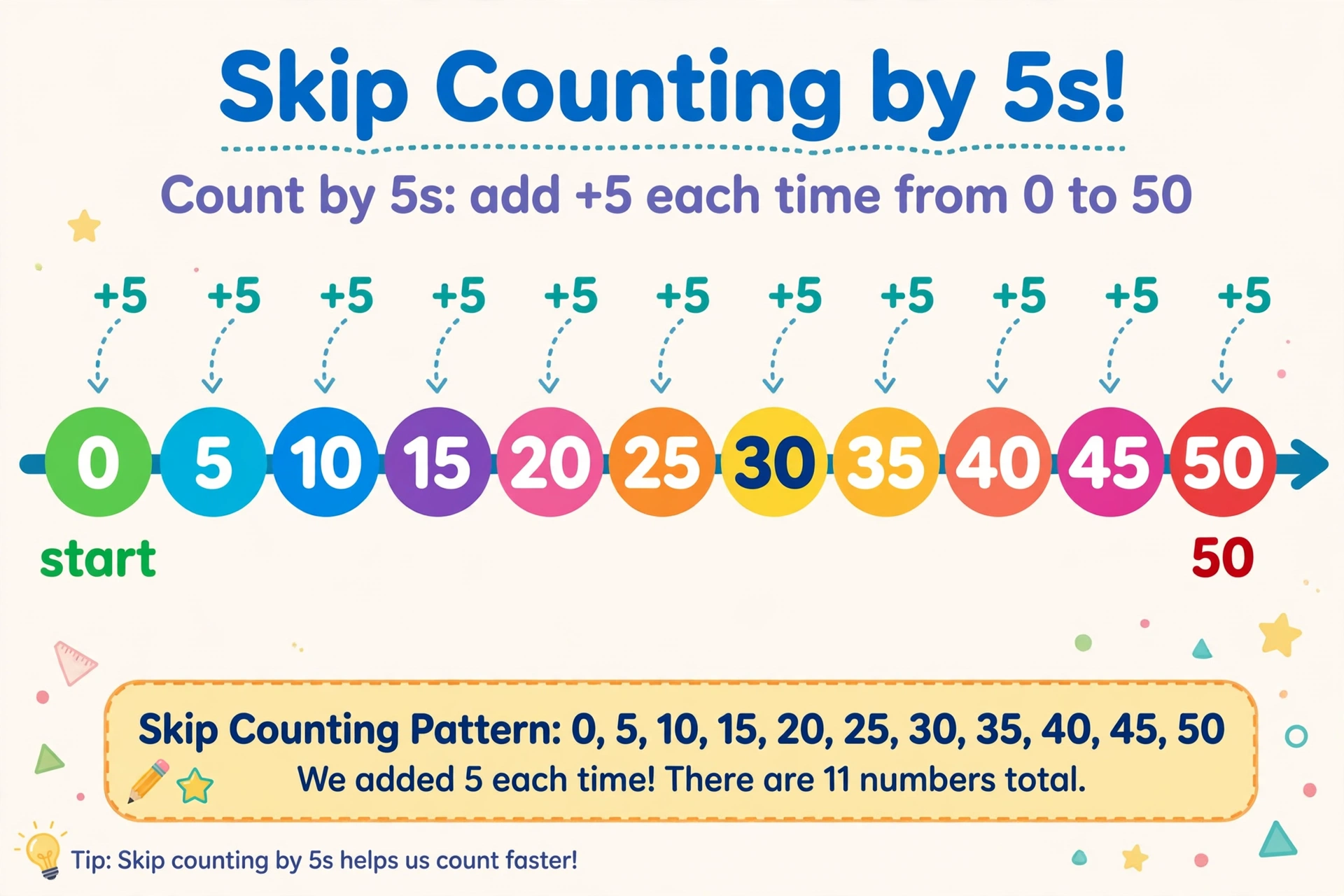
Skip counting means counting by a number other than one. Count by twos: 2, 4, 6, 8. By fives: 5, 10, 15, 20. By tens: 10, 20, 30. You “skip” the numbers in between, landing only on multiples of your counting number.
This is different from regular counting, where you say every number. Skip counting is selective. You are not just reciting; you are generating a pattern. That pattern recognition is what makes it powerful.
Why Is Skip Counting Important?
It is multiplication in disguise. Counting by 3s (3, 6, 9, 12) is the 3 times table. Students who can skip count by 4 have essentially memorized the 4s facts without flashcards. When they later meet formal multiplication, it feels familiar instead of foreign.
Skip counting also builds number sense. A student who skip counts by 10 understands place value deeply: each jump adds one ten. A student who skip counts by 5 sees the alternating 5-0 pattern in the ones place. These patterns reveal the structure of our number system.
How Do You Teach Skip Counting?
Start with movement. Have students hop, clap, or stomp on the counts: whisper 1, shout 2, whisper 3, shout 4. The physical emphasis marks the pattern. For fives, clap on 5, 10, 15. The body learns before the brain.
Use number lines and hundred charts. Highlight the multiples: color all the 5s on a hundred chart and watch the columns emerge. The visual pattern reinforces the auditory one. Students see what they are saying.
Connect to real contexts. Count pairs of socks by twos. Count nickels by fives. Count fingers (all ten) by tens. Real objects give the abstract pattern a concrete anchor.
What Comes After Basic Skip Counting?
Count backward. If you can go 5, 10, 15, can you go 15, 10, 5? Backward skip counting is harder and builds flexibility. It also prepares for subtraction and division.
Start from different numbers. Skip count by 3 starting from 1: 1, 4, 7, 10. This is advanced because it breaks the familiar pattern. Students must actually add 3 each time instead of reciting a memorized sequence. That is real computation.
Try It: Skip Count With Hops
Step 1: Mark the floor. Place number cards from 0 to 30 in order on the floor.
Step 2: Hop by 2s. Students hop from 0 to 2 to 4, saying each number. How far can they go?
Step 3: Hop by 5s. Start at 0, hop to 5, 10, 15. Notice how much faster you move.
Step 4: Mix it up. Hop by 3s. Hop backward by 2s. The challenges build flexibility.
Quick Practice
Question: Skip count by 4 starting from 0. Write the first 6 numbers. Then explain how this helps with 4 times 5.
Answer: 0, 4, 8, 12, 16, 20. The 5th number (not counting 0) is 20, which is 4 times 5. Skip counting generates the multiplication facts.
Frequently Asked Questions
When should children learn skip counting?
By 2s, 5s, and 10s in first grade. By 3s and 4s in second grade as multiplication approaches. The patterns should be solid before times tables begin.
Is skip counting the same as multiplication?
Not exactly, but closely related. Skip counting by 4 produces the 4s table. Multiplication is the operation; skip counting is one way to compute it. Students need both.
What if a student can only recite, not apply?
They have memorized the sequence without understanding. Ask them to start from a different number or count backward. If they cannot, they need more work with the underlying addition pattern.