
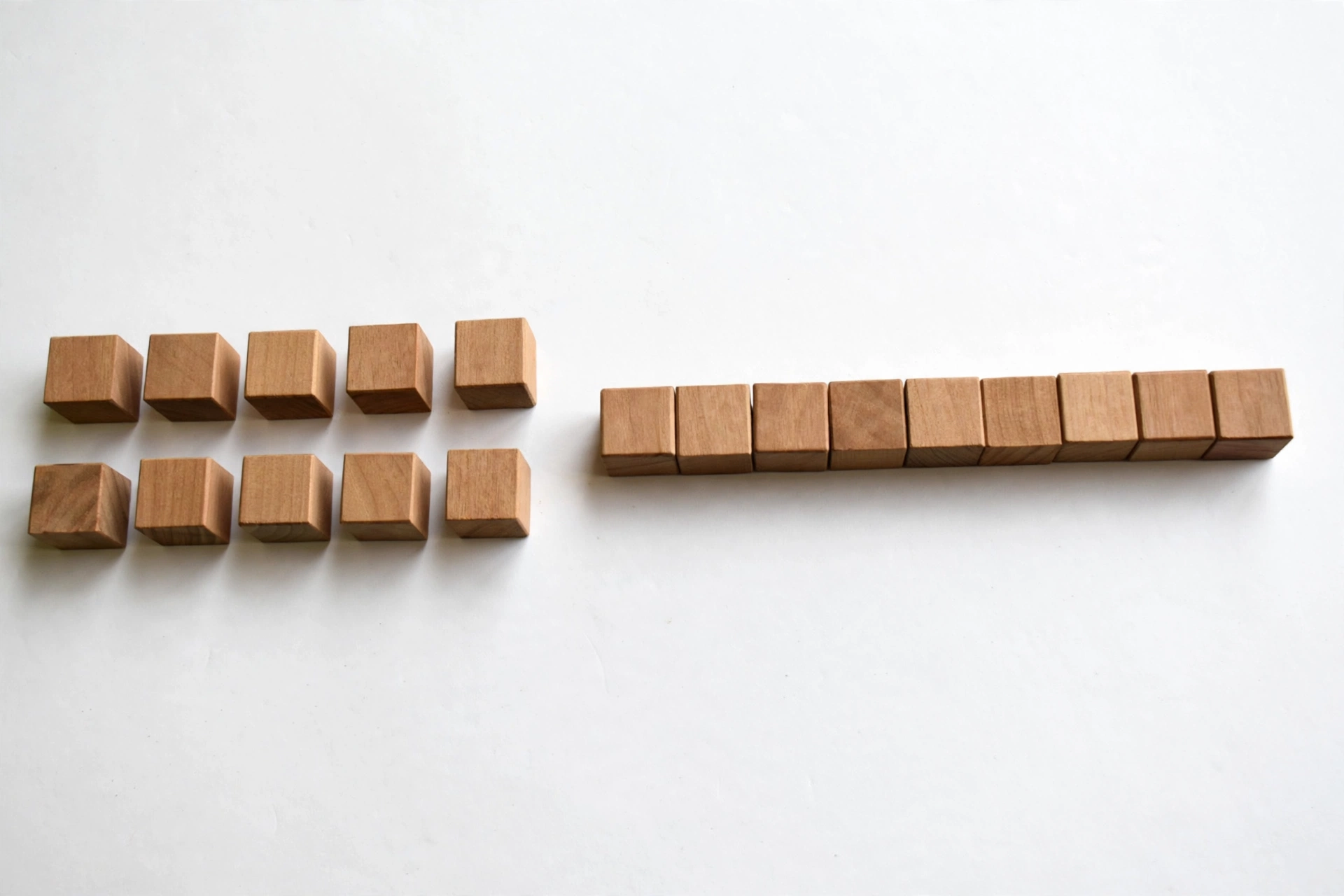
Hold up a ten-rod. Ask a child: “How many?” They might say “one” (one rod) or “ten” (ten ones). Both are correct. That ability to see one object as ten units, to hold both truths at once, is called unitizing. It is one of the most important ideas in elementary mathematics.
What Is Unitizing?
Unitizing means treating a group as a single unit while remembering what it is worth. A ten-rod is one rod, but it is worth ten ones. A hundred-flat is one flat, worth one hundred ones. A dozen eggs is one dozen, worth twelve eggs. The mind flexes between the group and its value.
This is harder than it sounds. Young children naturally see individual items. Seeing ten items as “one ten” requires a mental shift. That shift is the foundation of place value, and it takes time and experience to develop.
Why Is Unitizing Critical?
Place value depends entirely on it. The number 347 means 3 hundreds, 4 tens, 7 ones only if you can unitize: see “one hundred” as a unit worth 100, “one ten” as a unit worth 10. Without unitizing, 347 is just the digits 3, 4, 7 in a row.
Unitizing also powers multiplication (3 groups of 4 is 3 units of 4), fractions (3/4 is 3 units of 1/4), and measurement (1 meter is a unit of 100 centimeters). It is the thread connecting many topics. Students who unitize well learn faster across the board.
How Do You Build Unitizing?
Bundle physical objects. Give students loose straws and rubber bands. Every time they count ten, they bundle. Then ask: “How many bundles? How many ones?” They learn to see both the bundle (one ten) and its contents (ten ones) simultaneously.
Play the bank game. Students earn ones, then trade 10 ones for 1 ten, 10 tens for 1 hundred. The trading forces unitizing: to trade, you must see the group as a unit. The game makes the abstract idea concrete and fun.
Use the language intentionally. Say “one ten” not just “ten.” Say “three hundreds” not just “three hundred.” The unit word reminds students they are talking about groups, not just digits.
Try It: Unitize With Bundles
Step 1: Count loose. Give students 47 straws. Ask them to count by ones. (Takes a while.)
Step 2: Bundle. Now bundle every 10. They get 4 bundles and 7 loose. Count: “1 ten, 2 tens, 3 tens, 4 tens, and 7 ones. Forty-seven.”
Step 3: Compare. Which was faster? Which was easier to understand? Bundling wins because unitizing simplifies.
Step 4: Trade up. Give them 10 bundles. Trade for 1 hundred-bundle. Now they have unitized twice.
Quick Practice
Question: A student sees the number 560 and says “5, 6, 0.” What are they missing, and how would you help?
Answer: They see digits, not units. They are missing that 5 means 5 hundreds, 6 means 6 tens. Have them build 560 with blocks, then name each part: “5 hundreds, 6 tens, 0 ones.”
Frequently Asked Questions
When do children develop unitizing?
It emerges gradually from kindergarten through third grade. Ten as a unit typically solidifies in first grade. Hundred as a unit in second or third. It is a developmental process, not a single lesson.
How is unitizing different from counting?
Counting treats each item separately. Unitizing groups items and treats the group as one thing. A counter sees 10 ones. A unitizer sees 1 ten. Both are correct; unitizing is more powerful.
Can you unitize with fractions?
Yes. In 3/4, the unit is one fourth. You have three of them. Seeing “one fourth” as a unit that can be counted is unitizing applied to fractions.