
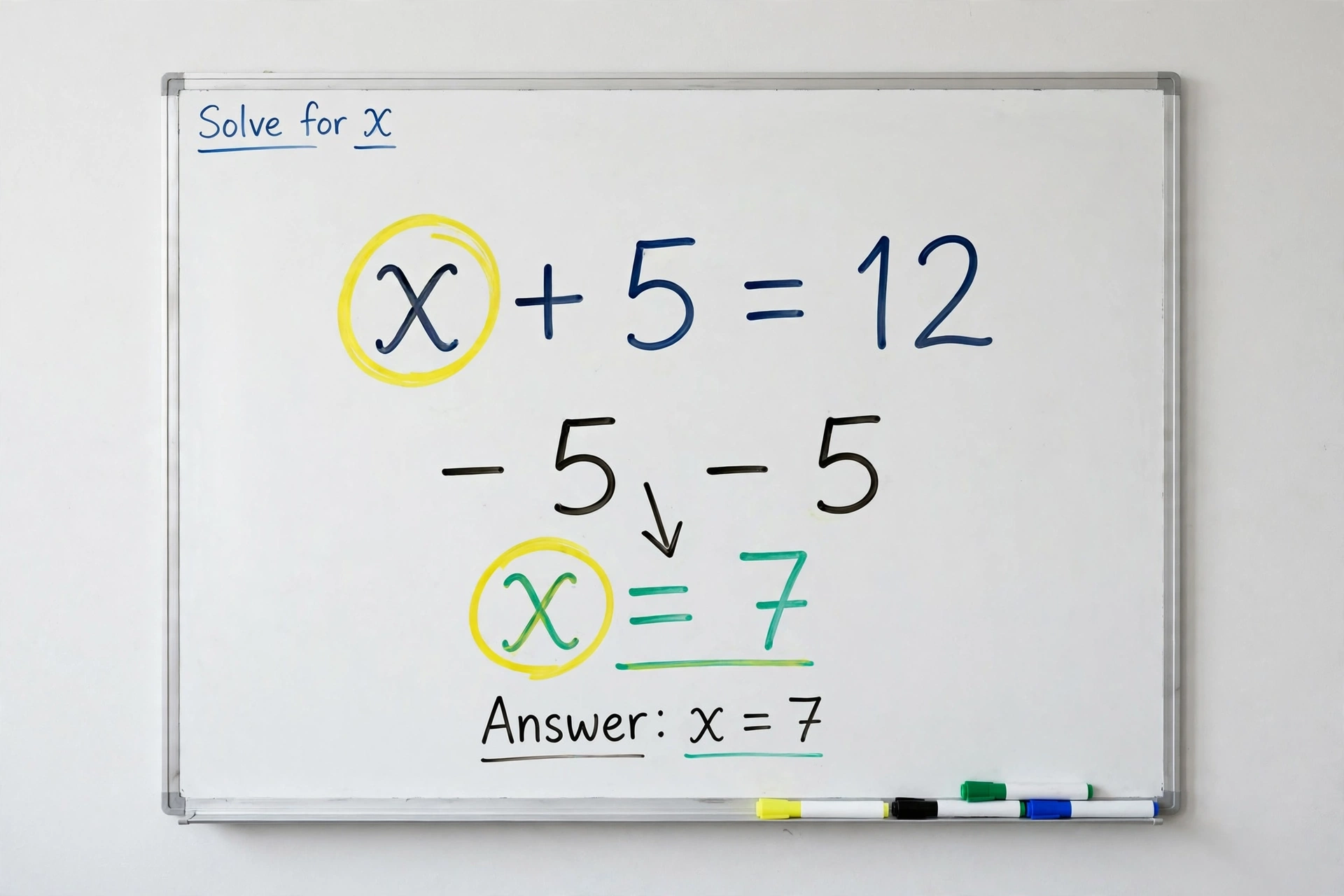
There are 7 apples in a bag. You add some more. Now there are 12. How many did you add? You just solved x + 7 = 12, where x stands for the mystery number. That x is a variable: a letter holding the place of a number we do not know yet.
What Is a Variable?
A variable is a symbol (usually a letter) that represents an unknown number. In x + 5 = 12, x is the variable. It could be any number, but the equation tells us it must be 7. Variables let us write mathematical puzzles and general rules.
Variables are not just for algebra class. They appear whenever we describe patterns: “The number of legs is 4 times the number of tables” becomes L = 4 × T. The letters make the relationship clear and general.
Why Do Variables Matter?
They turn arithmetic into algebra. Instead of solving one specific problem (7 + ? = 12), variables let us describe all such problems (? + 5 = 12, ? + 8 = 20). This generality is the power of algebra.
Variables also appear in formulas. Area = length × width (A = l × w) works for any rectangle. Without variables, we would need a separate rule for every size. With them, one formula handles infinitely many cases.
How Do You Introduce Variables Early?
Start with mystery numbers. “I am thinking of a number. Add 3 and you get 10. What is my number?” Students solve these intuitively. Then introduce the notation: “Let us call my number n. So n + 3 = 10.” The letter just names the mystery.
Use boxes first. Write □ + 5 = 12. Students find the box is 7. Then replace the box with x: x + 5 = 12. The transition is gentle because the idea is already understood. Only the symbol is new.
Connect to patterns. Show 1, 3, 5, 7… Ask: “What is the 10th number?” Students might list them out. Then show how 2n – 1 gives any term. Variables compress patterns into formulas.
Try It: Solve for X
Step 1: Start concrete. “I have some marbles. I give you 4. Now I have 6. How many did I start with?” Students reason: 6 + 4 = 10.
Step 2: Name it. “Let m be my marbles. So m – 4 = 6. What is m?”
Step 3: Solve. Students find m = 10. Check: 10 – 4 = 6. Correct.
Step 4: Generalize. Try x + 7 = 15, 3y = 12, z – 5 = 3. The method is always: figure out what the variable must be.
Quick Practice
Question: If a + 8 = 20, what is a? Explain how you know.
Answer: a = 12 because 12 + 8 = 20. Or think: 20 – 8 = 12. The variable a stands for 12.
Frequently Asked Questions
When do students learn variables?
Informal work with unknowns starts in early grades (“what number goes in the box?”). Formal variable notation typically appears in 4th-5th grade and becomes central in middle school algebra.
Why use letters instead of question marks?
Letters can be manipulated in equations: 2x + 3x = 5x. Question marks cannot. The letter is not just a placeholder; it is a mathematical object we can operate on.
Do variables always stand for one number?
No. In y = 2x, x can be many numbers, and y changes accordingly. Variables can represent unknowns to solve for, or quantities that vary. Both uses are important.