
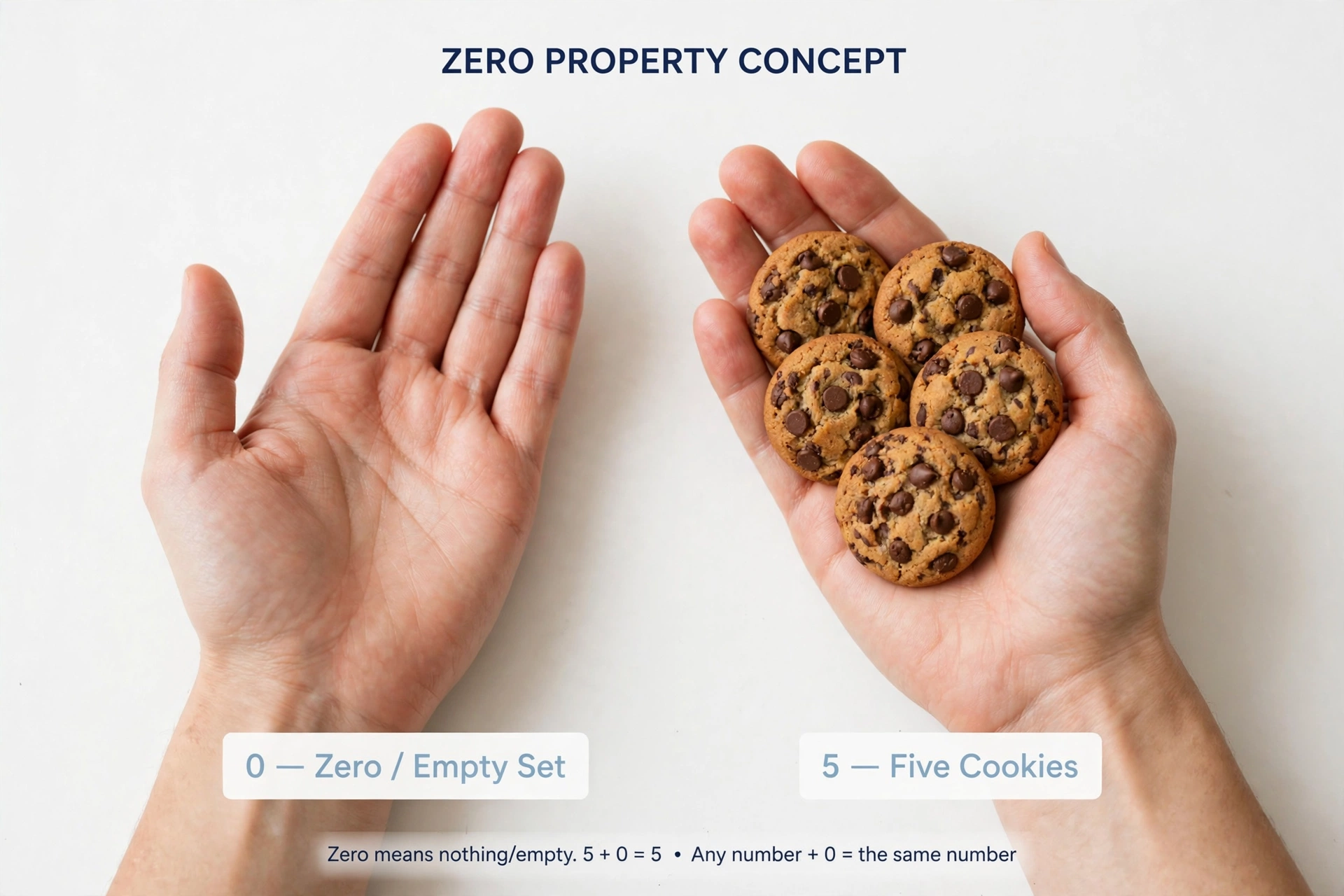
You have 5 cookies. I give you 0 more. How many? Still 5. Now I say: you have 5 bags with 0 cookies each. How many total? Zero. Same zero, completely different results. That is the zero property, and it has two faces.
What Is the Zero Property?
The zero property actually describes two rules. Addition: Adding zero to any number leaves it unchanged. 7 + 0 = 7. Zero is the additive identity: it preserves identity. Multiplication: Multiplying any number by zero gives zero. 7 × 0 = 0. Zero annihilates.
These seem contradictory, but they make sense. Adding zero means “add nothing,” so nothing changes. Multiplying by zero means “zero groups of,” so there is nothing to count. The operations ask different questions.
Why Does This Matter?
The addition rule helps with mental math. Students learn that +0 is a freebie: the answer is the other number. This builds confidence and speed.
The multiplication rule prevents errors. Students who think 5 × 0 = 5 (confusing with addition) will struggle. Understanding that multiplication by zero always gives zero is essential for algebra and beyond.
How Do You Teach It?
Use stories. “You have 8 stickers. I give you 0. How many?” (8). “You have 8 bags with 0 stickers each. How many total?” (0). The contrast makes both rules memorable.
Show with objects. For addition: put 6 counters down, add none, count: still 6. For multiplication: show 4 plates with 0 cookies each. Count total: 0. The empty plates are powerful visuals.
Try It: Zero Property Game
Step 1: Make cards: 5+0, 5×0, 9+0, 9×0, 3+0, 3×0.
Step 2: Students solve and sort into “Stays Same” vs “Becomes Zero.”
Step 3: Discuss the pattern: +0 keeps, ×0 zeroes.
Step 4: Challenge: 0+0? 0×0? (Both 0, but for different reasons.)
Quick Practice
Question: Solve: 12 + 0 = ? 12 × 0 = ? Explain the difference.
Answer: 12 + 0 = 12 (adding nothing changes nothing). 12 × 0 = 0 (zero groups of twelve is nothing). Same zero, different operations, different results.
Frequently Asked Questions
Is zero even or odd?
Even. It fits the pattern (divisible by 2). But that is a different property from the zero property of operations.
Why is anything times zero equal zero?
Multiplication is repeated addition. 3 × 0 means “add 3 zero times,” which is nothing. Or think groups: 3 bags with 0 items each holds 0 total.
Does zero property work for subtraction and division?
Subtraction: 5 – 0 = 5 (like addition). Division: 0 ÷ 5 = 0, but 5 ÷ 0 is undefined (cannot divide by zero). The patterns differ by operation.