Ratio Tables and Equivalent Ratios Grade 6: Lesson Pack with Slides and Answer Key (6.RP.A.3a)

Grade: 6-8 | Topic: Number Sense | Badge: 🔒 MEMBERS ONLY
Ratio Tables and Equivalent Ratios lesson pack for Grade 6 teachers and homeschoolers, the third lesson of the Ratios and Rates unit. Totals up front: 23 teaching slides, a printable worksheet PDF of 13 pages (5 student pages, 5 filled in key pages, a cover, a teacher guide and a closing links page), 6 Table Builders task cards, and 40 practice items across the four practice pages. The PDF also comes in a black and white ink saving file.
What is inside:
- 23 lesson slides that teach the table as a working tool: equivalent ratios defined in plain words, building up by multiplying both amounts, coming back down by dividing, the ratio table, double number lines in depth, tape diagrams in depth, plotting pairs on the coordinate plane, comparing two ratios at a shared amount, and the adding mistake shown with numbers so the class sees it fail. Every worked example shows each step on its own line and is followed by a your turn slide on the same pattern, with the answer on the next slide.
- Page 1: a teacher guide with the standard, the skills, how to use the lesson, a timing note and the terms of use line. One line names the skill underneath: multiples and factors thinking, taught in full in the Factors, Multiples, Prime and Composite pack.
- Page 2: the Table Builders. Six cut apart cards, each with a half built table and a target (a lemonade stand, a paint mix, a ticket price and three more). Pupils complete the table, then plot the pairs on the small grid printed on the card. One card is a trap card: a given row breaks the ratio, and pupils must spot it and fix it.
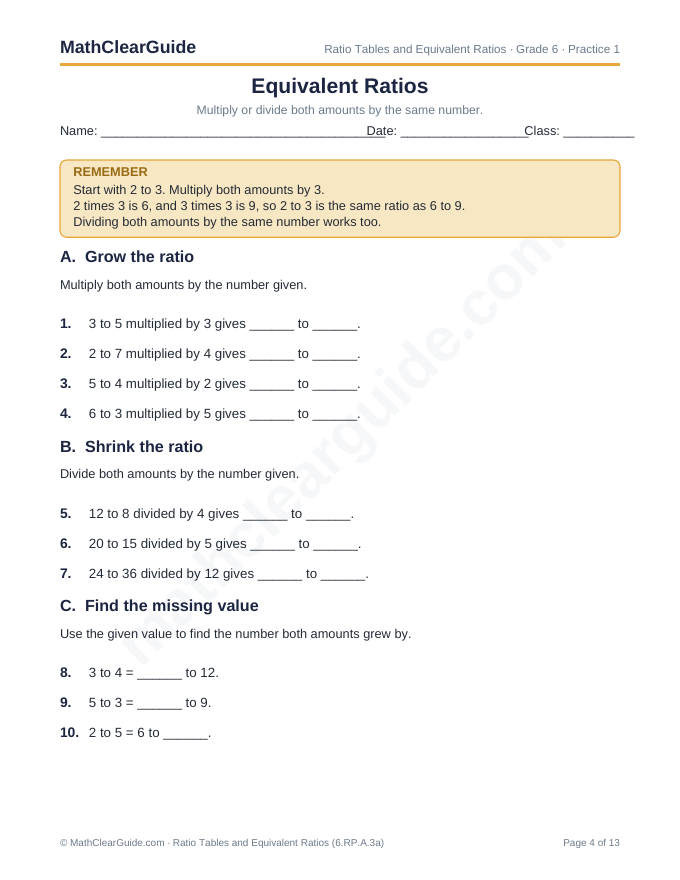
- Page 3: equivalent ratios, 10 questions. Multiply and divide both amounts by the same number, then find the missing value in a pair.
- Page 4: ratio tables with missing values, 3 tables and 10 missing values, including a missing middle value in every table.
- Page 5: double number lines, 12 items. Read two lines for a missing value and a direct read, then build two lines by filling the second line from the stated ratio.
- Page 6: plot the pairs from a table on a printed grid, then answer 3 questions from the plot. A Challenge strip on this page asks pupils to compare two ratios from two tables at a shared amount and defend the answer in one sentence, labelled Challenge.
- Pages 7 to 11: the filled in answer key, full copies of the student pages with answers filled in and working shown, never a bare list. The key copies show the completed tables, the filled double number lines and the plotted points, and the trap card key names the wrong value and its fix.
Standard, listed in full:
- CCSS 6.RP.A.3a: Make tables of equivalent ratios relating quantities with whole-number measurements, find missing values in the tables, and plot the pairs of values on the coordinate plane. (The lesson also teaches the rest of the standard in plain words: pupils use tables to compare ratios, by growing both tables to a shared amount.)
Also good for: Grade 5 multiplication and multiples review, and Grade 7 proportion readiness.
Formats: 23 teaching slides (PPTX, editable) plus a printable PDF worksheet in color and in a black and white ink saving file.
Levels: core Grade 6 practice on every page, plus the labelled Challenge strip on the plotting page, where pupils compare two mixes and defend the stronger one in one sentence.
Use it for: the ratio tables lesson of the unit, morning work, a math block, intervention, homework, sub plans and review.
Membership: this is a members only lesson. Members get all five lessons of the Ratios and Rates unit: Understanding Ratios (free), Unit Rates, this lesson, Ratios in Real Life, and Ratio Word Problems. One membership covers every grade on the site, K to 8, with no per grade stacking. Start with the free first lesson, Understanding Ratios, to see the unit at work.
Percent note: percent is not in this unit. It lives in the Percentages and FDP pack now, and in Unit 2 Percent in Full next, so no buyer is ever sold the same ground twice.
Look Inside