
Student-Friendly Definition
The not equal sign, ≠, shows that two numbers or amounts have different values.
What Does the Not Equal Sign Mean?
The not equal sign is written as ≠. We read it as “is not equal to” or “does not equal.”
For example:
5 ≠ 3
This says, “Five is not equal to three.” The statement is true because 5 and 3 are different numbers.
You can also use the not equal sign to compare two groups of objects. If one group has five counters and another group has three counters, the groups have different amounts. You can write:
5 ≠ 3
The slash through the equal sign shows that the two values do not match.
Compare Values, Not Just How They Look
Two sides of a math sentence can look different but still have the same value. For example:
2 + 3 = 5
The left side has an addition problem, while the right side has one number. Even though they look different, both sides have a value of 5.
Now compare this sentence:
2 + 3 ≠ 7
The left side equals 5, and 5 is different from 7. Therefore, the not equal sign makes the sentence true.
Before choosing = or ≠, find the value on each side. Then decide whether the values match.
Not Equal Does Not Mean Greater Than
The not equal sign tells us that two values are different. It does not tell us which value is larger.
For example:
3 ≠ 8
This statement is true because 3 and 8 are different. The statement does not say whether 3 is smaller or 8 is larger.
To show that 3 is smaller than 8, use the less-than sign:
3 < 8
To show that 8 is larger than 3, use the greater-than sign:
8 > 3
The order can change a greater-than or less-than statement, but both of these not-equal statements are true:
3 ≠ 8
8 ≠ 3
| Symbol | Meaning | Example |
| = | The two sides have the same value. | 4 = 4 |
| ≠ | The two sides have different values. | 4 ≠ 6 |
| < | The left side has a smaller value. | 4 < 6 |
| > | The left side has a larger value. | 6 > 4 |
How to Check a Not-Equal Sentence
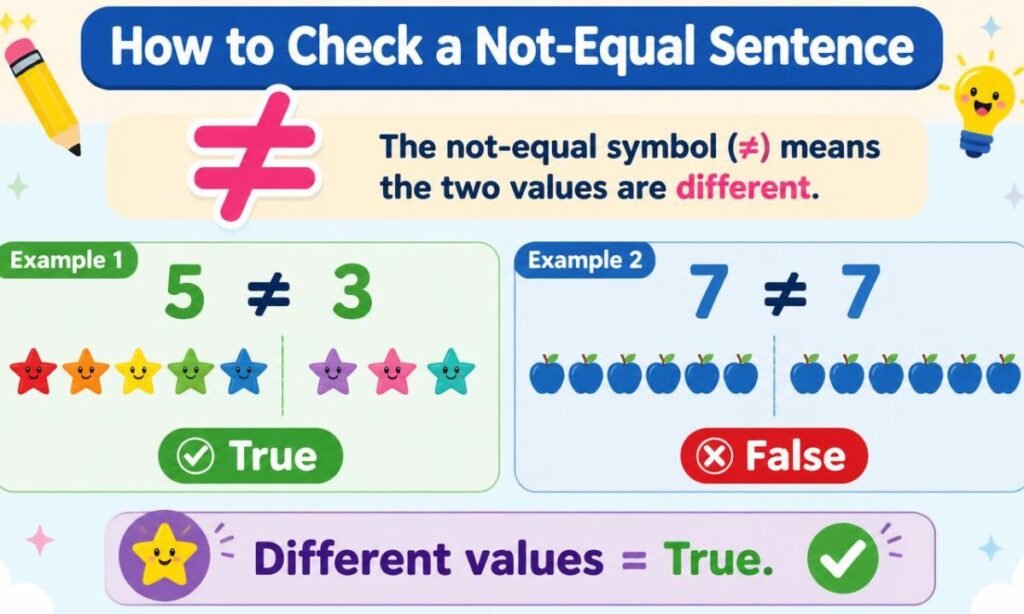
Use these three steps:
1.Find the value on the left side.
2.Find the value on the right side.
3.Decide whether the two values match.
Try this example:
3 + 1 ≠ 6
First, find the value on the left:
3 + 1 = 4
The right side is 6. Since 4 and 6 have different values, the statement is true:
3 + 1 ≠ 6
Now try this sentence:
2 + 4 ≠ 6
The left side equals 6, and the right side also equals 6. The values match, so the not-equal statement is false. The correct comparison is:
2 + 4 = 6
Teaching Strategies for Not Equal
Build Two Groups
Give the student counters, blocks, or small toys. Ask the student to build one group with four objects and another with seven objects.
Have the student compare the groups, say the comparison aloud, and write:
4 ≠ 7
Ask:
•Do both groups have the same amount?
•How do you know the groups are different?
•Which symbol shows that the amounts do not match?
Draw, Say, and Write
Ask the student to draw five dots on one side of a page and three dots on the other side. Let the student explain the drawing in words.
The student can say, “Five is not equal to three.” Then the student can write:
5 ≠ 3
This activity connects a picture, spoken language, and a math symbol.
Sort True and False Statements
Write several comparison sentences on cards:
•4 ≠ 9
•6 = 6
•2 + 2 ≠ 5
•3 + 3 ≠ 6
Ask the student to sort the cards into true and false groups. The student must find the value of each side before sorting.
Ask:
•What value does each side show?
•Do the values match?
•Which symbol should the sentence use?
•How can you prove your answer?
Use a Number Line
Place two numbers on a number line, such as 2 and 8. The numbers appear in different places, so they have different values.
Write:
2 ≠ 8
Then compare the same numbers with other symbols:
2 < 8
8 > 2
This helps the student see that ≠ means different, while < and > show which number has the larger value.
Common Misconceptions About Not Equal
“Not Equal” Means the Left Side Is Smaller
The not equal sign does not show which side is smaller. It only shows that the two values differ.
For example, both 3 ≠ 8 and 8 ≠ 3 are true. Use < or > when you need to show which value is larger.
Different-Looking Sides Must Be Not Equal
Students may think that 2 + 3 and 5 are not equal because one side has an addition problem and the other side has one number. Both sides equal 5, so the correct sentence is:
2 + 3 = 5
Always compare the values, not the way the expressions look.
The Slash Means the Sentence Is Wrong
The slash in ≠ has a special meaning. It tells us that the two values are different.
The sentence 4 ≠ 7 is not wrong. It is a true math sentence because 4 and 7 have different values.
Common Mistake: Do not choose ≠ just because the two sides look different. Find the value of each side first, then decide whether the values match.
Practice Example
Is this statement true or false?
4 + 1 ≠ 7
Answer: True. The left side equals 5, and 5 is different from 7. Therefore, 4 + 1 ≠ 7 is true.
Related Terms
•Equal
•Compare
•Greater than
•Less than
•Number sentence
FAQ
What does the not equal sign mean?
The not equal sign, ≠, means that two numbers or amounts have different values. For example, 6 ≠ 2 is true.
How do you read 5 ≠ 3?
Read 5 ≠ 3 as “five is not equal to three” or “five does not equal three.”
Is 3 ≠ 8 the same as 8 ≠ 3?
Yes. Both statements are true because 3 and 8 have different values.
Does the not equal sign show which number is bigger?
No. The not equal sign only shows that the values are different. Use < or > to show which number is smaller or larger.
How do you check a not-equal sentence?
Find the value on each side of the sentence. If the values differ, the not-equal sentence is true. If the values match, it is false.