
What Is Length in Math?
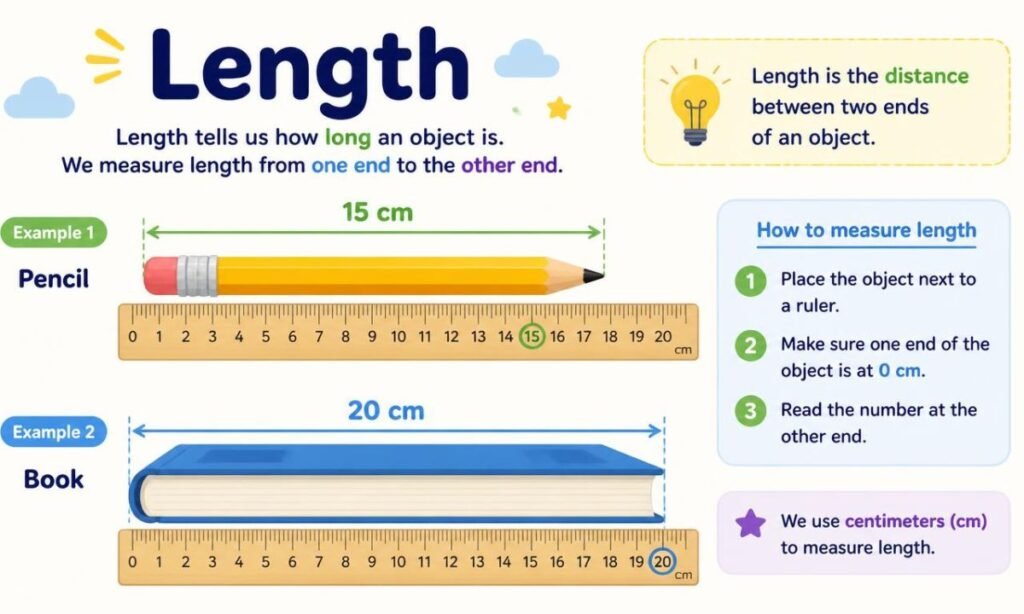
Length tells how long something is or how far it is from one end to the other. For example, you can measure the length of a pencil, book, ribbon, or table.
Length can also describe the distance between two points. If two children stand at different places on a playground, the distance between them has a length.
Plain Text
One end ●────────────● Other end length
A length measurement needs a unit. A unit is what we use to measure. Paper clips and blocks can be nonstandard units. Inches, feet, centimeters, and meters are standard units.
How Do You Compare Lengths?
Before measuring with numbers, you can compare two objects directly. Place the objects beside each other and line up one end. Then look at where the other ends stop.
•An object that reaches farther is longer.
•An object that does not reach as far is shorter.
•Objects that end at the same place are the same length.
For example, place two strips of paper together with their left ends lined up. If the blue strip reaches farther on the right, the blue strip is longer.
When two objects cannot be placed together, you can compare them indirectly. Use a third object, such as a piece of string, to compare each length. If the string is longer than one object but the same length as another, you know which object is longer.
How Do You Measure Length With Units?
Measuring With Nonstandard Units
Young students often begin with objects such as paper clips, blocks, tiles, or wooden sticks. These are called nonstandard units because they are not the same official size everywhere.
To measure a pencil with paper clips, place the clips in a straight row from one end of the pencil to the other. Use clips that are the same size. Count the clips.
Plain Text
Correct: [ ][ ][ ][ ][ ] Incorrect: [ ] [ ][ ] [ ] gaps
The units must touch end to end with no gaps and no overlaps. If there are gaps, the measurement does not cover the whole object. If units overlap, part of the object is counted twice.
Measuring With Standard Units
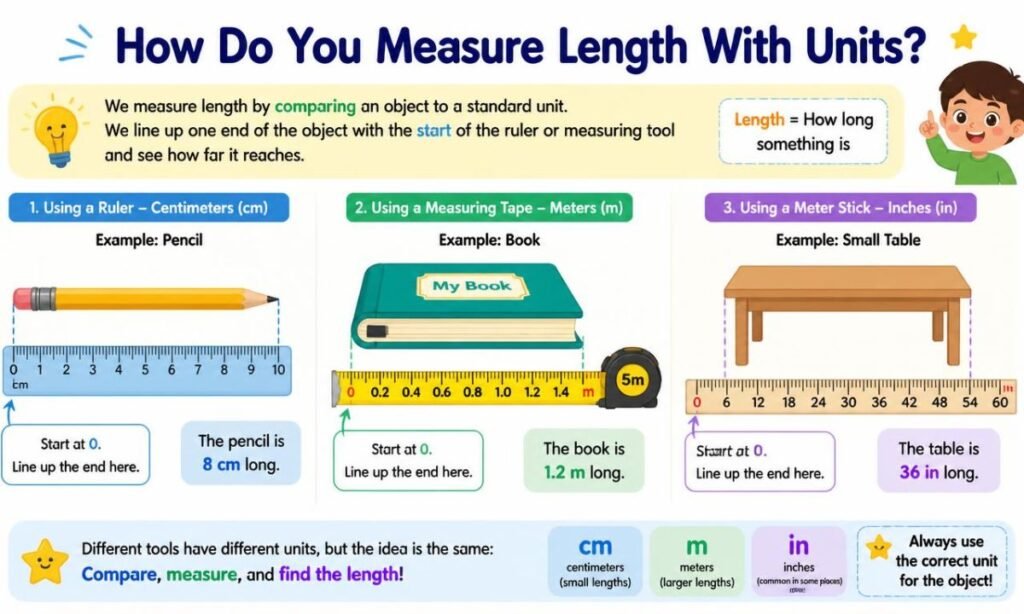
Standard units help people communicate measurements clearly. A centimeter has the same size wherever it is used. An inch also has the same size wherever it is used.
Common standard units include:
•Centimeters for small objects such as pencils
•Inches for small objects such as books
•Feet for objects or spaces such as a table or room
•Meters for longer distances such as the length of a classroom
•Yards for larger outdoor distances
The best unit depends on the size of what you are measuring. A pencil might be 15 centimeters long, while a soccer field might be about 100 yards long.
How Do You Measure With a Ruler?
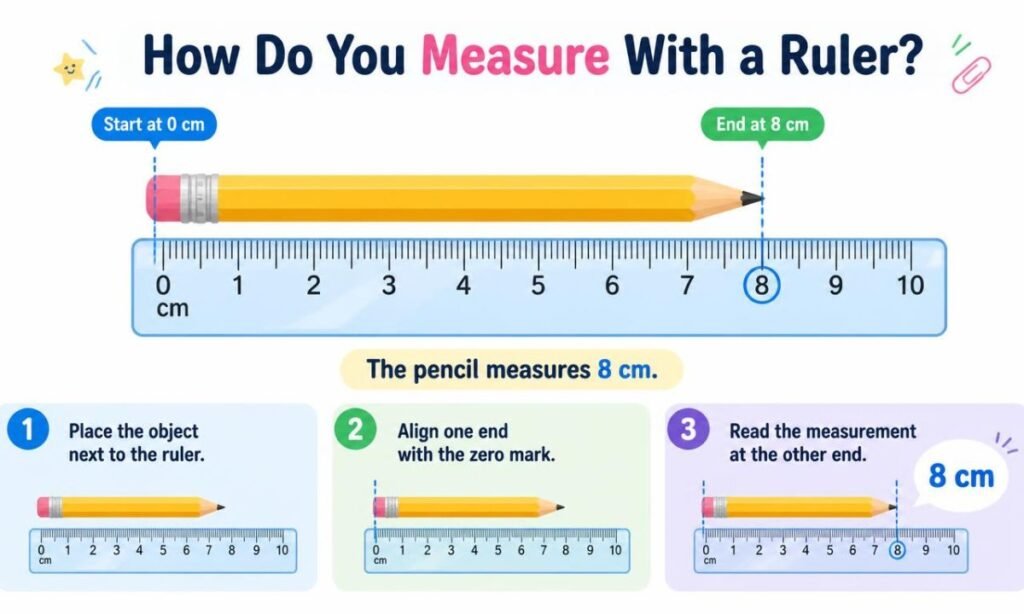
A ruler is a tool for measuring length. Follow these steps:
1.Place the ruler beside the object.
2.Line one end of the object up with the ruler’s 0 mark.
3.Keep the ruler straight.
4.Find the mark where the other end of the object stops.
5.Name the number and the unit.
If a pencil ends at 6 on the centimeter side of a ruler, its length is 6 centimeters.
Always check the zero mark. The physical edge of a ruler may have a blank space before the zero. Starting at the edge instead of at zero can give an incorrect measurement.
Length, Width, Height, and Distance
These words all describe measurements, but they are used in different ways.
| Term | What it often describes | Example |
| Length | How long something is or the distance from end to end | Length of a ribbon |
| Width | How wide something is from one side to the other | Width of a doorway |
| Height | How tall something is from bottom to top | Height of a flagpole |
| Distance | How far apart two points or places are | Distance between two houses |
The best word depends on the object and the purpose of the measurement. For a rectangle, people often call the longer side the length and the shorter side the width. If a rectangle stands upright, height and width may be clearer labels.
Length is not always horizontal, and it does not always have to be the longest measurement. Use labels that make the measurement clear.
Length, Perimeter, and Area Are Not the Same
These three ideas are related, but they measure different things.
•Length measures one distance or side.
•Perimeter measures the distance around a shape.
•Area measures the surface covered inside a shape.
For example, you can measure the length of one side of a rectangle. You can add the side lengths to find its perimeter. You can use the side lengths to find its area. The words name different measurements, even though they may describe the same shape.
Try This Measuring Activity
Measure, Estimate, and Check
Choose three objects, such as a pencil, book, and spoon. Before measuring, estimate the length of each object. Write down your estimates.
Next, measure each object with a ruler. Record the actual length and unit. Put the objects in order from shortest to longest.
Ask these questions:
•Which object is longest?
•Which object is shortest?
•Which estimate was closest?
•How did you know where to start measuring?
For an extension, measure one object with centimeters and then with paper clips. The numbers will be different because the units have different sizes. The object itself did not change.
Common Mistake: Gaps and Overlaps Change the Measurement
Measurement units must be equal in size and placed end to end with no gaps or overlaps. Five large blocks and five small blocks do not represent the same length because the units are different sizes.
A second common mistake is starting a ruler at its physical edge instead of at zero. Find the zero mark first. Then line up the object with that mark.
Quick Practice
A pencil starts at 0 on a ruler and ends at 7 centimeters. A crayon starts at 0 and ends at 5 centimeters.
1.What is the length of the pencil?
2.What is the length of the crayon?
3.Which object is longer, and by how many centimeters?
Answer: The pencil is 7 centimeters long. The crayon is 5 centimeters long. The pencil is longer by 2 centimeters.
Frequently Asked Questions About Length
What is length in math?
Length is the measurement of how long something is or the distance between two points.
What tools measure length?
Rulers, yardsticks, meter sticks, and measuring tapes measure length.
What are standard units of length?
Common standard units include inches, feet, yards, centimeters, and meters.
What are nonstandard units of length?
Nonstandard units are objects used for measuring that do not have one official size, such as paper clips, blocks, or hand spans.
Why must measurement units have no gaps or overlaps?
Units must touch end to end so they cover the measured distance exactly once. Gaps leave part of the distance unmeasured, and overlaps count part of the distance more than once.
Is length the same as width or height?
No. Length, width, and height describe different dimensions depending on the object and the situation. Clear labels help show which distance is being measured.
Is length the same as perimeter?
No. Length measures one distance or side. Perimeter measures the distance around a shape.