A division chart looks just like a multiplication chart. Same grid, same numbers, same neat rows of boxes.
The difference is the direction you read it. A multiplication chart starts with two small numbers and lands on a big one.
A division chart starts with the big number and works backwards. That one small change turns a familiar chart into the best division helper on the wall.
This post shows how the chart works and seven activities that build real division fact fluency with it.
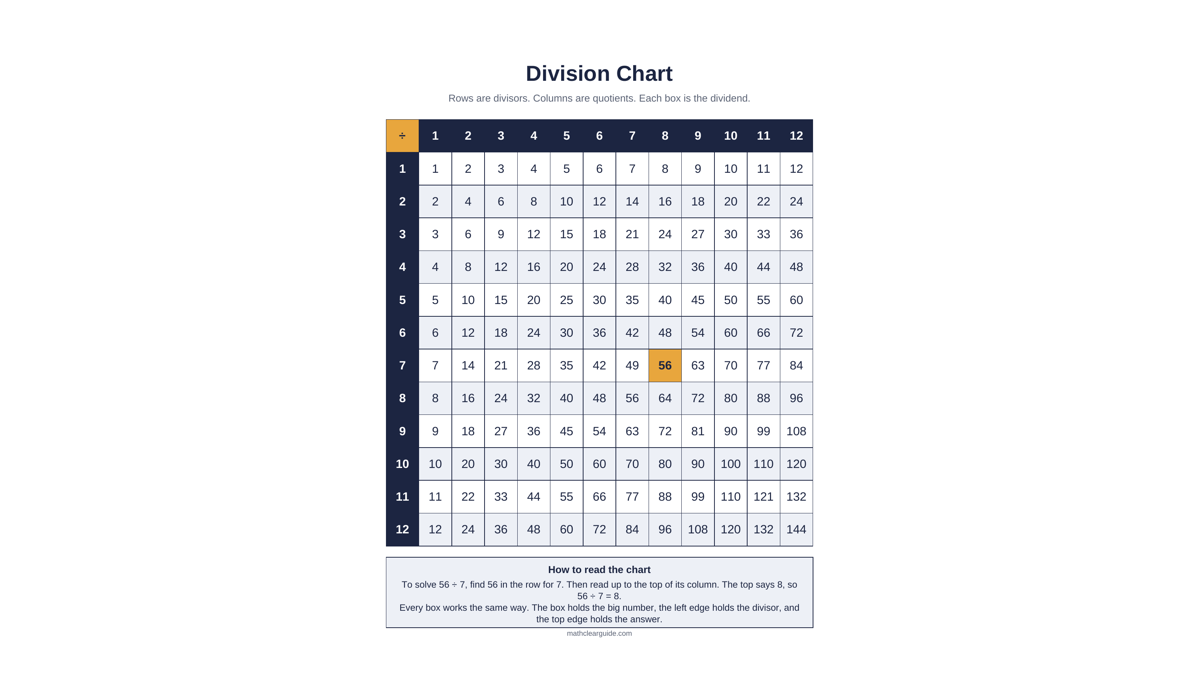
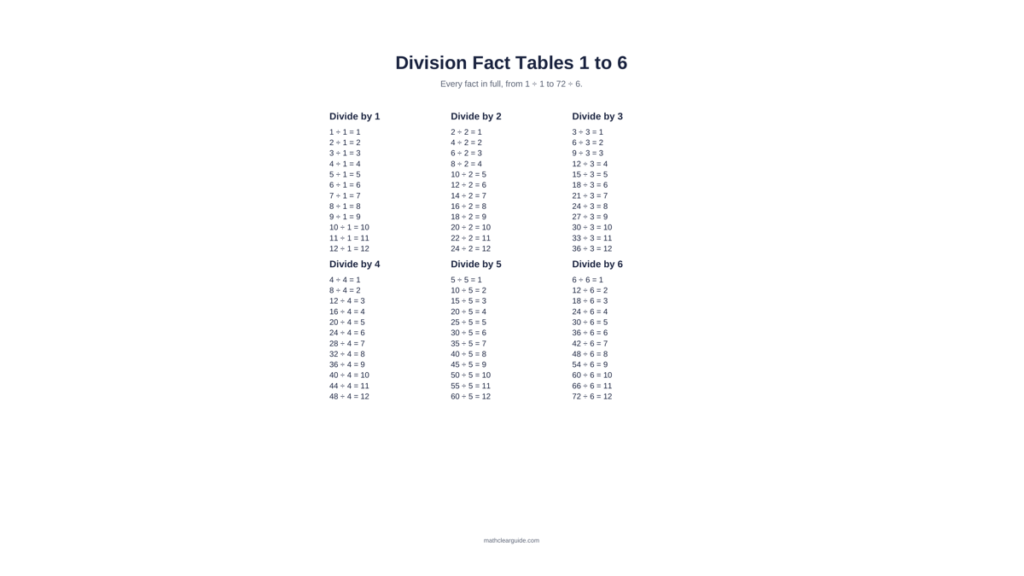
Every activity uses our free division chart printable, a chart with divisors and quotients from 1 to 12 and every fact table in full.
What is a division chart?
A division chart is a grid. The numbers down the left side are divisors, and the numbers across the top are quotients.
Each box inside the grid holds a dividend, the big number that starts a division fact. The box is always the divisor times the quotient.
It is the twin of our multiplication chart printable. Every box on one chart sits on the other chart too, holding the same fact.
Hang the two charts side by side and children start to see the point. Multiplication and division are the same facts, read in two directions.
Teachers like it for one more reason. A child can check any division fact alone, without waiting for an adult to mark the page.
How to read the chart backwards
Say you want to solve 56 ÷ 7. Division starts with the big number, so find 56 first.
Look in the row for 7, because 7 is the divisor. Run your finger along the row until you land on 56.
Now read straight up to the top of that column. The number at the top is 8, so 56 ÷ 7 = 8.
That is the whole method. Find the dividend inside the grid, then read the quotient off the top edge.
Children who learn this move stop guessing. Every fact has a place, and they know how to find it.
Find the dividend inside the grid. Read the answer off the top. The chart does the rest.
Fact families live on the chart
Pick any box on the chart and it hands you four facts at once. The box for 56 gives 7 × 8 = 56 and 8 × 7 = 56.
Turn the same box around and it gives 56 ÷ 7 = 8 and 56 ÷ 8 = 7. One box, one family, four facts.
This is why the chart beats a list of facts to memorize. A list hides the links between facts, and the chart shows them.
A child who knows 7 × 8 can find both division facts in seconds. The family does the memorizing for them.
One box on the chart holds four facts. Learn the box and the family comes free.
Seven division chart activities
Print one chart for the table and keep pencils nearby. Most of these activities take ten minutes or less.
1. Find It Fast. Call out a division fact. Your child finds the dividend in the divisor row, reads the quotient off the top, and says the whole fact out loud.
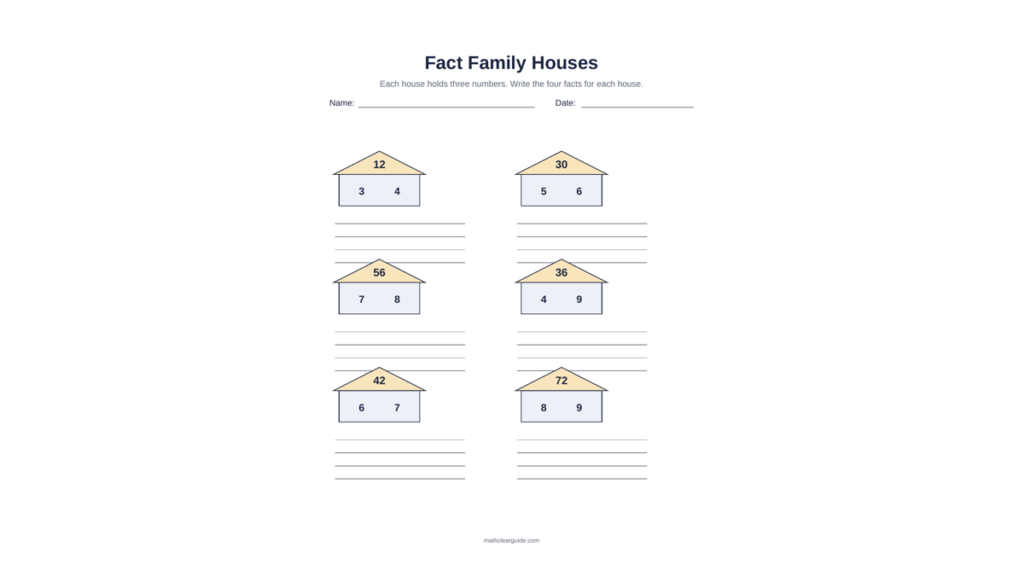
2. Fact Family Hunt. Point to any box. Your child writes the four facts in its family, two multiplication facts and two division facts, then checks them against the chart.
3. Cover the Box. Cover one box with your finger and ask what number divided by 7 gives 8. Your child works it out, then lifts your finger to check.
4. Check Your Times. After multiplication homework, check each answer on the division chart. Find the product in the row for the first number and see if the column matches.
5. Race a Row. Pick a divisor row and read every fact in it out loud against the clock. Write the time down and try to beat it next week.
6. Beat the Twelves. Save the rows for 11 and 12 for last. They look scary, but they follow the same pattern as every other row on the chart.
7. Sharing Stories. Pick a fact like 24 ÷ 6 = 4 and make up a sharing story for it. Stories glue facts to real life, where sharing is fair and groups are equal.
The blank chart, missing number problems, fact family houses and word problems that drill these games sit in our Division Chart Pack for members, with a full answer key.
Common mistakes to watch for
Looking for the answer inside the grid. The quotients live on the top edge, not inside the boxes. Children who hunt for 8 among the boxes get lost, so teach eyes up at the end of every search.
Starting with the small number. Division facts start with the big number. A child who starts at the divisor and guesses a box is working blind. Always find the dividend first.
Chanting rows without pointing. Reading facts off in a sing song voice feels like learning, but the learning lives in the pointing. Finger on the box, eyes to the top, every time.
Quick facts are not the finish line. They are the floor that long division stands on.
Questions teachers and parents ask
What is a division chart? It is a grid where the left side lists divisors, the top lists quotients, and each box holds the dividend. Find a fact inside the grid and read its answer off the top.
What age is a division chart for? Children meet division in second and third grade, and the chart fits from the first sharing lessons on. The rows for 11 and 12 carry it into fourth grade fluency work.
How is it different from a multiplication chart? The numbers are the same, but the reading direction flips. A multiplication chart starts with the two small numbers, and a division chart starts with the big one.
What comes after the chart? Bigger divisions, like 952 ÷ 14, where facts alone are not enough. Our free Long Division Calculator shows every step of the working for numbers like these.
Where can I get a free division chart? In our Resource Library. Our free division chart printable holds the color chart, the fact tables for 1 to 12 and a black and white chart.
A division chart costs one sheet of paper.
Used a little each week, it turns division facts from a wall of homework into a map your child can read.
Print the free chart, start with Find It Fast, and watch the rows get easier.
Reading about it is one thing, practising it is another. Our free What Is Division? lesson builds the idea step by step, with slides, a printable worksheet and a full answer key.
Members unlock every lesson in the library, including the full Fractions, Multiplication, Place Value, Addition & Subtraction, Time & Money and Geometry & Shapes units. See the full library