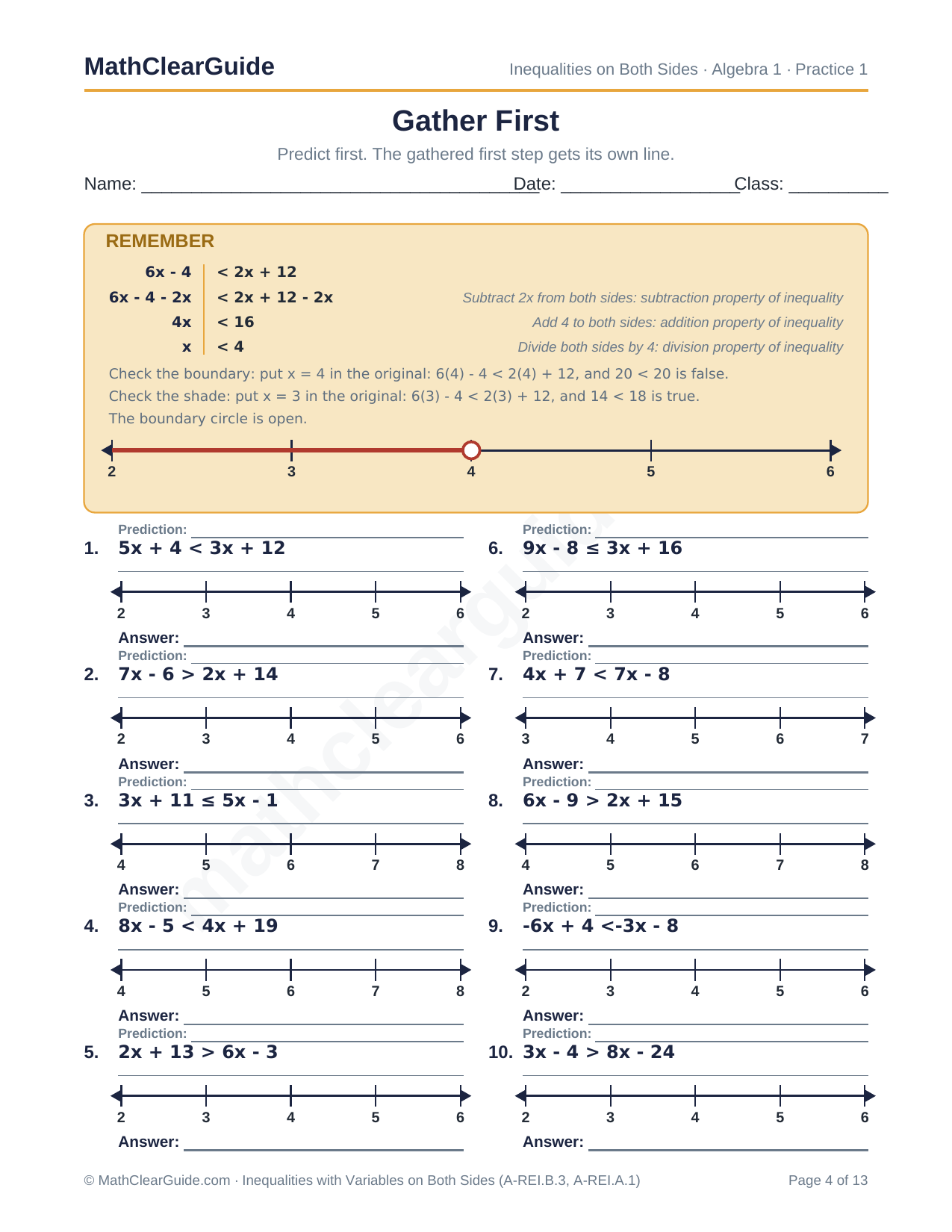
Inequalities with Variables on Both Sides Algebra 1: Lesson Pack with Slides and Worked Key (A-REI.B.3)
Grade: 9-10 | Topic: Operations | Badge: 🔒 MEMBERS ONLY
This Algebra 1 lesson teaches inequalities with variables on both sides as a prediction habit, not a routine: compare the two coefficients first and say what is coming (a ray this way, a ray that way, no solution, every number), then gather, solve, graph, and check with two test values, the boundary and one value inside the shade.
What is inside:
- A 23 slide teaching deck that opens on two phone plans, teaches choosing a side before gathering so the flip can be dodged where a side allows it, works five examples in full (including the flip arriving at the last step and a spot the error where a flip is claimed after an addition), and closes with an exit check.
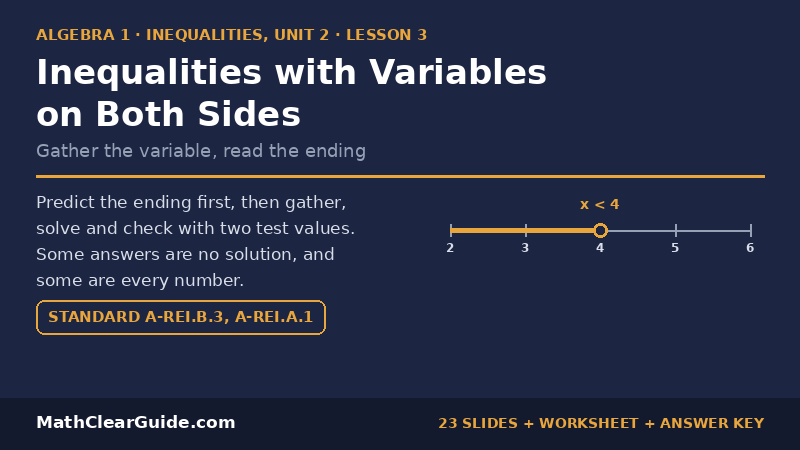
- A worksheet PDF of 13 pages: a cover, a teacher guide, and 5 student pages (the Predict the Ending task cards, 8 cards with a prediction line printed on each and two traps, then four practice pages: 10 plain gather first problems, 10 distribute first problems with two flips that cannot be dodged, the endings page of 10 where rays, no solution and every number are shuffled, and 8 stories that land on both sides with a labelled Challenge).
- The letters family at the foot of the endings page: one inequality with a letter coefficient, solved three ways, where the sign of the letter decides whether the sign flips.
- A filled in answer key of 5 pages, a copy of every student page. Every key entry states the prediction and whether it held, names the starting move first (gather, distribute, combine), then shows every step with the flip marked where it fires, the graph drawn or the ending stated in words, and the check with the boundary and one shade value. No bare answers.
Totals up front: 23 slides, 13 worksheet pages (5 student pages, 5 key pages), 50 problems in all.
The skill: pupils gather the variable from both sides into one place, choose the kinder side before gathering, distribute before gathering, read the endings that are not rays at all (no solution and every number) as endings and not as errors, and write two-plan stories (phone plans, savings races, tanks, gyms, wages) as inequalities and read the answers back from the boundary as from when sentences.
Standards: CCSS A-REI.B.3, quoted by its clean first sentence: “Solve linear equations and inequalities in one variable, including equations with coefficients represented by letters.” This lesson teaches the inequality half, and spends the letters clause once, honestly, in the letters family on the endings page. A-REI.A.1: “Explain each step in solving a simple equation as following from the equality of numbers asserted at the previous step, starting from the assumption that the original equation has a solution.” That text names equations. The habit is carried to inequalities here: every step names its property, and the flip is named on the line where it fires.
Also good for: variables on both sides inequalities worksheet, no solution inequality, inequalities with variables on both sides worksheet.
Formats: 23 teaching slides (PPTX) plus a printable PDF in color and in black and white.
Levels: core practice in every page, plus one labelled Challenge whose answer is a constant the pupil chooses.
Use it for: morning work, math block, intervention, homework, sub plans or review.
One honest line before you buy: this unit teaches one variable inequalities in depth. Quadratic inequalities, rational inequalities, absolute value equations and systems of inequalities wait for their own Algebra 1 units, and no page here repeats the solving equations unit or the Grade 6 inequalities lesson.
Members: this is a members only resource. Members download it as part of the plan, and the membership covers every lesson pack on the site, not only this one: the library of every grade, K to 10, each with slides, worksheet and worked key. This is Lesson 3 of Algebra 1 Unit 2, Inequalities. Lesson 1, Solving Multi-Step Inequalities, is free on this shelf and teaches the flip rule this lesson builds on.
Look Inside