
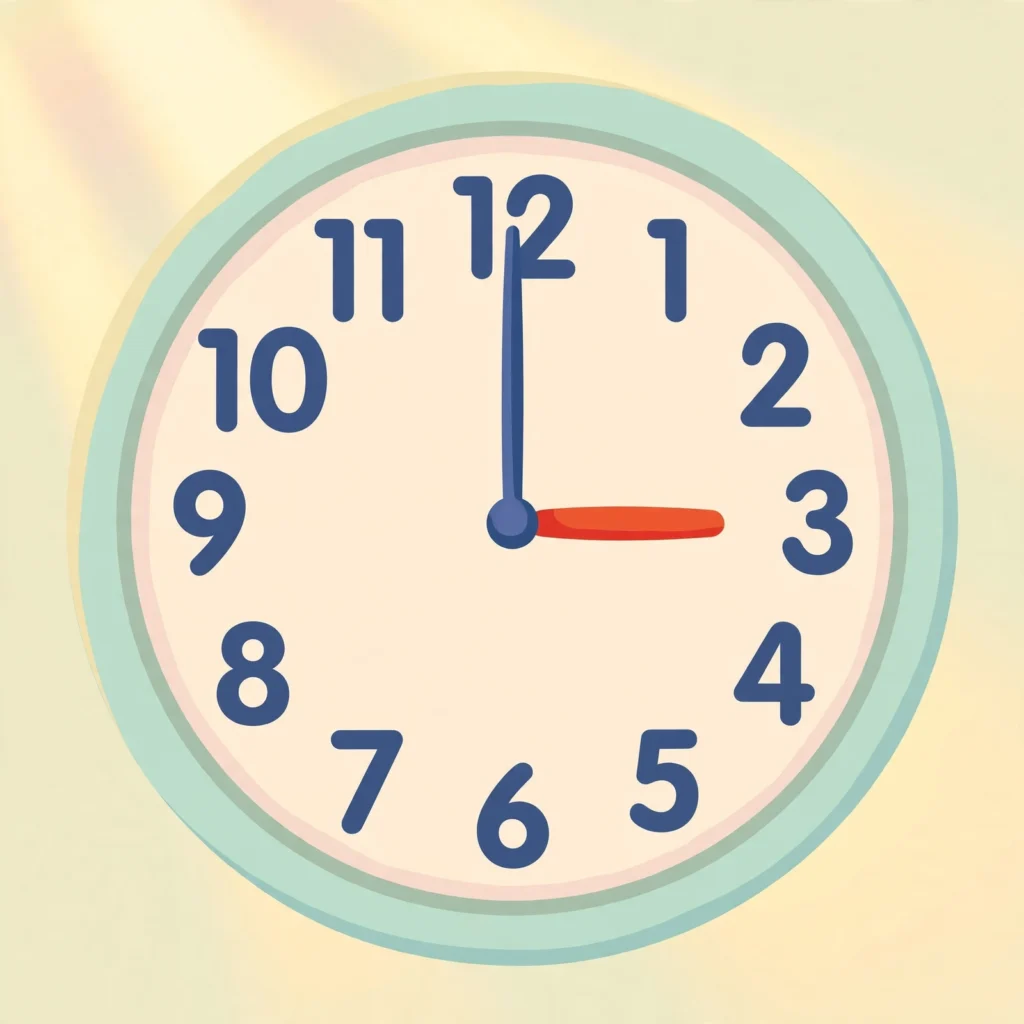
A warm classroom illustration of a round analog clock with large clear numbers, where the short hour hand is highlighted in a bright color so students can tell it apart from the longer minute hand.
An hour hand is the shorter hand on an analog clock. It points to the hour.
How Can You Spot the Hour Hand on a Clock?
Stand in front of any analog clock and look at its hands. Most clocks have two main hands, and some have a third thin one that ticks around fast. The hour hand is the shortest and often the thickest of the three. The longer, thinner hand is the minute hand, and the skinniest, fastest hand is the second hand.
Teachers like to call the hour hand the “short hand” because that trick almost never fails.
What Does the Hour Hand Tell You?
The hour hand answers one question: “What hour is it?” When the minute hand points straight up at 12 and the hour hand points at 7, the time is 7 o’clock. The hour hand does the talking about the hour, and the minute hand fills in the minutes.
How Does the Hour Hand Move Around the Clock Face?
The hour hand moves slowly, like a turtle. It takes a full 12 hours to travel once around the clock face. That means it makes two complete trips every day.
Because there are 12 hours on the clock and a full circle is 360 degrees, the hour hand moves 30 degrees each hour. That is a steady crawl, not a jump. Between one hour and the next, it slides forward bit by bit. In 30 minutes it moves halfway to the next number, and in 60 minutes it reaches the next number exactly.
Watch a classroom clock at 2:30. The hour hand will not point exactly at the 2 anymore. It will sit halfway between the 2 and the 3, because half the hour has passed. This slow glide is what makes the hour hand such a good picture of time passing.
How Do You Read the Hour Hand Between Numbers?
Reading the hour hand at an exact hour is simple: it points right at a number. Reading it between numbers takes a little more thought, and this is where many students get stuck.
Here is the rule: the hour does not change until the hour hand reaches the next number. If the hour hand is between the 4 and the 5, the hour is still 4, even though the hand is closer to the 5. Think of the hour hand as a person walking toward the next house. They have not arrived until they get there.
Picture a clock where the minute hand points at the 6, meaning 30 minutes past the hour. Now find the short hand. It sits halfway between two numbers. The hour is the number it just left behind, not the one it is moving toward. So if it sits between the 8 and the 9, the time is 8:30.
Common Mistake: Students often read the hour hand by looking at the number it is closest to. If the hand is between 5 and 6 but nearer to 6, they say “6 o’clock.” The fix is easy. Always ask, “Which number did the hour hand pass most recently?” That number is the hour.
Try It: Build a Paper Clock and Move the Hour Hand
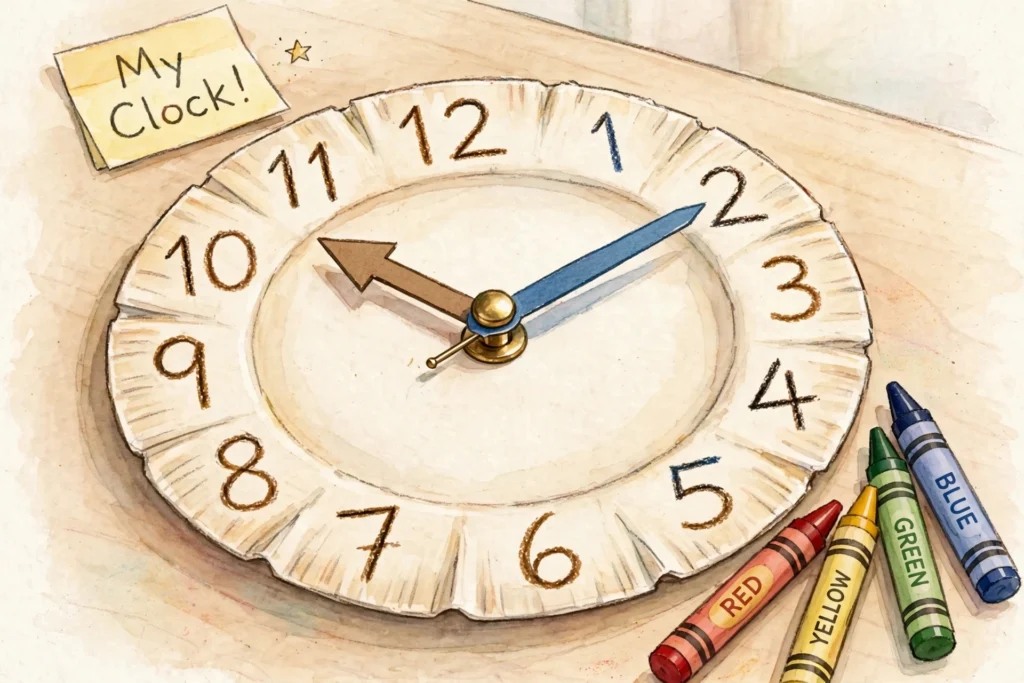
A close-up illustration of a paper plate clock with a brass split pin in the center, a short hand and a long hand that can turn, sitting on a classroom table next to crayons.
You will need a paper plate, a pencil, a split pin (also called a brass fastener), and two strips of card stock, one short and one long. If you do not have a split pin, a twist tie pushed through a small hole works too.
First, write the numbers 1 through 12 around the edge of the plate, just like a real clock. Keep the numbers big and spaced out evenly. Next, poke a small hole in the center of the plate and in one end of each card stock strip. Push the split pin through both strips and then through the plate so the hands can turn. The short strip is your hour hand and the long strip is your minute hand.
Now play a game with a partner. One person sets the clock to a time, and the other person reads it. Start with exact hours: put the minute hand on 12 and the hour hand on any number. Then make it harder. Move the minute hand to the 6 for half past, and slide the hour hand halfway between two numbers.
Quick Practice
The short hand on a clock sits between the 9 and the 10, closer to the 10. The long hand points straight at the 12. What time is it?
Answer: 10 o’clock is not correct, even though the short hand is close to the 10. The hour is the number the hand passed most recently, which is 9. With the long hand on 12, the time is 9 o’clock exactly.
Related Terms
Frequently Asked Questions
Is the hour hand the short hand or the long hand?
The hour hand is the short hand. The long hand is the minute hand. Remember it with a simple picture: an hour is a long stretch of time, so its hand takes short steps, while a minute is tiny, so its hand stretches long to count them.
How many times does the hour hand go around the clock in one day?
Two times. One full trip takes 12 hours, from midnight to noon, and the second trip takes the other 12 hours, from noon to midnight. That is why we read times like 3 o’clock twice a day, once in the morning and once in the afternoon.
Why is the hour hand between two numbers?
Because time keeps moving. The hour hand glides forward a little bit every minute, so it only points exactly at a number at the top of each hour. Between hours, it sits somewhere along the path to the next number, showing how much of the hour has passed.
Does a digital clock have an hour hand?
No. Digital clocks show numbers on a screen, like 4:30, instead of using hands. The digits on the left of the colon play the role of the hour hand by telling you the hour. Still, learning the hour hand on an analog clock helps you picture time as a circle, which makes the numbers on a digital clock easier to understand.
What grade learns about the hour hand?
Most students meet the hour hand in first grade, when they learn to tell time to the hour and half hour. It comes back in second and third grade with quarter hours and times to the nearest five minutes, so this little hand gets a lot of practice over the years.
Reading about it is one thing, practising it is another. Our free Telling Time to the Hour and Half Hour lesson builds the idea step by step, with slides, a printable worksheet and a full answer key.
Members unlock every lesson in the library, including the full Fractions, Multiplication, Place Value, Addition & Subtraction, Time & Money and Geometry & Shapes units. See the full library


