

A gram is a small unit of mass in the metric system. We use grams to measure how heavy light things are, like a paperclip or a marble.
What Does a Gram Measure?
When Maya’s third-grade class started a unit on measurement, her teacher set a paperclip on a kitchen scale and asked, “How heavy is this?” Nobody guessed a number at first. The needle settled on a tiny reading: 1 gram. The room filled with “oohs” because the number felt almost too small to be real.
A gram measures mass. Mass is how much matter, or stuff, an object holds. In everyday talk, most of us say “weight” instead of “mass,” and for classroom math that is perfectly fine. Scientists keep the two ideas separate, but in elementary math the gram is simply our unit for light things.
The symbol for gram is a lowercase g. On food packages and worksheets you will see it written with a space after the number, like 640 g. That little g tells the reader that the number counts grams, not centimeters or milliliters.
How Big Is One Gram?
One gram is small. Hold out your hand and picture one paperclip resting on your palm. That gentle press is about 1 gram. Once students can feel that press in their memory, the unit stops being abstract.
Here are everyday things that weigh close to one gram:
- A small paperclip
- A thumbtack
- One stick of chewing gum
- A single US dollar bill
- A pen cap
- A quarter teaspoon of sugar
Want a slightly bigger anchor? A US nickel, the five-cent coin, weighs 5 grams. That means five paperclips balance one nickel on a scale. Once kids learn the nickel trick, they start guessing the mass of everything in the pencil box, and their estimates get sharper every week.
How Many Grams Are in a Kilogram?
1,000 grams = 1 kilogram. The prefix “kilo” means thousand, so a kilogram is a thousand grams bundled together. The symbol for kilogram is kg.
Picture a one-liter bottle of water. It weighs about 1 kilogram, which is the same as 1,000 paperclips. That image helps students feel why we switch units. Counting to 1,000 in grams gets tiring, so we trade up to kilograms for heavier things.
A quick rule of thumb for the classroom: if you can lift it with two fingers, measure it in grams. If you need your whole hand or both arms, kilograms are the friendlier choice. A strawberry goes in grams. A backpack goes in kilograms.
Grams or Kilograms: How Do You Choose?
Teachers love a sorting game for this one. Make two labeled baskets, one marked “g” and one marked “kg,” and let students sort picture cards: a strawberry, a backpack, a letter, a cat, a crayon, a watermelon. The conversations that follow are where the learning lives, because someone always argues that a cat belongs in grams, and the class has to prove otherwise.
Grams show up on nutrition labels, in recipes, and on letters at the post office. Kilograms describe backpacks, pets, and people. One important boundary: grams never measure length or distance. If a worksheet asks “how long,” reach for centimeters or meters instead.
Did You Know: In Japan, the one-yen coin weighs exactly 1.00 gram, which makes a pocketful of those coins a secret little scale.
Why Do Grams Matter in Real Life?
Grams are working units, not just school vocabulary. Bakers weigh flour in grams because a cup of flour can pack down or fluff up, while 120 grams is 120 grams every time. That is why so many recipes from other countries list grams instead of cups.
Pharmacists and nurses measure medicine in grams and milligrams, and the post office prices letters by the gram. Even the nutrition label on a cereal box leans on grams to tell you how much sugar hides in one serving. When students see the little g in the wild, the classroom lesson clicks into place.
Try a hallway challenge: ask students to spot the letter g on three different packages at home. Cereal, pasta, and yogurt almost always carry it. The student who finds the most grams in one evening earns the title of Mass Detective for the week.
Try It: Weigh It Like a Scientist
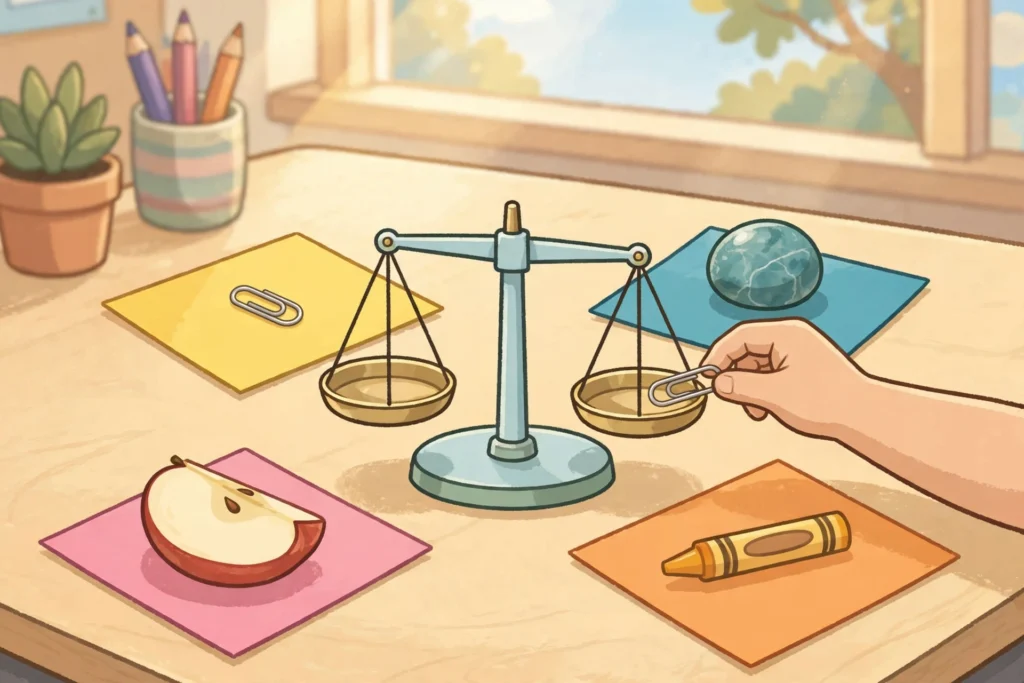
Time to run your own mass lab. You will need a kitchen scale or a simple balance, five small objects such as a paperclip, a marble, a crayon, an eraser, and a grape, plus a sheet of paper for recording.
- Step 1: Pick up each object and write down your guess in grams. Is it lighter than a paperclip (1 g), or is it closer to a nickel (5 g)?
- Step 2: Weigh each object and write the real number next to your guess.
- Step 3: Circle the guess that came closest. What trick will you use next time? Many kids start by asking, “How many paperclips would this be?”
Keep a class chart of the most surprising result. In one classroom, a single marble weighed the same as five paperclips, and the room buzzed about it for days. Estimation is a skill, and every round of guessing sharpens it.
Quick Practice
Question: A paperclip weighs about 1 gram. About how many grams do 8 paperclips weigh?
Answer: 8 paperclips times 1 gram each equals 8 grams. When every object weighs 1 gram, the count and the mass match, which is what makes paperclips such a handy classroom unit.
Related Terms
Keep exploring measurement with these dictionary entries:
Frequently Asked Questions
Is a gram the same as a kilogram?
No. A kilogram is much larger. It takes 1,000 grams to make one kilogram, so grams are for light things and kilograms are for heavy ones.
What is the symbol for gram?
The symbol is a lowercase g, written with a space after the number, like 640 g.
Can grams measure how long something is?
No. Grams measure mass. For length, use centimeters, meters, or inches instead.
Would you measure a person in grams or kilograms?
Kilograms. A person weighs far more than a few grams, so kilograms keep the numbers small and easy to read.
Which is heavier, 500 grams or 1 kilogram?
One kilogram is heavier. Since 1 kilogram equals 1,000 grams, it is twice as heavy as 500 grams.
Every topic clicks faster with practice. Our Resource Library has free lesson packs with slides, printable worksheets and full answer keys, ready to download and teach.
Members unlock every lesson in the library, including the full Fractions, Multiplication, Place Value, Addition & Subtraction, Time & Money and Geometry & Shapes units. See the full library


