Area is the amount of flat space inside a two-dimensional shape. It tells how much surface a shape covers.
What Is Area in Math?
Look at your desk. The top of it is a flat surface, and the area of that surface is the amount of tabletop you have for your books, your lunch tray, and your elbows. Area does not measure how long something is or how tall it is. It measures the whole flat space, edge to edge.
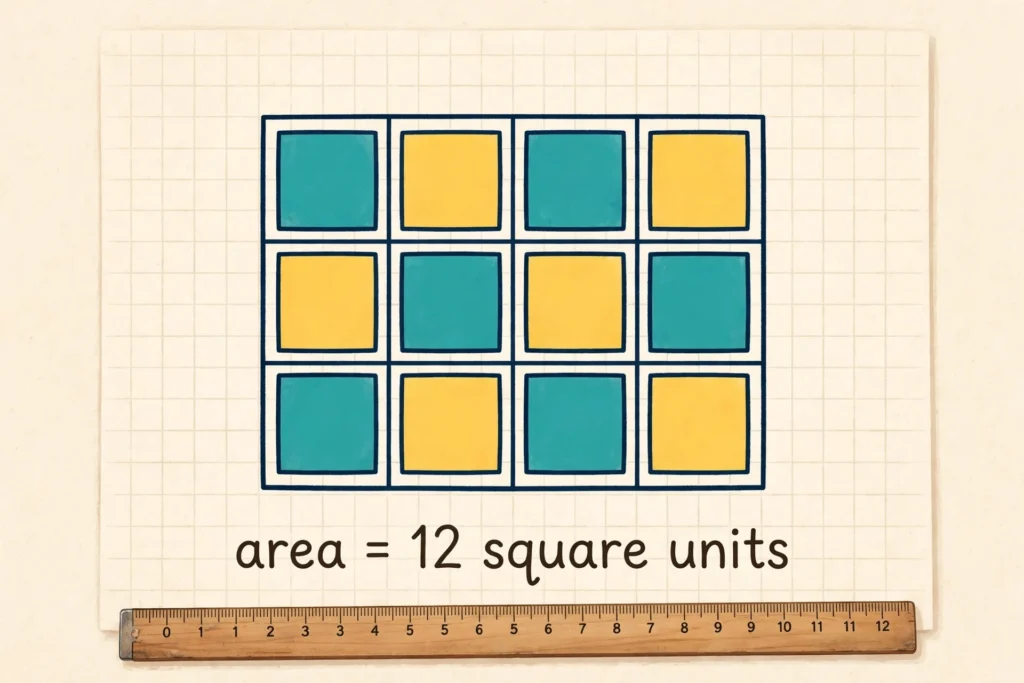
Here is the classic way to think about it. Imagine covering a shape with tiny square tiles, with no gaps and no overlaps. The number of tiles that fit is the area. If 12 tiles cover a book cover, the book cover has an area of 12 square units. The tiles do the measuring, and counting does the rest.
Area only works for flat shapes, the ones mathematicians call two-dimensional. A rectangle has area. A triangle has area. A circle has area. A box does not have area in the same way, because a box is three-dimensional. The outside of a box has surface area, which is a bigger idea for later grades.
What Are Square Units?
We measure area in square units. A square unit is a square with sides that are each one unit long. If your unit of length is the inch, your unit of area is the square inch. If your unit of length is the foot, your unit of area is the square foot.
The name is a picture of the idea. When you multiply a length by a width, you are asking how many little squares fit inside. A rectangle that is 4 inches long and 3 inches wide holds 12 squares, each one inch on a side. Its area is 12 square inches, written as 12 in². That small raised 2 is a reminder that two dimensions were multiplied.
Different jobs call for different square units. Floor tiles come in square inches or square feet. A classroom rug might be measured in square feet. A farm is measured in acres, and one acre is about 4,047 square meters. Countries are measured in square miles or square kilometers. The unit changes with the size of the job, but the idea never changes: count the squares that fit.
How Do You Find the Area of a Rectangle?
Counting squares works, but it gets slow when the shape is big. The shortcut for a rectangle is a formula: area equals length times width. Multiply the two side lengths, and the answer is the number of square units inside.
Try it with a notebook. Measure the cover: 8 inches long and 6 inches wide. Multiply 8 by 6 to get 48. The area is 48 square inches. If you drew the grid and counted, you would find exactly 48 little squares, but the multiplication gets you there in seconds.
A square is just a special rectangle where all sides are equal, so the same idea applies. If each side of a square is 5 centimeters, multiply 5 by 5 to get 25 square centimeters. Side times side, same answer either way.
Now try a big one. A basketball court is 94 feet long and 50 feet wide. Multiply 94 by 50 to get 4,700 square feet. That is a lot of counting if you did it tile by tile, which is exactly why the formula exists. Real architects, builders, and carpet installers use this same multiplication every day.
What Is the Difference Between Area and Perimeter?
Area and perimeter are the two measurements kids mix up most, so let us settle it once and for all. Perimeter is the distance around the outside of a shape. Area is the space inside it. Perimeter is the fence. Area is the yard.
Take a rectangle that is 4 inches long and 3 inches wide. Its perimeter is 4 + 3 + 4 + 3 = 14 inches, one unit of length. Its area is 4 x 3 = 12 square inches, two units multiplied. Different numbers, different units, different ideas.
Common Mistake: Students give an area answer in plain units, like “12 inches,” instead of square units. Always add the word “square” to an area answer. If you painted the wall, you bought square feet of paint, not feet of paint, and the word “square” is what makes the answer correct.
Try It: Cover the Desk

You need a stack of square sticky notes, a desk or table, and a notebook. Every sticky note is one square unit.
- Start in one corner of the desk and lay sticky notes in straight rows, edge to edge, with no gaps and no overlaps.
- Count how many notes fit along the length and how many fit along the width. Write both numbers down.
- Multiply the two numbers. If 6 notes fit along the length and 4 fit along the width, your desk has an area of 24 sticky-note square units.
- Count every note on the desk to check. The total should match your multiplication.
- For a challenge, predict the area of a second desk before you cover it, using only the length and width. Then test your prediction.
What you just did is the whole history of area in one activity. People measured fields and floors by covering them with standard squares long before formulas existed. The multiplication is simply a faster way to do the same counting.
Quick Practice
A garden bed is 9 feet long and 5 feet wide. What is its area?
Worked answer: Area equals length times width. Multiply 9 by 5 to get 45. The area of the garden bed is 45 square feet. That means 45 one-foot squares would fit inside it.
Related Terms
When your child is ready to work backwards from an area to a missing side, our Finding the Missing Side lesson pack walks through it with slides, a worksheet and a full answer key.
Frequently Asked Questions
How do you find the area of a square?
Multiply the side length by itself. A square with sides of 7 centimeters has an area of 7 x 7 = 49 square centimeters.
Can area be measured in inches?
Area is measured in square inches, not inches. Inches measure length, which is one dimension. Area needs two dimensions, so the unit is the square inch.
What is the area of a triangle?
The area of a triangle is one half times base times height. You will meet this formula in later grades, after rectangles feel easy.
Why do we use square units for area?
Because area measures two dimensions at once, length and width. Multiplying a length unit by a width unit creates a square unit, like square inches or square centimeters.
Reading about it is one thing, practising it is another. Our free What Is Area? lesson builds the idea step by step, with slides, a printable worksheet and a full answer key.
Members unlock every lesson in the library, including the full Fractions, Multiplication, Place Value, Addition & Subtraction, Time & Money and Geometry & Shapes units. See the full library