
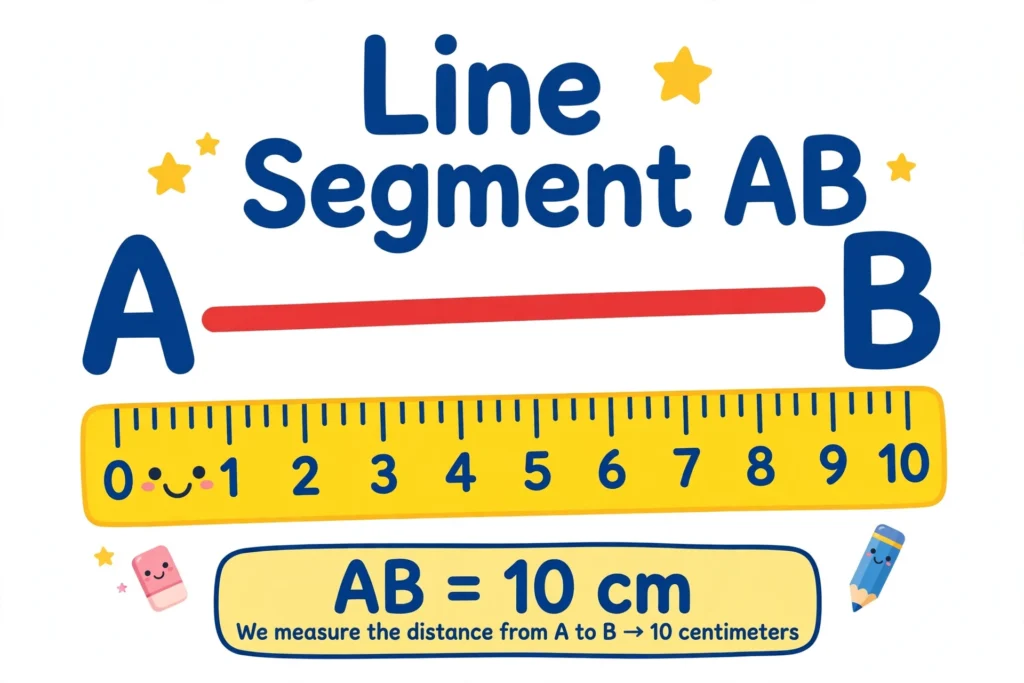
A line segment is a straight path that starts at one point and stops at another point. Because it has two endpoints, it has a length you can measure.
How Is a Line Segment Different from a Line and a Ray?
These three words sound alike, and students mix them up all the time. Picture a road. A line is a road that goes on forever in both directions, with arrows on each end to show it never stops. A ray is a road that starts at one point, like a driveway, and then keeps going in one direction with a single arrow. A line segment is the part of the road between two street signs, with a clear start and a clear stop.
Here is a quick comparison:
| Feature | Line | Ray | Line Segment |
|---|---|---|---|
| Endpoints | None | One | Two |
| Arrows in a drawing | Both ends | One end | No arrows |
| Length | Goes on forever | Goes on forever in one direction | Fixed, and you can measure it |
| Example | A train track stretching into the distance | A flashlight beam | A pencil lying on a desk |
Quick Answer: If the drawing has arrows on the ends, it is not a line segment. Arrows mean the line keeps going past the picture.
How Do You Name and Draw a Line Segment?
Every line segment gets its name from its two endpoints. Mathematicians label endpoints with capital letters, so the segment in the picture above is called segment AB. You can write it with a short bar over the letters, like AB with a line on top, which tells a reader that the name means a segment and not a line or a ray. The order of the letters does not matter, so segment BA names the same segment as segment AB.
To draw one, grab a ruler and follow three steps. First, make two small dots on your paper where you want the segment to start and stop. Second, label the dots with capital letters. Third, place your ruler along the dots and connect them with a straight stroke. No arrows at the ends, because your segment stops right at those dots.
In class, I like to ask students to draw segment PQ, then hold their papers up. We look around the room together. One student made a short segment, another made one that stretches across the whole page, and both are correct. Every pair of endpoints gives a real line segment, long or short.
Can You Measure a Line Segment?
Yes, and that is what makes segments so useful. A full line goes on forever, so you can never measure its whole length. A ray goes on forever in one direction, so it cannot be measured either. A line segment stops at both ends, so its length is a number you can find with a ruler or a tape measure.
To measure, place the zero mark of your ruler right at one endpoint and read the number that lines up with the other endpoint. If a segment starts at the zero mark and ends at the 7 centimeter mark, its length is 7 centimeters. Students who start the ruler a little past zero will get the wrong number, so remind them to check that zero mark.
Line segments are also the building blocks of shapes. The sides of a triangle are three line segments joined end to end. The sides of a square are four line segments of equal length. Once students see that polygons are chains of segments, drawing shapes and finding perimeters feels much more natural.
Where Do Line Segments Show Up in Real Life?
Line segments hide in plain sight all over a classroom. The edge of a whiteboard is a segment. So is the side of a book, the length of a crayon, a drinking straw, and the spine of a folder. When a student holds a jump rope tight between two hands, the rope forms a segment. When two friends stand apart and stretch a string between them, that string is a segment too.
Builders and designers use segments every day. A fence panel between two posts is a segment. A shelf between two brackets is a segment. Each plank of a sidewalk is a segment. Talking about these examples helps students see that geometry is not just something on a worksheet, it is the shape of the world around them.
Try It: Segment Sort Hunt
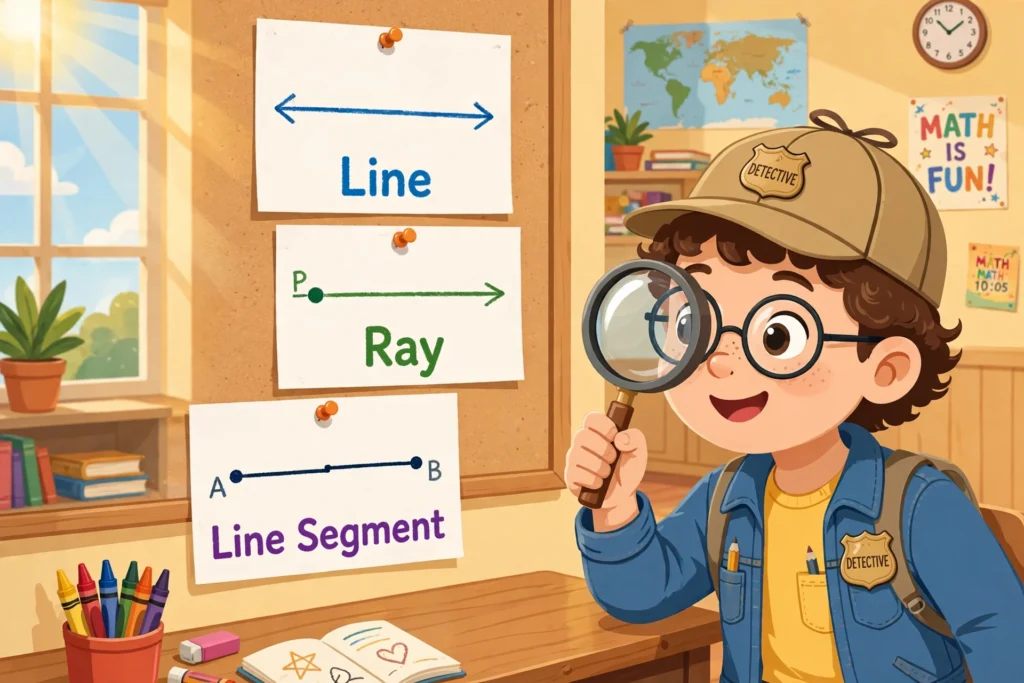
Turn your classroom into a detective scene. Before the lesson, tape up ten simple drawings around the room. Some show lines with arrows on both ends, some show rays with one arrow, and some show plain segments with two labeled endpoints. Hand each student a recording sheet with three columns: Line, Ray, and Line Segment.
Students walk the room in pairs, studying each drawing like a clue. For each one, they ask the detective question: How many arrows do I see? Two arrows means line, one arrow means ray, and no arrows means line segment. They write the drawing number in the matching column and move on.
After the hunt, gather everyone back on the rug. Pick three or four drawings that tricked people and talk them through together. The ray that looked like a segment is always a favorite, because the single arrow is easy to miss. End with a bonus round: challenge pairs to spot three real line segments in the classroom and write down what the two endpoints are. The edge of the door works, from the top hinge to the bottom hinge, and so does the pencil in a desk, from its tip to its eraser.
Quick Practice
Question: Points C and D sit on a straight line, 9 centimeters apart. Name the line segment they form and give its length.
Worked answer: The segment formed by points C and D is called segment CD. You can also name it segment DC, since the order of the endpoints does not change the segment. Its length is 9 centimeters, because the distance between the two endpoints is 9 centimeters.
Related Terms
- Length: a line segment has a fixed length, and length tells you how long it is.
- Number Line: a number line is built from line segments between the marked numbers.
Frequently Asked Questions
Is a line segment the same as a line?
No. A line goes on forever in both directions and cannot be measured. A line segment stops at two endpoints, so it has a fixed length you can measure.
Can a line segment be curved?
No. A line segment is always straight. If the path bends or curves, it is not a segment.
What are the endpoints of a line segment?
Endpoints are the two points where the segment starts and stops. In drawings, they look like small dots and are labeled with capital letters such as A and B.
Does it matter which endpoint I name first?
No. Segment AB and segment BA name the same segment.
How many line segments are in a triangle?
A triangle is made of three line segments joined end to end. Each side of the triangle is one segment, and the three endpoints where they meet are the vertices.
Every topic clicks faster with practice. Our Resource Library has free lesson packs with slides, printable worksheets and full answer keys, ready to download and teach.
Members unlock every lesson in the library, including the full Fractions, Multiplication, Place Value, Addition & Subtraction, Time & Money and Geometry & Shapes units. See the full library


