

Congruent means exactly the same size and exactly the same shape. Two shapes are congruent when one fits perfectly on top of the other.
What Does Congruent Mean?
Say a teacher cuts two paper stars with the same stencil. Lay one star over the other and every point lines up, every edge matches. Those stars are congruent. Now cut a third star freehand, a little bigger and a little lopsided. It will not line up, so it is not congruent to the first two.
Mathematicians write congruence with a special symbol: ≅, read as “is congruent to.” If triangle ABC matches triangle DEF in every way, they write triangle ABC ≅ triangle DEF. The symbol looks like an equals sign wearing a little hat, which is fitting, because for shapes, congruent plays the role that equal plays for numbers.
Congruence is not just for fancy shapes. Line segments can be congruent when they have the same length. Angles can be congruent when they have the same measure. Any two figures with matching size and shape earn the word.
How Do You Check If Two Shapes Are Congruent?
The simplest test is the overlay test. Trace one shape onto tracing paper, cut it out, and slide it over the other shape. If every side and corner lines up with nothing hanging over the edge, the shapes are congruent.
No tracing paper? Measure instead. For polygons like triangles and rectangles, check that every matching side has the same length and every matching angle has the same measure. Two rectangles that both measure 4 cm by 6 cm are congruent, no matter how they are turned.
Classrooms love the sticker version. The teacher hands out pairs of shapes, some congruent and some sneaky near-matches. Students test each pair with tracing paper and sort them into two piles: congruent and not congruent. The near-matches spark the best arguments, and arguing with evidence is the whole point.
Can Congruent Shapes Be Turned or Flipped?
Yes, and this is the idea that unlocks the whole topic. Congruent shapes stay congruent when they are slid across the table, spun around, or flipped over. Position and direction never matter. Only size and shape count.
Picture two identical paper arrows. Leave one pointing up and spin the other to point left. They look different at first glance, but slide the spun arrow back upright and it lands exactly on its partner. Spinning changed nothing about its size or shape, so the two arrows are congruent.
Flipping works the same way. A shape and its mirror image are congruent, just like your left and right hands are mirror images with matching size and shape. Mathematicians have names for these moves: slide (translation), turn (rotation), and flip (reflection). None of them can break congruence.
What Is the Difference Between Congruent and Similar?
This pair confuses everyone at first, so pin it down early. Congruent means the same shape AND the same size. Similar means the same shape but a different size. Every congruent pair is similar, but most similar pairs are not congruent.
Think of photos. A small print and a big poster of the same photo are similar: same picture, different sizes. Two identical prints from the same negative are congruent: same picture, same size. Enlarging changes similarity. Only exact copies stay congruent.
A quick test settles any pair. Ask two questions: same shape? Same size? Yes to both means congruent. Same shape but different size means similar. No to the shape question means neither.
Common Mistake: Calling two shapes congruent when they have the same shape but different sizes. A big square and a small square look like twins, but they are similar, not congruent. Fix it by checking size as well as shape: measure one side of each, and if the measurements differ, congruence is off the table.
Try It: Trace and Match
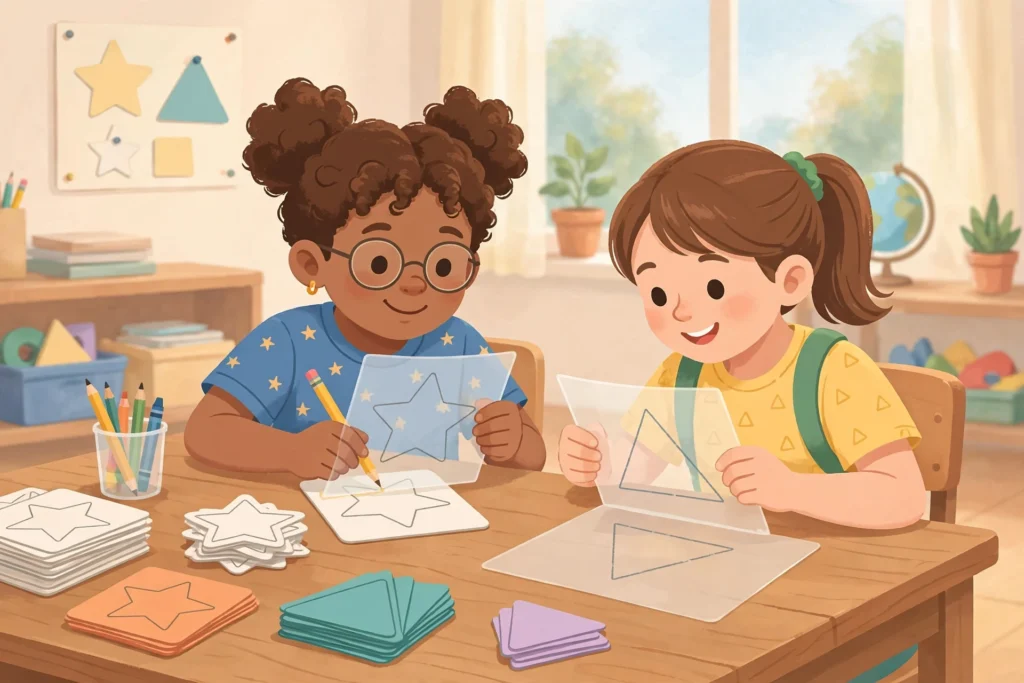
This activity needs shape cards (cut pairs of triangles, rectangles, and stars, plus a few similar-but-different-size distractors), tracing paper, and pencils. Plan for about twenty minutes with partners.
First, each partner draws two shape cards without showing them. One partner traces their shape onto tracing paper and cuts out the tracing. No peeking at the partner’s card yet.
Next, run the overlay test. Lay the tracing over the partner’s shape and check every side and corner. If the tracing covers the shape exactly, the pair is congruent: drop both cards in the “congruent” pile. If anything hangs over or falls short, they land in the “not congruent” pile.
Finally, the class reviews the tricky piles together. The similar-but-different-size distractors always catch a few pairs, which leads to the perfect closing question: same shape, different size, congruent or not? Not congruent. Similar. The tracing paper proved it.
Quick Practice
Question: Triangle A has sides of 3 cm, 4 cm, and 5 cm. Triangle B has sides of 3 cm, 4 cm, and 5 cm, but it is flipped upside down. Are the triangles congruent?
Answer: Yes. Flipping a shape does not change its size or shape, so all three sides still match: 3 cm with 3 cm, 4 cm with 4 cm, 5 cm with 5 cm. Same size and same shape means congruent.
Frequently Asked Questions
What does the symbol ≅ mean?
The symbol ≅ means “is congruent to.” It says the figures on either side have exactly the same size and shape, like an equals sign for geometry.
Are all squares congruent?
No. All squares share the same shape, but only same-size squares are congruent. A 2 cm square and a 5 cm square are similar, not congruent.
Can line segments be congruent?
Yes. Two line segments are congruent when they have the same length. A 7 cm segment and another 7 cm segment are congruent segments.
What is the difference between congruent and equal?
Equal usually describes numbers, like 2 + 2 = 4. Congruent describes figures, like two matching triangles. For shapes, congruent is the precise word for “equal in size and shape.”
When do kids learn about congruent shapes?
Matching same-size, same-shape figures begins in second and third grade with shape sorting and tracing. The formal vocabulary of congruence, including the ≅ symbol, arrives in upper elementary and middle school geometry.
Reading about it is one thing, practising it is another. Our free What Are 2D Shapes? lesson builds the idea step by step, with slides, a printable worksheet and a full answer key.
Members unlock every lesson in the library, including the full Fractions, Multiplication, Place Value, Addition & Subtraction, Time & Money and Geometry & Shapes units. See the full library


