Perimeter is the distance all the way around the outside of a shape. If you walk around the edge of a playground and end up where you started, the length of your walk is the perimeter.
How Do You Find the Perimeter of a Rectangle?
Add up all four sides. A rectangle has two long sides and two short sides, and opposite sides match. If a garden is 6 feet long and 4 feet wide, its perimeter is 6 + 4 + 6 + 4 = 20 feet.
There is a shortcut that does the same adding in fewer steps. Add the length and the width, then double the total: perimeter = 2 x (length + width). For the same garden, 2 x (6 + 4) = 2 x 10 = 20 feet. Both roads lead to the same answer, so pick the one that feels easier.
Squares are rectangles with a bonus: all four sides are equal. That makes the math even quicker. Multiply one side by 4: perimeter = 4 x side. A square sandbox with 5-foot sides has a perimeter of 4 x 5 = 20 feet. One multiplication and you are done.
How Do You Find the Perimeter of a Triangle?
Add the three sides: perimeter = side A + side B + side C. Triangles do not get a shortcut because their sides can all be different. A triangle with sides of 3 inches, 4 inches, and 5 inches has a perimeter of 3 + 4 + 5 = 12 inches.
Watch the units. Perimeter is a length, so the answer always carries a length unit: inches, feet, yards, centimeters, or meters. If the sides are given in different units, change them to match before you add. You cannot add 2 feet and 6 inches until both speak the same unit language.
Mr. Okafor turns this into a race. He hands each table a paper triangle with labeled sides and a ruler. “First table to report the perimeter wins, but the answer must include the unit.” His fourth graders learned fast that “14” earns half credit and “14 centimeters” earns the win.
What Is the Difference Between Perimeter and Area?
Perimeter is the fence. Area is the grass inside the fence. Perimeter measures the distance around a shape in units like inches or feet. Area measures the surface a shape covers in square units like square inches or square feet.
Common Mistake: Mixing up perimeter and area on tests. Ask yourself what the question wants. “How much fence?” means perimeter, so add the sides. “How much carpet?” means area, so multiply length by width. Fence goes around, carpet fills inside.
The same perimeter can hide different areas. A 4-by-4 square and a 1-by-7 rectangle both have a perimeter of 16 units, but the square covers 16 square units while the skinny rectangle covers only 7. Shape matters, not just the distance around.
Where Is Perimeter Used in Real Life?
Fences are the classic example. To fence a rectangular yard that is 50 feet by 40 feet, you need 2 x (50 + 40) = 180 feet of fencing. Picture frames, garden borders, and the trim around a bulletin board all follow the same idea: measure around, then buy that much material.
Builders and decorators live by perimeter. Baseboards run along the bottom of walls, so the perimeter of a room tells how much baseboard to buy. Wallpaper borders hug the top of walls the same way. Even gift wrapping leans on it: the ribbon around a box follows the perimeter of the lid.
Sports fields are measured in perimeters too. A football field with end zones is 360 feet long and 160 feet wide, giving a perimeter of 360 + 160 + 360 + 160 = 1,040 feet. Runners who circle the field once have run just over 1,000 feet, and now they know exactly how far.
Try It: Fence the Garden
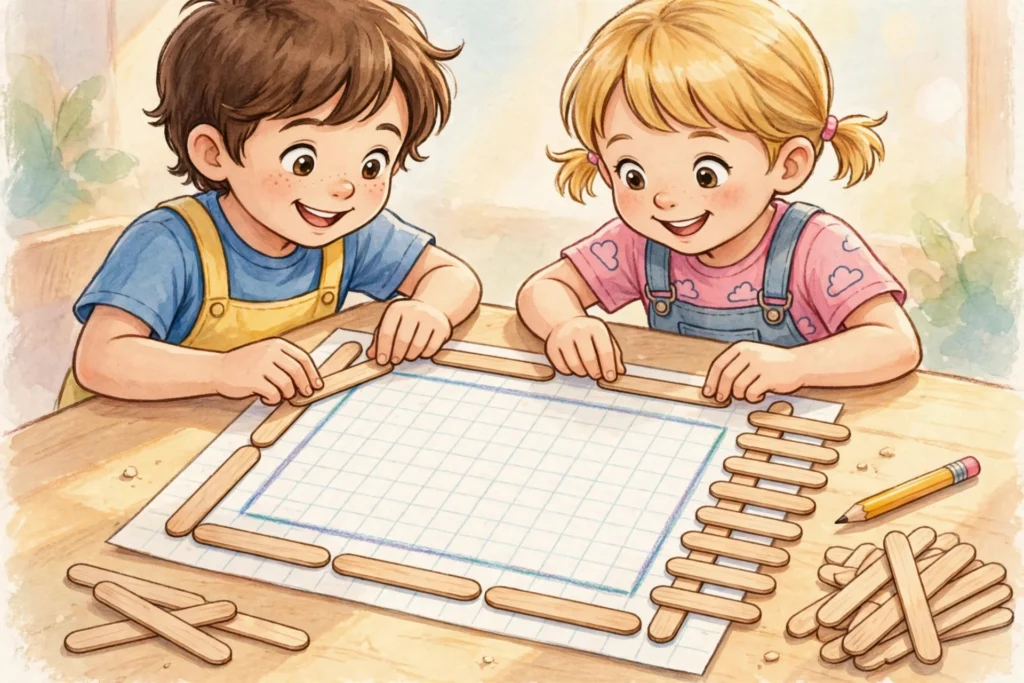
Grab graph paper, a pencil, and popsicle sticks or straws. You are about to fence a tiny garden.
- Step 1: Draw a rectangle on the graph paper that is 8 squares long and 5 squares wide. This is your garden.
- Step 2: Lay popsicle sticks along the edges of the rectangle, one stick per square. Count how many sticks it takes to go all the way around.
- Step 3: Now add the side lengths instead: 8 + 5 + 8 + 5. Compare with your stick count. Both should give 26 units.
- Step 4: Draw a new garden with different side lengths and predict the perimeter before you lay the sticks. Check your prediction.
Try an L-shaped garden next. The sides get trickier, but the rule never changes: add up every outer edge, and skip nothing. That total is your fence order.
Quick Practice
Question: A rectangular dog run is 9 feet long and 6 feet wide. How many feet of fencing are needed to go all the way around it?
Answer: Add all four sides: 9 + 6 + 9 + 6 = 30 feet. Or use the shortcut: 2 x (9 + 6) = 2 x 15 = 30 feet. You need 30 feet of fencing.
Related Terms
Keep exploring measurement with Length, Width, and Inches.
Frequently Asked Questions
What is perimeter in simple words?
Perimeter is the total distance around the outside of a shape. Walk the whole edge of a shape and come back to your start, and the length of your walk is the perimeter.
How do you find the perimeter of any shape?
Add the lengths of all its sides together. That rule works for every polygon, from triangles to hexagons to twisty irregular shapes. Just be sure to count every outer edge once.
What is the perimeter of a circle called?
The perimeter of a circle is called the circumference. You find it by multiplying the diameter by pi, about 3.14, instead of adding straight sides.
Is perimeter measured in square units?
No. Perimeter is a length, so it uses regular units like inches, feet, or centimeters. Square units belong to area, which measures the surface inside the shape.
Can two shapes have the same perimeter but different areas?
Yes. A 4-by-4 square and a 1-by-7 rectangle both have a perimeter of 16 units, but their areas are 16 and 7 square units. The distance around does not decide the space inside.
Reading about it is one thing, practising it is another. Our free Area and Perimeter lesson builds the idea step by step, with slides, a printable worksheet and a full answer key.
Members unlock every lesson in the library, including the full Fractions, Multiplication, Place Value, Addition & Subtraction, Time & Money and Geometry & Shapes units. See the full library