
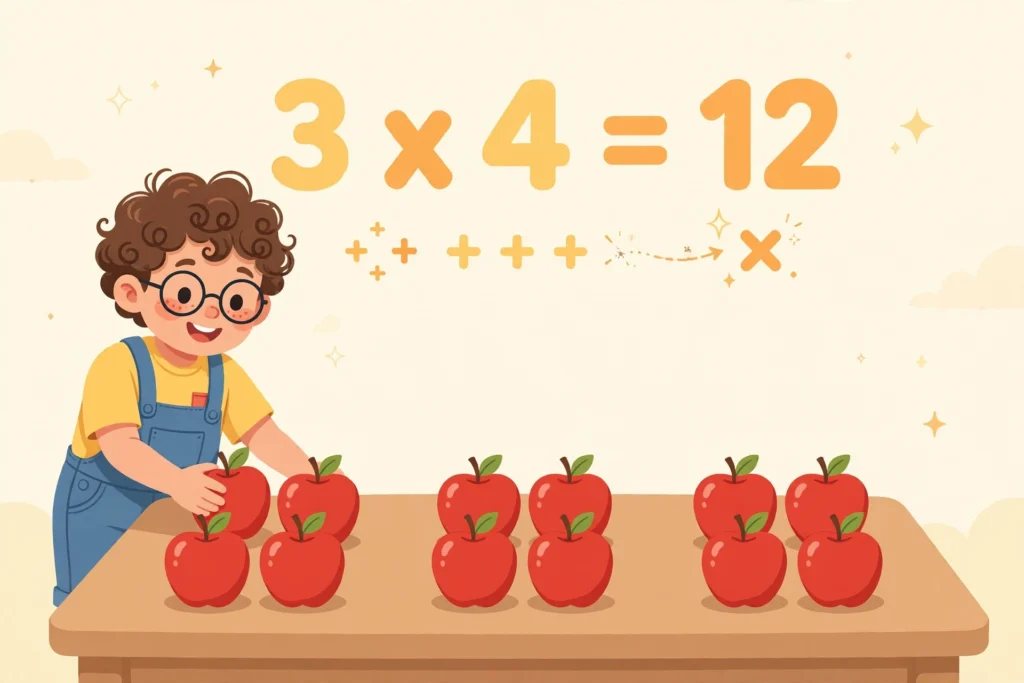
Multiplication is a shortcut for adding equal groups. Instead of writing 4 + 4 + 4, you can write 3 × 4. Both equal 12.
Master multiplication facts fast with our free interactive multiplication chart — hover, click, and practice any fact.
What Is Multiplication as Repeated Addition?
Imagine three gift bags on a party table, and each bag holds 4 stickers. To find the total, you add the same number three times: 4 + 4 + 4 = 12. That is repeated addition, and multiplication is the faster way to write it: 3 × 4 = 12.
The × symbol is read as “times.” So 3 × 4 is read “three times four,” which means three groups of four. The answer to a multiplication problem is called the product. In 3 × 4 = 12, the product is 12.
In a third grade classroom last spring, a teacher dumped a bag of linking cubes on the rug and asked table groups to build “four towers of five.” The room filled with clicking sounds as kids snapped cubes together. Then she asked, “Who can write one number sentence that shows all four towers at once?” A boy named Devon wrote 4 × 5 = 20 on his whiteboard and grinned. He had just traded a long addition string for one short sentence.
Common Mistake: mixing up the number of groups with the size of each group. For “four groups of three,” some kids write 4 + 4 + 4, which is three groups of four. The matching repeated addition is 3 + 3 + 3 + 3, with the 3 appearing four times. Saying the words “groups of” out loud before writing helps keep the two numbers straight.
What Are the Parts of a Multiplication Problem?
Every multiplication problem has the same three parts. The numbers being multiplied are called factors, and the answer is called the product. Here they are in action:
| Problem | Factors | Product | Repeated addition |
|---|---|---|---|
| 2 × 5 = 10 | 2 and 5 | 10 | 5 + 5 = 10 |
| 4 × 3 = 12 | 4 and 3 | 12 | 3 + 3 + 3 + 3 = 12 |
| 5 × 5 = 25 | 5 and 5 | 25 | 5 + 5 + 5 + 5 + 5 = 25 |
Notice the pattern in the last column: the number being added matches one factor, and the count of addends matches the other.
How Is Multiplication Different From Addition?
Addition combines any numbers, equal or not. You can add 3 + 4 + 2 and get 9. Multiplication only steps in when the groups are equal. That is why 4 + 4 + 4 becomes 3 × 4, but 3 + 4 + 2 stays as addition.
Speed is the other big difference. Adding 2 six times (2 + 2 + 2 + 2 + 2 + 2) takes a while to write and invites copy errors. Writing 6 × 2 = 12 says the same thing in a flash.
Does the Order Matter in Multiplication?
No, and that is one of the friendliest facts in all of math. Three groups of four gives the same total as four groups of three: 3 × 4 = 12 and 4 × 3 = 12. This is called the commutative property of multiplication.
Arrays make it visible. Build 3 rows of 4 counters and you get 12 counters. Turn the whole array sideways and you see 4 rows of 3, still 12 counters.
If 7 × 3 feels hard but 3 × 7 feels easier, kids can flip the factors and solve the friendlier version. The product stays the same either way.
Where Do We Use Multiplication in Real Life?
Multiplication hides in plain sight all over daily life. An egg carton holds 2 rows of 6, which is 2 × 6 = 12 eggs. A muffin tin with 3 rows of 4 holds 3 × 4 = 12 muffins. Three cars in a parking lot have 4 wheels each, so 3 × 4 = 12 wheels.
Time runs on multiplication too. There are 7 days in a week, so 4 weeks hold 4 × 7 = 28 days. Once kids start looking, they find equal groups in the grocery store, the toy box, and the classroom supply shelf.
What Is the Easiest Way to Learn Multiplication Facts?
Start with the friendly families: 2s, 5s, and 10s. The 2s are just doubles, which most kids already know. The 5s follow a skip-counting rhythm (5, 10, 15, 20) that ends in 5 or 0. The 10s simply add a zero. Mastering those three families first gives kids quick wins and real confidence.
Skip counting is the engine behind all of it. A child who can count by threes (3, 6, 9, 12, 15) is already most of the way to knowing 5 × 3 = 15. Arrays, songs, and card games keep the practice playful instead of drill-like.
Learn facts in context, not isolation: a story about six bags with four marbles in each bag sticks, because the brain remembers the picture along with the numbers.
Try It: The Egg Carton Array

Grab an empty egg carton and a bag of pom-poms or dried beans for this hands-on array activity.
- Point out the carton’s shape: 2 rows with 6 cups in each row. That is an array, and it shows 2 × 6.
- Drop one pom-pom into each cup, counting by rows: 6 in the first row, 6 in the second row. Write 6 + 6 = 12, then 2 × 6 = 12.
- Turn the carton sideways. Now you see 6 rows of 2. Write 2 + 2 + 2 + 2 + 2 + 2 = 12, then 6 × 2 = 12. Same total, flipped factors.
- Try a muffin tin next: 3 rows of 4 cups shows 3 × 4 = 12. Hunt the kitchen for more arrays.
Ask your young mathematician to say each discovery out loud: “Two groups of six equals twelve.”
Quick Practice
Question: A baker packs 4 boxes with 5 muffins in each box. How many muffins are there in all?
Worked answer: This is 4 groups of 5, so write 4 × 5. As repeated addition, that is 5 + 5 + 5 + 5 = 20. The baker packed 20 muffins.
Related Terms
Frequently Asked Questions
What is the answer to a multiplication problem called?
The answer is called the product. The numbers being multiplied are called factors. In 6 × 4 = 24, the factors are 6 and 4, and the product is 24.
Is multiplication just fast adding?
That is a great first description. Multiplication is repeated addition of equal groups, written in a shorter form. As kids grow, they will also meet it as scaling and as area, but “fast adding of equal groups” carries them far.
What happens when you multiply by 0 or 1?
Zero groups of anything is nothing, so any number times 0 equals 0. One group of a number is just the number itself, so any number times 1 stays the same. These two rules save a lot of memorizing.
When do kids learn multiplication?
The groundwork starts in second grade with equal groups and arrays. Formal multiplication facts and fluency are a third grade focus, and the skills keep growing through fourth and fifth grade with larger numbers.
Reading about it is one thing, practising it is another. Our free What Is Multiplication? lesson builds the idea step by step, with slides, a printable worksheet and a full answer key.
Members unlock every lesson in the library, including the full Fractions, Multiplication, Place Value, Addition & Subtraction, Time & Money and Geometry & Shapes units. See the full library


