
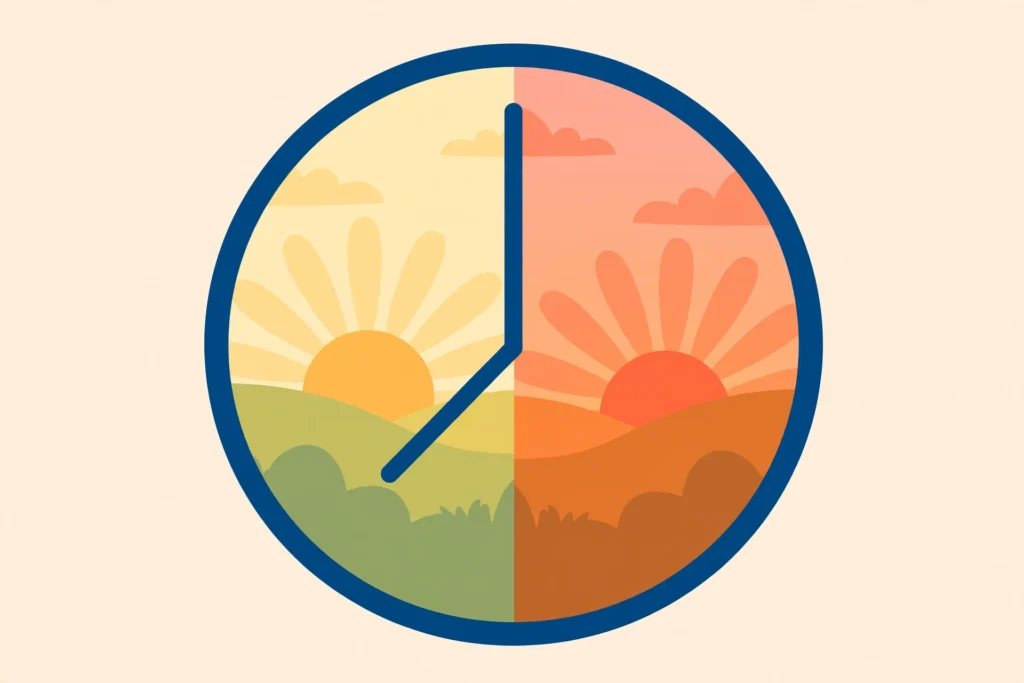
A.M. labels the hours from midnight to noon, short for the Latin words ante meridiem, which mean before midday.
What Does A.M. Mean in Time?
Your alarm rings at 7:00. Is it morning or evening? The clock face cannot tell you. It just says 7:00, and 7:00 happens twice every day. A.M. is the tag that says “the morning one.”
A.M. covers the first half of the day, from midnight to noon. Breakfast happens in the a.m. School starts in the a.m. Lunch lands right at the edge, at noon, where a.m. hands the day over to p.m.
What Do A.M. and P.M. Stand For?
A.M. stands for ante meridiem, Latin for before midday. P.M. stands for post meridiem, Latin for after midday. Long ago, the Romans split the day at the moment the sun sat highest in the sky. Morning was before that moment. Afternoon was after it. We still use their words.
Meridiem points at midday, noon, the middle of the day. So a.m. means the sun has not reached its peak yet. P.M. means the sun already passed it. Once you know the Latin, the letters stop feeling random.
Why Do We Need A.M. and P.M.?
A clock face shows only 12 hours, but a day has 24. So the clock runs through its numbers twice. Without a.m. and p.m., “meet me at 4:00” might mean afternoon playtime or a 4:00 a.m. wake-up nobody wants.
The letters remove the doubt. 4:00 p.m. is afternoon. 4:00 a.m. is the middle of the night. Every appointment, bus schedule, and birthday party invitation leans on these two little letters to land at the right hour.
Is Midnight A.M. or P.M.?
Midnight is 12 a.m. Noon is 12 p.m. This is the standard convention in the United States, and it trips up nearly everyone the first time.
Here is the logic. A.M. runs from midnight to noon. Midnight starts that stretch, so it takes the a.m. label: 12 a.m. Noon starts the p.m. stretch, so it takes the p.m. label: 12 p.m. Think of 12 as the starting line of each half, not the finish line.
The trick students remember: 12 a.m. is when the day begins, dark and quiet. 12 p.m. is when the sun is highest and lunch is served. If a schedule confuses you, write “midnight” or “noon” next to the 12 and the fog lifts.
What Does a Morning in A.M. Look Like?
Walk through a school-day morning in a.m. hours. 6:30 a.m.: the alarm rings and feet hit the floor. 7:15 a.m.: breakfast, maybe toast, maybe cereal. 8:00 a.m.: the first bell. 10:30 a.m.: recess, the best twenty minutes of the day. 11:45 a.m.: the class lines up for lunch, and the clock is nearly ready to flip.
At 12:00 p.m. the morning ends. Notice how every one of those times needed its a.m. tag to make sense. Without it, 6:30 might mean sunrise or supper. The letters keep the whole day in order.
Quick Answer: Which Hours Are A.M.?
Quick Answer: 12 a.m. through 11:59 a.m. is the a.m. half: midnight, the early morning hours, and the whole morning up to noon. 12 p.m. through 11:59 p.m. is the p.m. half: noon, afternoon, evening, and night.
Try It: Sort the Schedule

Make picture cards for ten daily events: waking up, eating breakfast, morning recess, lunch, soccer practice, dinner, brushing teeth at night, fireworks, sunrise, and a midnight snack. Label two columns on a pocket chart: A.M. and P.M.
Students take turns placing cards and defending their choice. Sunrise sparks debate: it happens in the a.m., but which hour? Fireworks split the room until someone points out they happen after dark, deep in p.m. territory. The midnight snack card causes the biggest argument of all, and settling it cements 12 a.m. forever.
For a challenge round, add times to the cards: 6:30, 12:00, 3:15, 11:45. Now students must attach a.m. or p.m. to each one. 12:00 gets two cards, one for noon and one for midnight, and the class decides which is which.
Quick Practice
Label each time with a.m. or p.m. School starts at 8:00. Lunch is at 12:00 midday. Soccer practice ends at 5:30. The baby wakes up crying at 2:00 in the dark.
Answer: 8:00 a.m., 12:00 p.m., 5:30 p.m., 2:00 a.m. Morning school hours are a.m. Midday noon is p.m. Evening practice is p.m. The dark middle-of-the-night waking is a.m.
Related Terms
Frequently Asked Questions
When does A.M. start?
At midnight, 12 a.m. The a.m. hours run from midnight through 11:59 in the morning, right up to noon.
What does 12:30 a.m. mean?
Half past midnight, thirty minutes after the day begins. It is the middle of the night, firmly in a.m. territory.
Do all countries use A.M. and P.M.?
No. Many countries use the 24-hour clock instead. On a 24-hour clock, 2:00 p.m. is written 14:00 and 9:00 p.m. is 21:00. The United States, Canada, and Australia are among the places that keep the 12-hour clock with a.m. and p.m.
How do you write A.M. correctly?
All the common forms work: a.m., am, A.M., AM. Pick one style and stick with it in your writing. Most elementary classrooms use a.m. and p.m. with the periods.
Glance at a clock today and add the letters in your head. Morning or night, the little tag tells the whole story.
Reading about it is one thing, practising it is another. Our free Telling Time to the Hour and Half Hour lesson builds the idea step by step, with slides, a printable worksheet and a full answer key.
Members unlock every lesson in the library, including the full Fractions, Multiplication, Place Value, Addition & Subtraction, Time & Money and Geometry & Shapes units. See the full library


