
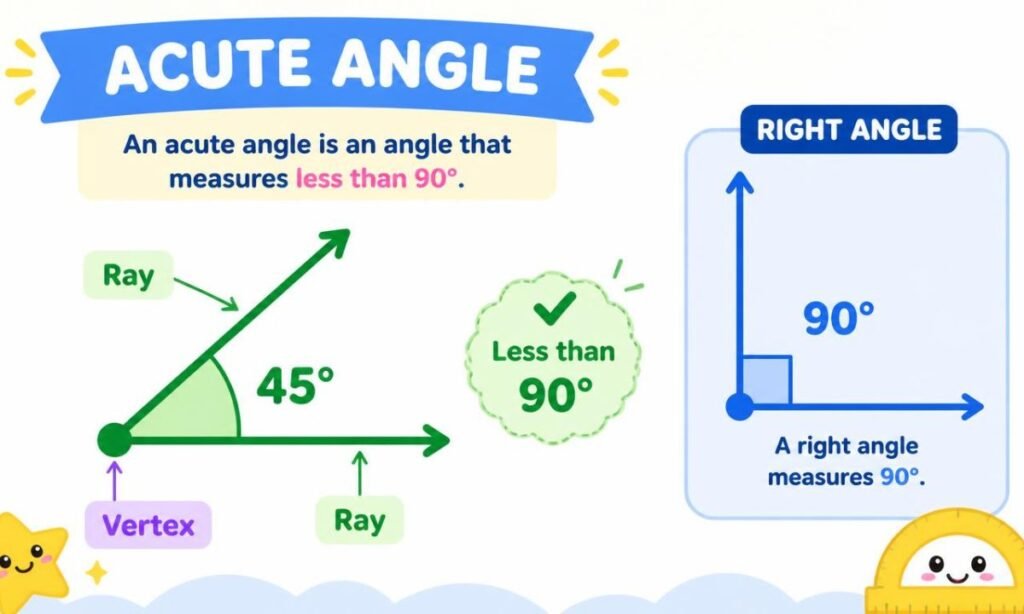
What Is an Acute Angle?
Picture opening a book just a tiny bit, not all the way flat. That narrow space between the pages? That’s an acute angle.
An acute angle is any angle that measures more than 0 degrees and less than 90 degrees. It’s smaller than a right angle, which is the perfect square corner you see on a piece of paper. Because it’s smaller, an acute angle looks sharp and narrow, almost like it’s squeezing shut.
How to Spot an Acute Angle Without a Protractor
You don’t need a protractor to check if an angle is acute. Grab any piece of paper and look at one of its corners. That corner is exactly 90 degrees, a right angle.
Now hold that corner up against the angle you’re checking. If the angle you’re looking at is smaller than the paper’s corner, it’s acute. If it matches the corner exactly, it’s a right angle. If it’s bigger and spreads out wider than the corner, it’s obtuse.
This trick works anywhere. Try it on a triangle in a book, a slice of toast, or even the hands of a clock.
Acute vs. Right vs. Obtuse Angles
Here’s a quick way to compare the three angle types kids meet most often.
| Angle Type | Degree Range | Everyday Example |
|---|---|---|
| Acute | Between 0° and 90° | An open pair of scissors |
| Right | Exactly 90° | The corner of a window |
| Obtuse | Between 90° and 180° | A fully reclined chair back |
Common Mistake: Is 90 Degrees an Acute Angle?
No. A 90 degree angle is a right angle, not an acute one. This trips up a lot of kids because 90 feels close to acute territory. The rule to remember is that acute angles have to be strictly less than 90 degrees. Even 89 degrees counts as acute, but 90 degrees does not.
Acute Angles in Everyday Life
Once you know what to look for, acute angles show up everywhere. A slice of pizza usually has an acute angle at its point. The tip of a rooftop often forms one too. So does the letter V, an open pair of scissors, and the hands of a clock at ten minutes to ten.
Spotting these in daily life helps the idea stick better than memorizing a definition alone.
Acute Triangles: When All the Corners Are Small
Angles don’t just stand alone. They also help describe shapes. A triangle where all three corners are acute angles is called an acute triangle. Picture a triangle that looks evenly balanced, with no corner stretching out wide or standing straight up like a right angle. Every corner in it is small and sharp.
Try It Yourself
Look around the room right now and find one angle you think is acute. Maybe it’s on a picture frame, a folded piece of paper, or the top of a pencil. Then use the paper-corner test from earlier to check your guess. Was it smaller than the paper’s corner?
Quick Practice Question
Which of these angles is acute: 45°, 90°, or 120°?
The answer is 45°. It’s the only one of the three that’s less than 90 degrees. A 90° angle is a right angle, and 120° is obtuse.
Related Terms
Acute angles connect closely to right angles, obtuse angles, and acute triangles. Understanding one makes the others easier to sort out.
FAQs
Can an angle be acute if it’s exactly 90 degrees?
No. Exactly 90 degrees is always a right angle. An acute angle has to be smaller than that.
What’s an easy way to remember what “acute” means?
Think of “a cute little angle.” Acute angles are small and narrow, so the smaller and sharper the angle looks, the more likely it’s acute.
Do all triangles have at least one acute angle?
Yes. Every triangle has at least two acute angles, no matter its type. A triangle can have one right angle or one obtuse angle, but the other two corners are always acute.