
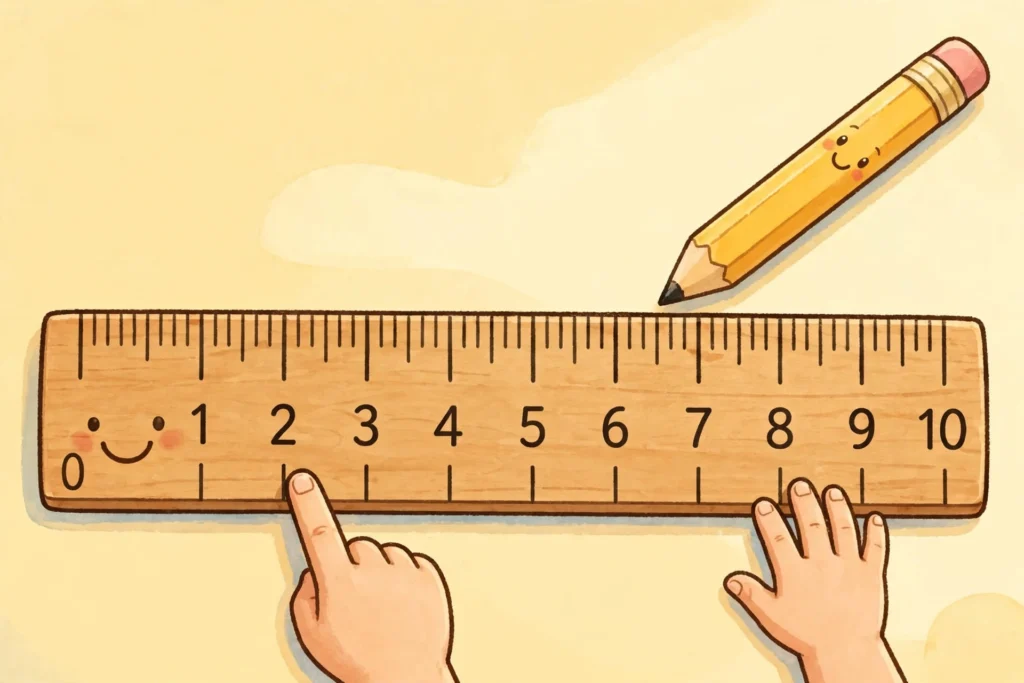
A centimeter is a small unit of length in the metric system. It is about as wide as your pinky fingernail.
How Long Is a Centimeter?
Look at your pinky fingernail. The width of that nail is close to 1 centimeter, which means you carry a rough ruler everywhere you go. Teachers love this trick because it turns every hand into a measuring tool.
The symbol for centimeter is cm. A US dime, the ten-cent coin, is 17.91 millimeters across, which is about 1.8 centimeters. So a dime is a little shorter than two centimeters wide. A standard pencil, the kind with the yellow paint and pink eraser, stretches about 18 centimeters from tip to eraser.
Each centimeter splits into 10 even smaller units called millimeters (mm). When a measurement needs extra precision, like the thickness of a coin, millimeters take over.
How Many Centimeters Are in a Meter?
100 centimeters = 1 meter. The word “centimeter” comes from the Latin centum, meaning hundred, plus meter. A centimeter is one hundredth of a meter, and the name says so right out loud.
It helps to see the chain laid out:
- 10 millimeters = 1 centimeter
- 100 centimeters = 1 meter
- 1,000 meters = 1 kilometer
For a real-world anchor, stand next to a door. The doorknob sits about 1 meter above the floor, which is 100 centimeters. A sheet of notebook paper is about 28 centimeters long, and most smartphones stand about 15 centimeters tall. Once students start converting between these, meters stop feeling giant and centimeters stop feeling tiny.
Centimeters vs. Inches: Which Unit Fits?
The United States mostly measures short lengths in inches, while most of the world and nearly all of science uses centimeters. The two systems meet on every standard ruler, which is why rulers print both scales side by side.
The exact trade is 1 inch = 2.54 centimeters. That means an inch is more than twice as long as a centimeter. If a friend says a book is 10 inches wide, you can picture about 25 centimeters.
Which unit should a student choose? In science class and in most countries, centimeters win. For a woodworking project at home in the US, inches are common. The math does not change, only the label. Being fluent in both is a quiet superpower, and it starts with knowing that 2.54.
How Do You Read a Centimeter Ruler?
Reading a ruler trips up more students than any other part of measurement, and the mistakes follow a pattern. In one second-grade class, Jamal measured his pencil starting at the 1 mark instead of 0 and proudly announced it was 17 centimeters long. His teacher smiled and asked the class to check where his ruler began. The whole room learned the golden rule that day.
Golden rule: line the object up with the 0 mark, not the edge of the ruler and not the 1. Each long numbered line after 0 marks one more centimeter. The shorter lines between them are millimeters, and there are 10 of them in every centimeter.
To read a length, find the numbered line closest to the end of the object without going past it, then count the little millimeter lines after it. A crayon that ends 3 small lines past the 9 is 9 centimeters and 3 millimeters long, written as 9.3 cm.
Quick Answer: One centimeter equals 10 millimeters, which is a little less than half an inch.
Where Do Centimeters Show Up Every Day?
Centimeters are hiding in plain sight. Shoe sizes in many countries, the height listed on an ID card, and the “28 cm” printed on a pizza box all use them. Rain gauges measure storms in centimeters, and weather reports in metric countries say “5 cm of snow” the way US reports say “2 inches.”
Tailors and sewing shops live in centimeters too, because fabric cut a centimeter too short ruins a sleeve. Even video games borrow the unit: character height screens often list centimeters first. When students hunt for “cm” at home, they usually return with a list longer than anyone expects.
Try It: Measure Like a Detective

Grab a centimeter ruler, a notebook, and your best detective focus. The mission: measure five classroom objects and record each length in centimeters.
- Step 1: Pick five objects of different sizes, such as a crayon, a book, a shoe, a pencil, and your hand.
- Step 2: Before measuring, write a guess for each one. Detectives always make a prediction first.
- Step 3: Line each object up at the 0 mark, read the centimeters, and write the real length next to your guess.
- Step 4: Give yourself one star for every guess within 2 centimeters of the truth. Three stars earns the title of Measurement Detective.
For a bonus round, measure one object in both centimeters and inches, then check your answer with the 2.54 rule. Ten inches should land near 25 centimeters, and students light up when the math confirms their ruler reading.
Quick Practice
Question: A crayon is 9 centimeters long. How many millimeters is that?
Answer: Each centimeter holds 10 millimeters, so 9 times 10 equals 90 millimeters. The crayon is 90 mm long.
Related Terms
Keep exploring measurement with these dictionary entries:
Practice Questions
Now it is your turn. Try these six questions about measuring in centimeters.
- A paper clip is about 3 centimeters long. How long are 4 paper clips laid in a row?
- Which is longer, a pencil of 15 centimeters or a crayon of 9 centimeters?
- A worm crawls 6 centimeters, rests, then crawls 5 more centimeters. How far has it crawled in all?
- True or false: your thumbnail is about 1 centimeter wide.
- A sticker is 4 centimeters wide. A notebook page is 20 centimeters wide. How many stickers fit side by side across the page?
- Mia’s ribbon was 18 centimeters long. She cut off 7 centimeters. How long is the ribbon now?
Answers
- 12 centimeters.
- The pencil, at 15 centimeters.
- 11 centimeters.
- True.
- 5 stickers.
- 11 centimeters.
Frequently Asked Questions
How many centimeters are in a meter?
There are 100 centimeters in 1 meter. The prefix “centi” means one hundredth, so the name tells you the answer.
Is a centimeter bigger than an inch?
No. An inch is longer. It takes about 2.54 centimeters to match one inch, so centimeters are the smaller unit.
What is the symbol for centimeter?
The symbol is cm, a lowercase c followed by a lowercase m, written right after the number like 18 cm.
Can I estimate a centimeter without a ruler?
Yes. The width of an adult pinky fingernail is about 1 centimeter, which makes your hand a handy backup ruler.
Why do rulers show both centimeters and inches?
Many rulers serve both systems at once. Scientists and most countries use centimeters, while everyday life in the US often uses inches, so one tool covers both.
Reading about it is one thing, practising it is another. Our free Measuring Length lesson builds the idea step by step, with slides, a printable worksheet and a full answer key.
Members unlock every lesson in the library, including the full Fractions, Multiplication, Place Value, Addition & Subtraction, Time & Money and Geometry & Shapes units. See the full library


