

A composite figure is a shape made by joining two or more simple shapes together. A square with a triangle on top, like a house, is a composite figure.
What Shapes Can Make a Composite Figure?
Almost any simple shape can be a building block. Rectangles, squares, triangles, trapezoids, circles, and semicircles all show up in composite figures. Put a rectangle and a semicircle together and you get the shape of a running track. Stack a triangle on a square and you get a house. Join three rectangles and you might get an L-shape or a T-shape.
Composite figures are everywhere once you start looking. A stop sign shape with a post under it is a composite figure. A bookshelf with a triangular top is one too. In class, I keep a box of foam shapes on the rug, and students love the challenge of building the most interesting composite figure they can from just four pieces.
How Do You Find the Area of a Composite Figure?
There is no single formula for a composite figure, so we use a three-step strategy instead. First, split the figure into simple shapes you already know. Second, find the area of each simple shape with its own formula. Third, add the areas together. If a piece is missing from the shape, like a bite taken out of it, subtract that piece’s area instead.
Take the house shape. The bottom is a square with sides of 6 meters, so its area is 6 times 6, which is 36 square meters. The roof is a triangle with a base of 6 meters and a height of 4 meters, so its area is one half times 6 times 4, which is 12 square meters. Add them: 36 plus 12 equals 48 square meters for the whole house.
Sometimes you need to find a missing measurement before you can start. If the figure does not label every side, look for a side on a neighboring shape that matches it. Students get good at this detective work with practice, and it is one of the most satisfying parts of the topic.
How Do You Find the Perimeter of a Composite Figure?
Perimeter means the distance around the outside of the shape, so the rule is simple: add up only the outer edges. The lines inside the figure, where the simple shapes join, are not part of the outside, so you skip them.
Go back to the house. The square has three outer sides, because its top side is hidden under the triangle roof. The triangle has two outer slanted sides, because its bottom side sits on the square. Add those five outer sides together and you have the perimeter. The two inner lines where the shapes meet never enter the calculation.
Common Mistake: adding the inner joining lines when finding perimeter. Those lines are inside the figure, not on its border. Trace the outside of the shape with your finger first, and only add the sides your finger touches.
What Is the Difference Between a Composite Figure and a Rectilinear Figure?
These two ideas overlap, but they are not the same. A rectilinear figure must be built only from straight line segments, with no curves at all. A composite figure has no such rule: it can mix straight and curved shapes freely.
An L-shape made of two rectangles is both a rectilinear figure and a composite figure. But a running track, a rectangle with a semicircle on each end, is a composite figure and not a rectilinear figure, because the semicircles curve. So every rectilinear L-shape or T-shape is composite, but a composite figure with any curve in it is not rectilinear.
Try It: Design a Floor Plan
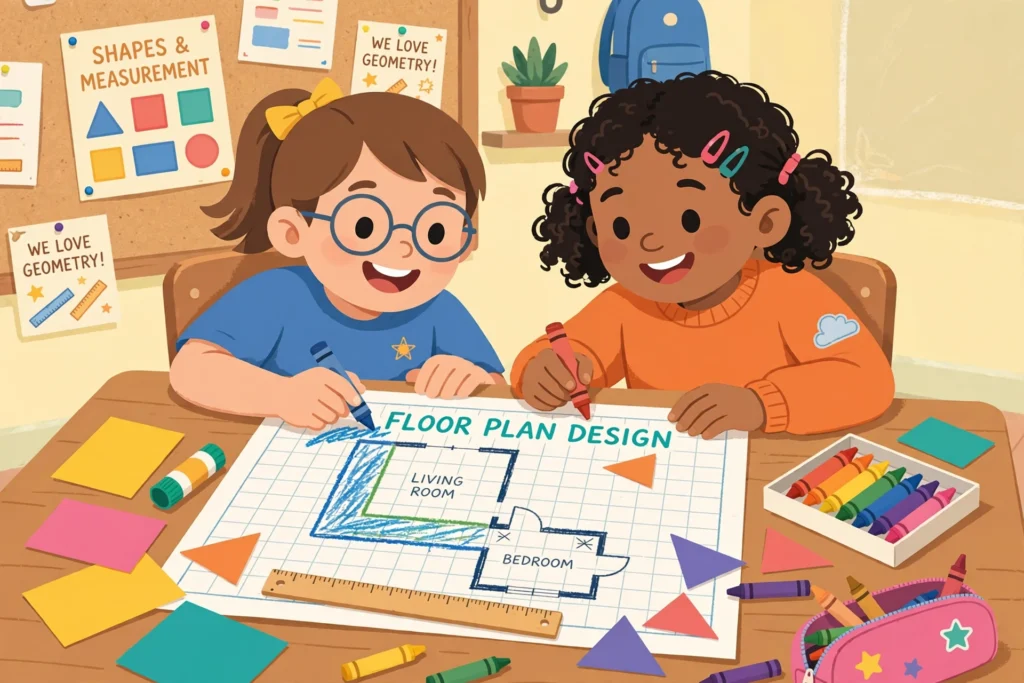
Give each pair of students a large sheet of grid paper and a set of paper shapes: rectangles, squares, triangles, and semicircles. Their task is to design a floor plan for a dream clubhouse using at least three shapes joined together. Every shape must touch at least one other shape along a full side.
Once the plan is glued down, students label every room with its measurements. A rectangle room might be 5 units by 4 units. A triangular reading nook might have a base of 4 units and a height of 3 units. Then they find each room’s area and add them to get the total floor space of the clubhouse.
For a bonus challenge, ask pairs to find the perimeter of their whole clubhouse, the distance around the outside walls. Remind them to skip the inner walls where rooms join. When groups compare results, they will notice that the same three shapes can make different clubhouses, yet the area stays the same no matter how the rooms are arranged.
Quick Practice
Question: A composite figure is made of a square with sides of 6 meters and a triangle on top with a base of 6 meters and a height of 4 meters. What is the total area?
Worked answer: Find each part’s area first. The square: 6 times 6 equals 36 square meters. The triangle: one half times 6 times 4 equals 12 square meters. Add the parts: 36 plus 12 equals 48. The total area of the composite figure is 48 square meters.
Related Terms
- Decompose: splitting a composite figure into simple shapes is the first step in finding its area or perimeter.
Frequently Asked Questions
Can a composite figure include a circle?
Yes. A shape made of a rectangle with a semicircle attached is a classic composite figure. Any simple shape, straight-edged or curved, can be one of the building blocks.
Do the shapes in a composite figure have to touch?
Yes, they join together to form a single figure. If the shapes sit apart with space between them, you just have separate shapes, not one composite figure.
Can you split a composite figure in more than one way?
Often, yes. An L-shape can be split into a tall rectangle plus a short one, or a wide rectangle plus a small one. Every fair split gives the same total area, which makes a great class investigation.
What if part of the figure is missing?
Then subtract. Find the area of the full shape as if the missing part were still there, find the area of the missing piece, and subtract. A garden with a rectangular pond cut out of it works exactly this way.
Is a composite figure always irregular?
Not always. Two squares joined side by side make a rectangle, which is a regular, familiar shape. But most composite figures look irregular, which is why we split them into pieces we know.
Every topic clicks faster with practice. Our Resource Library has free lesson packs with slides, printable worksheets and full answer keys, ready to download and teach.
Members unlock every lesson in the library, including the full Fractions, Multiplication, Place Value, Addition & Subtraction, Time & Money and Geometry & Shapes units. See the full library


