
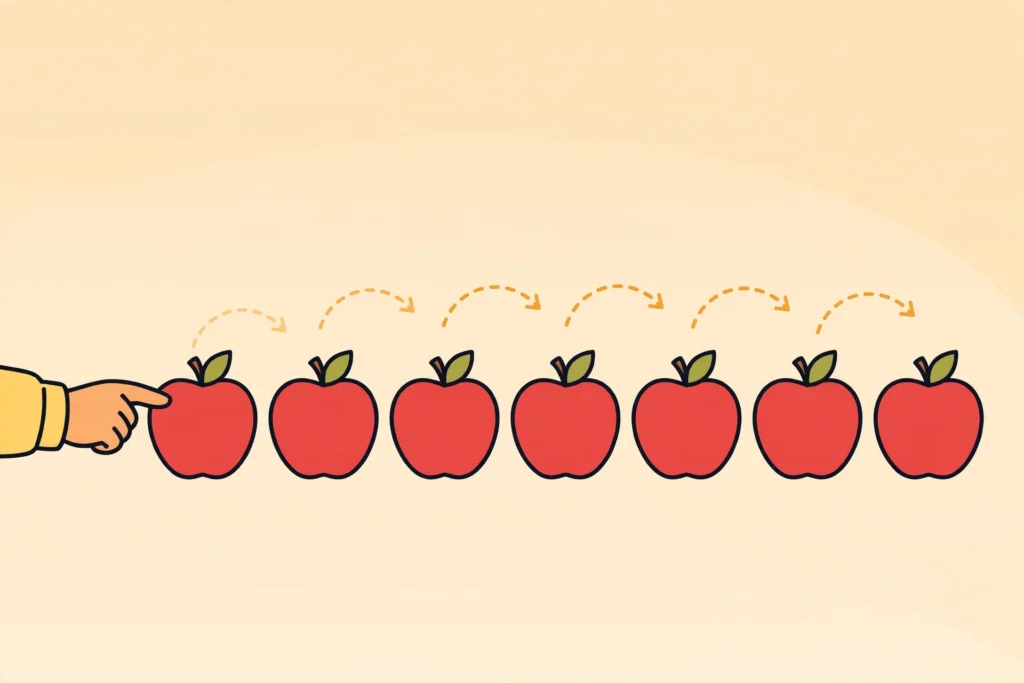
Counting means matching one number word to each object, in order, so the last number you say tells how many there are.
What Is Counting in Math?
Saying “one, two, three” fast is easy. Counting a wiggly pile of crayons without skipping one or counting one twice is the real skill. Real counting pairs number words with objects, one to one, in the right order.
Watch a kindergartner count a row of blocks. She touches each block as she says its number: one, two, three, four. Then she announces “four!” with total confidence. That touch-say-match rhythm is the whole engine of early math. Addition, subtraction, and everything after it ride on this skill.
What Is One-to-One Correspondence?
One-to-one correspondence is the rule behind accurate counting: one number word for each object, each object touched exactly once. No skips, no doubles.
Teachers chant it as “one number, one touch.” The finger slows the mouth down. A child who can rattle off numbers to fifty might still stumble counting seven buttons, because the mouth runs ahead of the finger. The touch keeps them honest.
Arranging objects in a line makes it easier. Scattered groups are harder because the eye loses track of what is counted. Sliding each counted object aside is the oldest trick in the book: what has moved is counted, what has not moved is waiting.
What Is Cardinality?
Cardinality is the payoff moment. When you finish counting and the last number you said names the total, you understand cardinality. Count five shells: one, two, three, four, five. There are five shells. The five is not just the last word, it is the answer to “how many?”
Some children count perfectly and then freeze when asked “so how many?” They start over instead of repeating the last number. That is the missing link. Practice the finish line: count, then say it again with pride. “One, two, three. Three apples!”
How Can You Count Without Losing Track?
Three strategies carry young counters through any pile.
First, line objects up. A neat row beats a messy heap every time. Second, move each object as you count it. Push counted bears to the other side of the tray. Third, mark what you counted. On paper, cross out or circle each picture as its number is said.
Start counting anywhere in the sequence. You do not have to start at one. If three ducks are already in the pond and two more waddle in, count on: four, five. Five ducks. That flexibility, counting on from any number, is a big step toward addition.
Common Mistake: “She Can Count to 100!”
Common Mistake: reciting number words is not the same as counting objects. A child who chants to 100 may still skip objects or double-count a pile of ten. Real counting means one number word matched to one object. If you want to check the skill, hand over a scattered handful of buttons and watch the fingers, not the mouth.
Try It: Counting Collections

Fill cups with collections: buttons, shells, beads, dried beans, pom-poms. Each pair of students grabs one cup and dumps it out. Their job: find out how many, using any strategy they like.
Partners watch and check. Did every object get exactly one number? Does the last number match a recount? Pairs who disagree recount together, and the negotiation teaches more than any worksheet.
Record the total on a sticky note and stick it on the cup. Then swap cups with another pair and check their count. Finding someone else’s mistake feels like detective work, and it sharpens every counter in the room.
Quick Practice
You count a scattered pile of crayons: 1, 2, 3, 4, 5, 6, 7. Then your friend counts the same pile and gets 8. What is the smartest way to settle it?
Answer: line the crayons up in a row and count again slowly, touching each one once. Or move each crayon aside as you count it. The recount with a tracking strategy gives the true total, and it shows whether someone skipped one or counted one twice.
Related Terms
Explore skip counting and number line.
Frequently Asked Questions
Can you start counting at a number other than one?
Yes. Counting on from any number is a real skill. If you already know there are 4 cookies on the plate and someone adds 3 more, count five, six, seven. Seven total.
What is the difference between rote counting and real counting?
Rote counting is reciting the number words in order, like singing a song. Real counting matches each word to an object. Rote counting comes first, but it only becomes math when the words attach to things.
How high should a kindergartner be able to count?
By the end of kindergarten, most standards expect counting to 100 by ones and tens, and counting up to 20 objects accurately. The object counting matters more than the big number. Twenty objects counted perfectly beats a shaky sprint to 100.
Counting looks simple until you watch it closely. One number, one touch, and the last number wins. That is the whole beautiful machine.
Every topic clicks faster with practice. Our Resource Library has free lesson packs with slides, printable worksheets and full answer keys, ready to download and teach.
Members unlock every lesson in the library, including the full Fractions, Multiplication, Place Value, Addition & Subtraction, Time & Money and Geometry & Shapes units. See the full library


