
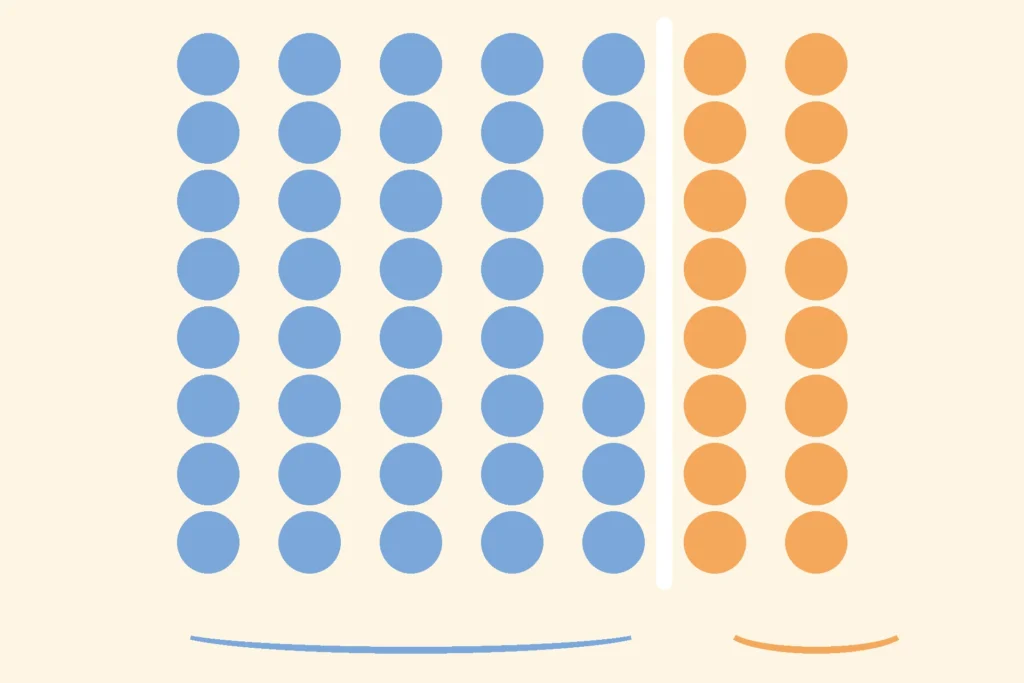
The distributive property says that multiplying a number by a sum gives the same answer as multiplying by each part of the sum and then adding. In symbols: a × (b + c) = (a × b) + (a × c).
What Is the Distributive Property?
Long name, friendly idea. The outside number gets shared, or distributed, to every number inside the parentheses. For 3 × (4 + 5), the 3 multiplies the 4 and also multiplies the 5: (3 × 4) + (3 × 5) = 12 + 15 = 27. The shortcut 3 × 9 = 27 gives the same answer, which is exactly the point.
Third graders meet this property as a strategy for hard multiplication facts. Nobody loves memorizing 8 × 7 from scratch. But 8 × 5 is easy (40) and 8 × 2 is easy (16), and 40 + 16 = 56. That is the distributive property quietly doing its job.
How Does the Distributive Property Work in Third Grade?
Teachers call it “break apart to multiply.” Pick a hard fact, split one factor into two easier parts, multiply both parts, and add. Take 6 × 7. Seven is a tough partner, so break it into 5 + 2. Now multiply: (6 × 5) + (6 × 2) = 30 + 12 = 42.
The break-apart choices are flexible. For 9 × 8, a student might split 8 into 5 + 3: (9 × 5) + (9 × 3) = 45 + 27 = 72. Another student might split 9 into 5 + 4: (5 × 8) + (4 × 8) = 40 + 32 = 72. Same answer, different road. That flexibility is why the property builds number sense instead of just another rule to memorize.
What Does the Distributive Property Look Like?
The area model makes it visible. Draw a rectangle that is 8 rows by 7 columns. That rectangle shows 8 × 7. Now draw a line after the fifth column, splitting the big rectangle into an 8-by-5 piece and an 8-by-2 piece. The first piece holds 40 squares and the second holds 16 squares. Add them: 40 + 16 = 56, which is 8 × 7.
Arrays of dots work the same way. Eight rows of seven dots can be circled as eight rows of five dots plus eight rows of two dots. Kids who see the split rectangle once tend to remember the property forever, because the picture proves the rule instead of just stating it.
Does the Distributive Property Work with Subtraction?
Yes. The outside number distributes over a difference too: a × (b – c) = (a × b) – (a × c). For 7 × (9 – 4), multiply 7 by 9 to get 63, multiply 7 by 4 to get 28, then subtract: 63 – 28 = 35. The shortcut 7 × 5 = 35 matches.
Subtraction versions are handy for facts near a ten. Take 8 × 9. Think of 9 as (10 – 1): (8 × 10) – (8 × 1) = 80 – 8 = 72. Break the fact near a ten, multiply both parts, subtract, and a scary fact becomes two easy ones.
Why Is the Distributive Property Useful?
Three reasons keep it in the curriculum year after year. First, it turns hard multiplication facts into easy ones, which builds confidence with facts through 10 × 10. Second, it is a mental math superpower: 7 × 12 becomes 7 × 10 plus 7 × 2, which is 70 + 14 = 84, all doable in your head.
Third, it is the on-ramp to algebra. When students later meet 4(x + 6), they will expand it to 4x + 24 using the same move they learned with numbers in third grade. The property never changes, and only the numbers get fancier.
Why Is It Called the Distributive Property?
Because the multiplier gets distributed, handed out like party favors, to each term inside the parentheses. In 5 × (3 + 4), the 5 visits the 3 and then visits the 4. Nothing inside the parentheses gets skipped.
Common Mistake: The number-one error is distributing to only the first term. A student writes 3 × (4 + 5) = (3 × 4) + 5 = 12 + 5 = 17. Wrong. The 3 must multiply the 5 as well: (3 × 4) + (3 × 5) = 12 + 15 = 27. Every term inside the parentheses gets a visit from the outside number, no exceptions.
Try It: Break Apart and Multiply

Grab grid paper and two crayons. Color an 8-by-7 rectangle of squares: 8 rows, 7 columns. Count the squares if you like. There are 56.
Now draw a bold line after the fifth column, splitting your rectangle into an 8-by-5 section and an 8-by-2 section. Color the first section with one crayon and the second with the other. Count each section: 40 squares and 16 squares.
Write the matching equation under your drawing: 8 × 7 = 8 × (5 + 2) = (8 × 5) + (8 × 2) = 40 + 16 = 56. Try it again with 7 × 9, splitting 9 into 5 + 4. Your grid paper is now a multiplication machine.
Quick Practice
Use the distributive property to solve 4 × (6 + 3). Show your steps.
Distribute the 4 to both terms: (4 × 6) + (4 × 3). Multiply each part: 24 + 12. Add: 36. Check with the shortcut: 4 × 9 = 36. The answer is 36.
Related Terms
Frequently Asked Questions
What is the distributive property formula?
For multiplication over addition: a × (b + c) = (a × b) + (a × c). For multiplication over subtraction: a × (b – c) = (a × b) – (a × c).
What grade learns the distributive property?
Third grade. The Common Core standard 3.OA.B.5 asks students to apply properties of operations as strategies to multiply, and the classic example is 8 × 7 = 8 × (5 + 2) = (8 × 5) + (8 × 2).
Does the distributive property work with division?
Not in the same clean way. Division distributes over addition only from the right side, like (12 + 8) ÷ 4 = 3 + 2, which is a fifth-grade topic. In elementary grades, kids use the distributive property with multiplication over addition and subtraction.
Can you use the distributive property backwards?
Yes. Going backwards is called factoring. (8 × 5) + (8 × 2) can be packed back into 8 × (5 + 2). Spotting the shared 8 is the whole trick.
Every topic clicks faster with practice. Our Resource Library has free lesson packs with slides, printable worksheets and full answer keys, ready to download and teach.
Members unlock every lesson in the library, including the full Fractions, Multiplication, Place Value, Addition & Subtraction, Time & Money and Geometry & Shapes units. See the full library


