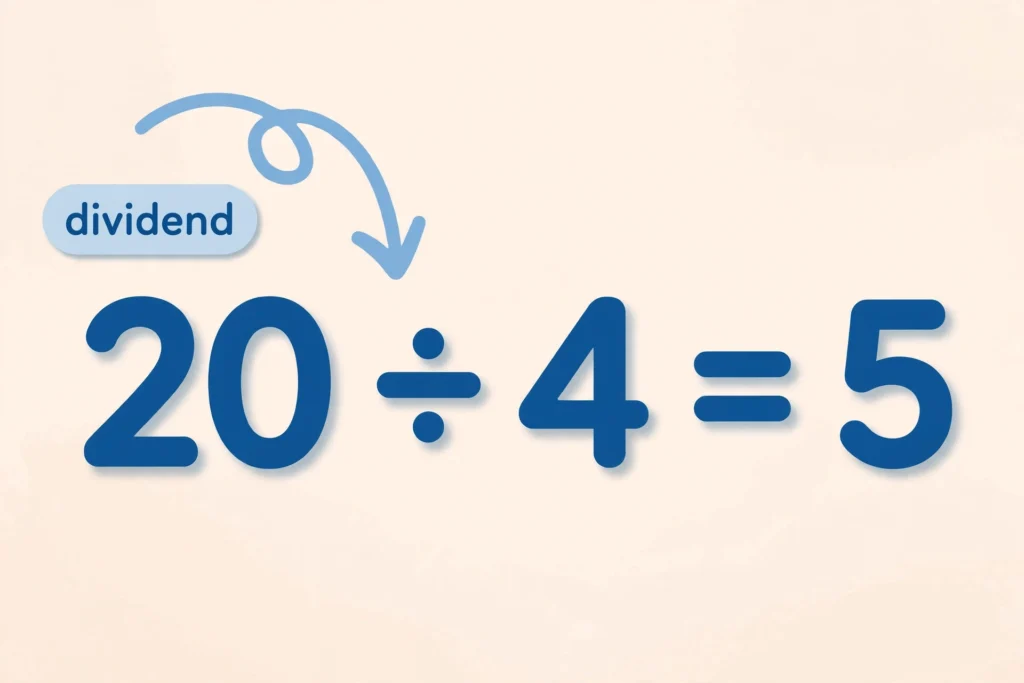
The dividend is the number being divided in a division problem, like 20 in 20 ÷ 4 = 5.
What Is a Dividend in Division?
Imagine 20 cookies spread across the table and 4 friends waiting. The 20 cookies are the starting pile, the total that needs sharing. In math, that starting pile has a name: the dividend.
The dividend is the number being divided. It is the total amount before any sharing happens. Every division problem starts with one, whether it is written as 20 ÷ 4 = 5, as a fraction, or inside the long-division bracket.
How Do You Find the Dividend in a Division Problem?
Look for the number being split up. In a flat number sentence, it comes first: in 36 ÷ 6, the dividend is 36. In long division, it hides inside the bracket: in 6 ⟌ 36, the 36 inside is the dividend and the 6 outside is the divisor.
A story makes it stick. “28 apples shared among 7 children” becomes 28 ÷ 7 = 4. The 28 apples existed before the sharing started, so 28 is the dividend. Ask students to circle the dividend in five problems and read each one as a sharing story. The circling takes seconds, and the understanding lasts.
Dividend vs. Divisor vs. Quotient: What Is the Difference?
Three names, three jobs. Mix them up and the whole problem falls apart.
| Part | Job | In 20 ÷ 4 = 5 |
|---|---|---|
| Dividend | the number being divided (the total) | 20 |
| Divisor | the number you divide by (groups, or size of each group) | 4 |
| Quotient | the answer (how many in each group) | 5 |
| Remainder | what is left over, if anything | 0 |
Read it like a sentence: the dividend gets divided by the divisor to make the quotient. Say it with the cookie story: 20 cookies (dividend) shared among 4 friends (divisor) gives 5 cookies each (quotient).
How Is the Dividend Connected to Multiplication?
Division and multiplication are inverse operations, which means they undo each other. That link turns the dividend into a checking tool.
In a fact family, the product of the multiplication fact becomes the dividend of the division facts. From 6 × 5 = 30 come 30 ÷ 5 = 6 and 30 ÷ 6 = 5. The 30 travels from product to dividend without changing.
This gives students a way to verify any division answer with the check formula:
Dividend = (Divisor × Quotient) + Remainder
Try it: 17 ÷ 5 = 3 remainder 2. Check: (5 × 3) + 2 = 15 + 2 = 17. The dividend reappears, which proves the division was correct. Teach this check early and long-division errors drop fast.
Can the Dividend Be Smaller Than the Divisor?
Yes. Nothing in the definition requires the dividend to be bigger. Take 3 ÷ 4. You cannot make a full group of 4 from 3 items, so the quotient is 0 and the remainder is 3, the whole dividend left over.
Students often assume the bigger number must come first. Show them 3 ÷ 4 on paper and with counters: three counters, groups of four. Zero full groups, three left over. The rule “dividend comes first” is about position, not size.
Common Mistake: Mixing Up Dividend and Divisor
Common Mistake: calling the divisor the dividend. The words sound alike and both start the problem, so the confusion is natural. The memory hook that works: dividend and divide share their first five letters. The dividend is the number getting divided.
Another trap: in long division, students point at the number outside the bracket. Drill the positions with a chant: “inside gets divided.” After a week of chanting, the error mostly disappears.
Try It: Cookie Sharing

Cut 20 paper circles for cookies and set out 4 paper plates. Ask: what is our dividend? Twenty, the starting pile. Now deal the cookies one at a time around the plates, like cards.
When the dealing ends, count each plate: 5 cookies. Write the full sentence together: 20 ÷ 4 = 5, then label each part. Next round, use 23 cookies. The deal leaves 3 plates with 6 and one extra cookie that cannot be shared fairly. That leftover is the remainder, and the check formula brings back the dividend: (4 × 5) + 3 = 23.
Quick Practice
In 7 ⟌ 84, identify the dividend, divisor, and quotient. Then check your answer with the formula.
Answer: dividend = 84 (inside the bracket), divisor = 7 (outside), quotient = 12. Check: 7 × 12 = 84. No remainder, and the dividend reappears.
Related Terms
Explore quotient.
Frequently Asked Questions
Where is the dividend in long division?
Inside the division bracket. In 6 ⟌ 36, the 36 under the bracket is the dividend. The number outside, 6, is the divisor.
What if the dividend is 0?
Then the quotient is 0. Sharing nothing among any number of groups gives each group nothing: 0 ÷ 8 = 0.
Does the dividend always come first?
In a division expression, yes: dividend ÷ divisor = quotient. The dividend is always the number being divided, wherever it is written.
Is the dividend the numerator in a fraction?
Yes. In the fraction 20/4, the 20 on top is the dividend and the 4 below is the divisor. A fraction bar is just another way to write division.
The next time you split a pack of crayons or deal out game cards, name the starting pile out loud. That pile is the dividend, and now you will never unsee it.
To practise dividing a dividend of your choice, use our free long division calculator.
Reading about it is one thing, practising it is another. Our free What Is Division? lesson builds the idea step by step, with slides, a printable worksheet and a full answer key.
Members unlock every lesson in the library, including the full Fractions, Multiplication, Place Value, Addition & Subtraction, Time & Money and Geometry & Shapes units. See the full library