
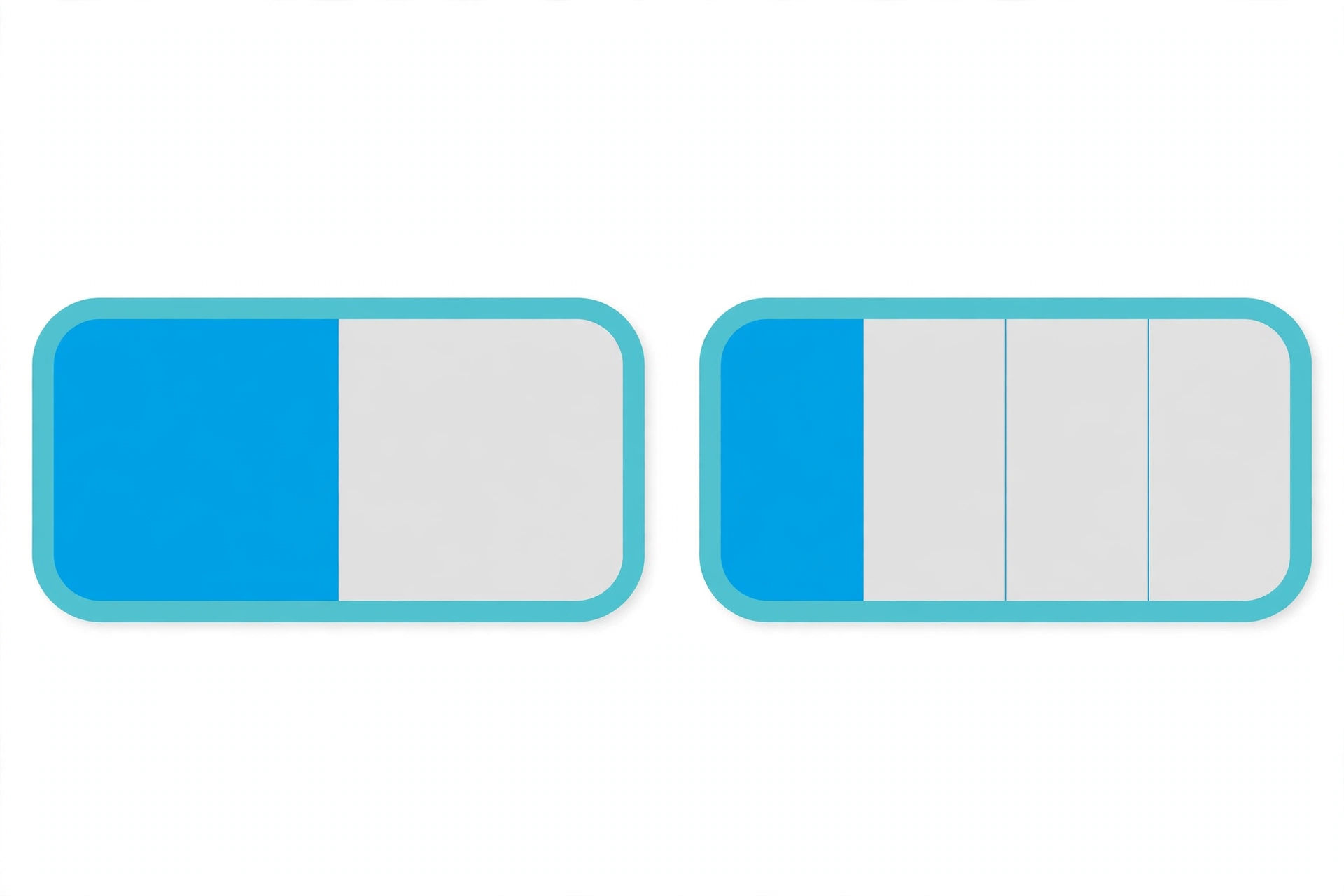
Cut a sandwich in half and you have two pieces. Cut each half in half again and you have four pieces. Eat one of the original halves, or eat two of the smaller quarters. Either way, you ate the same amount of sandwich. That is the whole idea of equivalent fractions: different fractions that name the same amount.
What Are Equivalent Fractions?
Equivalent fractions are fractions that look different but represent the same value. One half (1/2) and two fourths (2/4) are equivalent because they cover the same amount. Three thirds (3/3) and one whole (1/1) are equivalent because both equal one complete thing. The numerators and denominators differ, but the actual quantity is identical.
This confuses students at first because it breaks the pattern they expect. In whole numbers, different names mean different amounts: 3 is not 4. But in fractions, 1/2 is 2/4. The key insight is that fractions describe a relationship (parts to whole), not just a count. Change both the parts and the whole proportionally, and the relationship stays the same.
How Do You Know Fractions Are Equivalent?
The most reliable test is visual: draw both fractions with the same-sized whole and see if they cover the same area. Draw 1/2 as half of a rectangle. Draw 2/4 as two quarters of an identical rectangle. Lay them side by side. If the shaded regions match exactly, the fractions are equivalent. Pictures do not lie about size.
The numerical test is to multiply or divide the numerator and denominator by the same number. Multiply both parts of 1/2 by 2 and you get 2/4. Multiply by 3 and you get 3/6. All equivalent. This works because you are cutting each existing piece into smaller equal pieces, which changes the count but not the total amount. It is the sandwich cut in half again.
Why Do Equivalent Fractions Matter?
You cannot add or subtract fractions with different denominators without them. To solve 1/2 plus 1/4, you must first see that 1/2 equals 2/4. Then the problem becomes 2/4 plus 1/4, which is 3/4. Equivalent fractions are the bridge that makes fraction operations possible.
They also power simplifying. The fraction 4/8 looks complicated, but recognizing it as equivalent to 1/2 makes it simple. Students who can spot equivalences compute faster and with fewer errors because they work with the simplest form. It is like reducing a fraction to its essence.
What Mistakes Do Students Make?
The biggest error is thinking that bigger numbers mean bigger fractions. A student sees 2/4 and 1/2 and insists 2/4 is larger “because 2 is bigger than 1 and 4 is bigger than 2.” They are comparing digits instead of quantities. The fix is always visual: draw both, compare the shaded areas, let the picture correct the misconception.
Another mistake is adding the tops and bottoms: thinking 1/2 equals 2/3 because “you add 1 to both.” This reveals a student treating fractions as two separate whole numbers rather than one relationship. Fraction strips, where they can physically align 1/2 against other fractions, break this habit fast.
How Can Families Practice at Home?
Cook together. Recipes are full of equivalent fractions: 1/2 cup equals 2 quarter-cups. Let your child measure both and see they fill the same space. Doubling a recipe shows equivalence in action: 1/2 becomes 2/4 when you need twice as much.
Fold paper. Take a strip, fold it in half, shade one side: that is 1/2. Take another identical strip, fold it in quarters, shade two: that is 2/4. Hold them up together. The visual proof is immediate and unforgettable.
Try It: Fold Strips to Find Equivalents
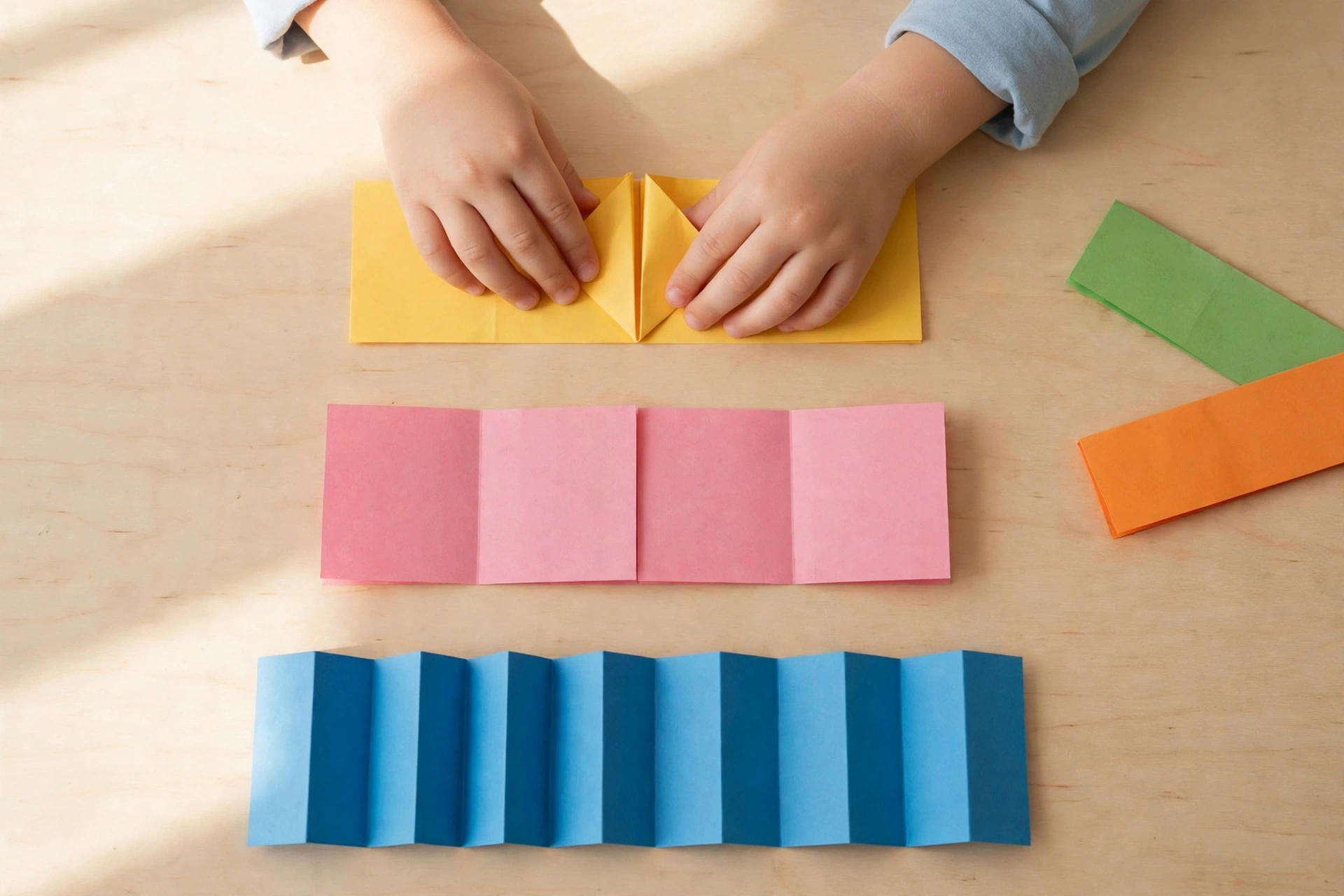
Step 1: Make the strips. Cut 4 identical paper strips. Label them: wholes, halves, fourths, eighths.
Step 2: Fold and shade. Fold one strip in half and shade 1/2. Fold another in fourths and shade 2/4. Fold a third in eighths and shade 4/8.
Step 3: Compare. Line up the shaded portions. They are all the same length. Write the equivalence: 1/2 = 2/4 = 4/8.
Step 4: Hunt for more. Can you show 1/3 as an equivalent fraction? What about 3/4? Let students discover that some fractions have many equivalents and the pattern is always multiply top and bottom by the same number.
Quick Practice
Question: A student says 3/6 is bigger than 1/2 because 3 is bigger than 1. How would you prove them wrong using a visual model?
Answer: Draw two identical rectangles. Shade 1/2 of one and 3/6 of the other. The shaded areas will be exactly the same size, proving 3/6 = 1/2. The digits differ but the amount is identical.
Frequently Asked Questions
How do you find equivalent fractions?
Multiply or divide both the numerator and denominator by the same nonzero number. For 1/3, multiply by 2 to get 2/6, by 3 to get 3/9, by 4 to get 4/12. All are equivalent to 1/3.
Are 2/3 and 4/6 equivalent?
Yes. Multiply both parts of 2/3 by 2 and you get 4/6. Draw them with the same-sized whole and the shaded areas will match perfectly.
Why do we need equivalent fractions for adding?
You can only add fractions that name the same-sized parts. One half and one fourth are different-sized pieces, so you must convert 1/2 to 2/4 first. Then you are adding fourths to fourths, which works like adding whole numbers.