

An even number is a whole number that can be split into two equal groups with nothing left over.
What Is an Even Number?
Imagine you have 6 cookies and two friends at your table. You hand one cookie to each friend, then another to each friend, then a third to each friend. Both friends end up with 3 cookies, and your plate is empty. Nobody is left out, and nothing is left over. That is what makes 6 an even number.
Mathematicians say a number is even when every item can be paired up and each item has a partner. Draw 8 dots on paper and circle them in pairs. You get four neat pairs and zero lonely dots. Do the same with 7 dots, and one dot sits alone with no partner. So 8 is even and 7 is not.
The first even numbers are 2, 4, 6, 8, and 10. Notice that every even number is two more than the one before it. Counting by twos, 2, 4, 6, 8, 10, 12, lands on even numbers every single time. That pattern is the first clue kids use to spot even numbers on a number chart.
How Can You Tell If a Number Is Even?
You do not need to draw dots for big numbers. There is a shortcut that always works. Look at the last digit. If it is 0, 2, 4, 6, or 8, the number is even. The number 5,917,624 is even because it ends in 4. The number 30 is even because it ends in 0.
Why does the last digit get to decide? Every number is a bunch of tens plus its ones digit. Multiples of ten are always even, since ten itself splits into two fives. So the tens part is always even, and only the ones digit can tip the total toward even or odd. That is the whole secret behind the trick, and second graders love hearing it.
The pair-up test still works as a backup. Ask a child to deal out 14 counters into two rows. If both rows come out the same with nothing left over, 14 is even. This test never fails, no matter how large the number grows.
What Is the Difference Between Even and Odd Numbers?
Every whole number is either even or odd. There is no third team. Odd numbers are the ones that leave one item without a partner when you try to pair them up: 1, 3, 5, 7, 9, and so on. Odd numbers always end in 1, 3, 5, 7, or 9.
Even and odd numbers follow friendly rules when you add them. An even number plus an even number is always even, like 2 + 4 = 6. An odd number plus an odd number is also even, like 3 + 5 = 8, because the two lonely leftovers pair up with each other. An even plus an odd is always odd, like 4 + 3 = 7. A third grade class can spend a whole math talk testing these rules with counters and finding that they never break.
Is Zero an Even Number?
Yes. Zero is an even number, and this question starts more classroom debates than almost any other in second grade. Here is the proof. Split zero dots into two groups. Each group gets zero dots, the groups are equal, and nothing is left over. Zero passes the pair-up test perfectly.
Zero also passes the last-digit test, since it ends in 0. And it fits the pattern: even numbers are numbers you reach when you count by twos starting from 0. Zero is where the pattern begins. Teachers often settle the debate with a vote, then reveal that mathematicians everywhere agree. Zero is even.
Quick Answer: a number is even if it can be divided into two equal groups with nothing left over. The fast check is the last digit. If it is 0, 2, 4, 6, or 8, the number is even. Zero counts as even.
Try It: Pair Up the Buttons
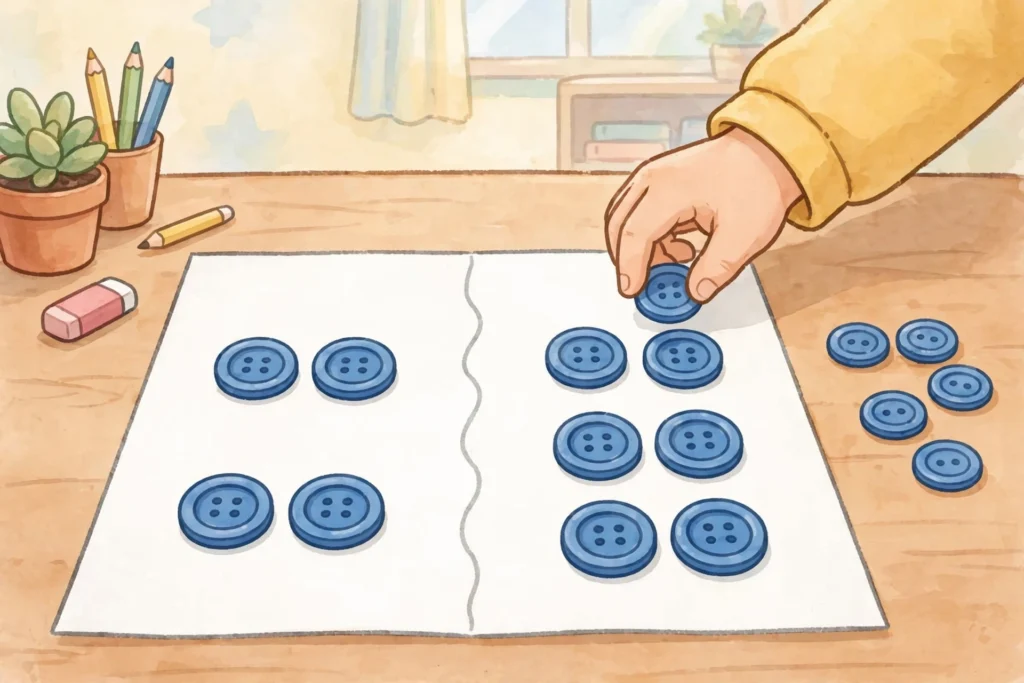
You need: 12 buttons or small counters and a piece of paper. Draw a big line down the middle of the paper to make two columns. This will be your pairing board.
Pick a number between 1 and 12. Place that many buttons on the desk. Now deal them onto the board one at a time, alternating columns, like dealing cards. When you run out, look at the two columns. Are they equal? Is every button paired with one across the line? If yes, your number is even. If one button has no partner, your number is odd.
Try every number from 1 to 12 and record your results in a list. Circle the even ones. You should see the pattern: even, odd, even, odd, all the way up. For a challenge, test 20, 25, and 30 by drawing pairs on paper instead of using buttons.
Quick Practice
Question: Is 34 an even number or an odd number? How do you know?
Worked answer: 34 is even. The last digit is 4, and 4 is one of the even digits: 0, 2, 4, 6, 8. You can also picture pairing 34 dots. Every dot finds a partner and none is left alone, so 34 splits into two equal groups of 17.
Related Terms
Frequently Asked Questions
What are the first ten even numbers?
The first ten even numbers are 2, 4, 6, 8, 10, 12, 14, 16, 18, and 20. Each one is two more than the last. If you include zero, the list starts at 0 and runs 0, 2, 4, 6, 8, 10, 12, 14, 16, 18.
Can negative numbers be even?
Yes. Negative numbers follow the same rule. A negative number is even if it can be split into two equal groups, which works out to the last-digit test again. So negative 4 and negative 20 are even, while negative 3 and negative 15 are odd. Elementary classes usually stick with positive numbers, but the pattern holds.
Why do students need to learn even and odd numbers?
Even and odd patterns show up in skip counting, multiplication, and division. Knowing that an even number always splits into two equal groups helps kids predict answers before they calculate. Later, the same idea powers divisibility rules and helps with fractions, factors, and algebra.
Do even numbers always end in the same digits?
Yes. Every even number, no matter how large, ends in 0, 2, 4, 6, or 8. This is because the tens and hundreds in a number are always even, so only the ones digit decides. Check any phone number, street address, or page number with this trick. It works every time.
Every topic clicks faster with practice. Our Resource Library has free lesson packs with slides, printable worksheets and full answer keys, ready to download and teach.
Members unlock every lesson in the library, including the full Fractions, Multiplication, Place Value, Addition & Subtraction, Time & Money and Geometry & Shapes units. See the full library


