
Short Definition for Students
A fact family is a group of related addition and subtraction equations that use the same three numbers, such as 3, 5, and 8.
Fact Family: Definition and Examples And Full Details
A fact family is a group of related math facts that use the same three numbers. In an addition and subtraction fact family, two numbers are the parts and the largest number is the whole.
For example, 3, 5, and 8 make this fact family:
• 3 + 5 = 8
• 5 + 3 = 8
• 8 − 3 = 5
• 8 − 5 = 3
Each equation uses the same three numbers. The equations show how addition and subtraction are connected.
Parts and Whole in a Fact Family
Imagine 3 red counters and 5 blue counters. Put the two groups together, and you have 8 counters.
In this example:
•3 and 5 are the parts.
•8 is the whole.
The addition facts put the parts together:
3 + 5 = 8
5 + 3 = 8
The subtraction facts start with the whole and take away one part:
8 − 3 = 5
8 − 5 = 3
A drawing or a group of counters can help students see why each equation is true.
How the Four Facts Are Connected
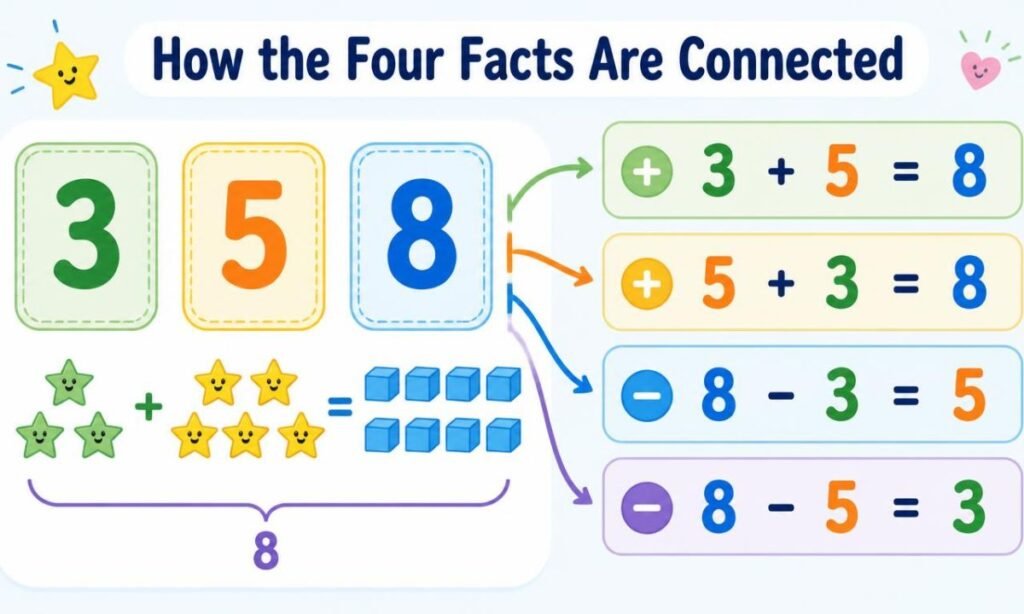
The Two Addition Facts
The two parts can switch places in an addition equation without changing the sum. This idea is called the commutative property of addition.
3 + 5 = 8
5 + 3 = 8
Both equations say that the same two parts make a whole of 8.
The Two Subtraction Facts
Subtraction works from the whole back to a part. Start with 8, take away 3, and 5 remain. Start with 8, take away 5, and 3 remain.
8 − 3 = 5
8 − 5 = 3
This is why addition and subtraction facts belong in the same family. Addition combines the parts, and subtraction separates the whole into parts.
Fact Family Examples at a Glance
| Parts | Whole | Addition facts | Subtraction facts |
| 4 and 6 | 10 | 4 + 6 = 10 and 6 + 4 = 10 | 10 − 4 = 6 and 10 − 6 = 4 |
| 2 and 7 | 9 | 2 + 7 = 9 and 7 + 2 = 9 | 9 − 2 = 7 and 9 − 7 = 2 |
Before writing the equations, ask, “Which number is the whole?” The whole is the number that the two parts make when they are combined.
Use a Fact Family to Find a Missing Number
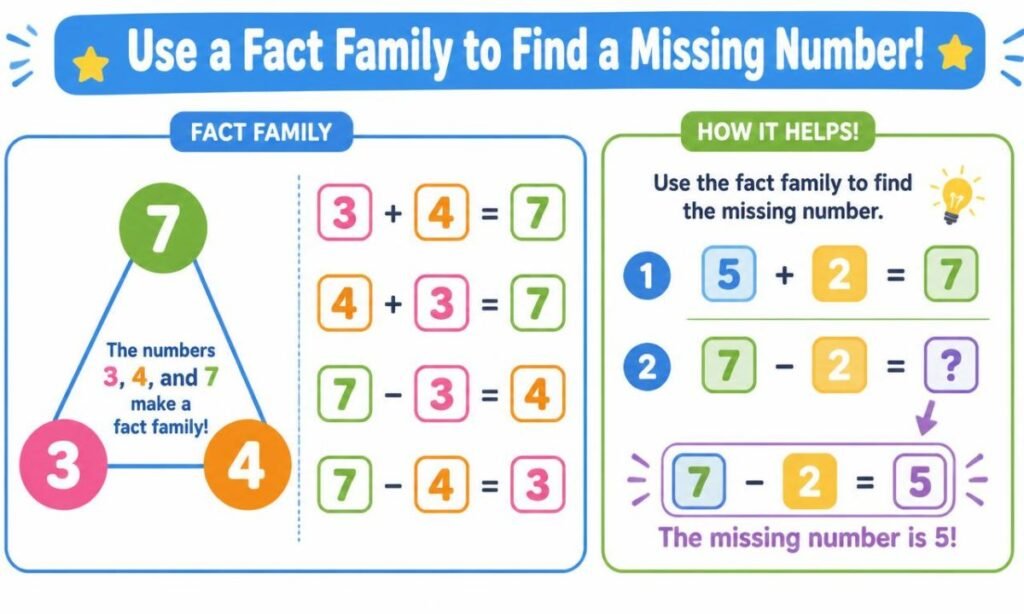
Fact families help students use a known fact to solve an unknown fact.
Suppose you see:
6 + __ = 10
The whole is 10, and one part is 6. Find the other part by thinking about the related subtraction fact:
10 − 6 = 4
So the missing number is 4:
6 + 4 = 10
A number bond or counters can show the same idea. The two parts, 6 and 4, join to make the whole, 10.
Common Mistake: Reversing the Subtraction
A fact family does not mean that the three numbers can appear in any order. The whole must begin each subtraction equation.
For 4, 5, and 9, this equation is correct:
9 − 4 = 5
This equation does not show the same fact family:
4 − 9 = 5
If you start with 4 and take away 9, the result is not 5. Use counters or a drawing to check the quantities. The two parts may switch places in addition, but subtraction does not work the same way.
Fact Family or Number Bond?
A number bond shows how parts make a whole. A fact family uses those same parts and whole in related equations.
| Number bond | Fact family |
| Shows parts and a whole | Shows related equations |
| Often uses circles or a drawing | Uses operation and equal signs |
| Helps students see number relationships | Connects addition and subtraction facts |
These tools work well together. A student can use a number bond to understand the numbers, then use the numbers to write a fact family.
Try It With Three Number Cards
Choose the number cards 2, 6, and 8. Use counters or draw two groups to decide which numbers are the parts and which number is the whole.
Then write:
•2 + 6 = 8
•6 + 2 = 8
•8 − 2 = 6
•8 − 6 = 2
A helpful question for a parent or teacher is, “Which number is the whole? How do you know?” This question asks the student to explain the quantities instead of copying a pattern.
Do All Fact Families Have Four Different Equations?
Most addition and subtraction fact families have four standard equations. When the two parts are the same, fewer distinct equations appear.
For 4, 4, and 8, the fact family is:
•4 + 4 = 8
•8 − 4 = 4
Writing 4 + 4 = 8 a second time does not create a new equation because the addends are identical.
Some lessons also count equivalent forms with the equal sign on the other side, such as 8 = 4 + 4. Elementary practice usually focuses on the four standard forms.
Practice Problem
Use 3, 7, and 10 to write the fact family.
Answer:
•3 + 7 = 10
•7 + 3 = 10
•10 − 3 = 7
•10 − 7 = 3
Frequently Asked Questions
How many equations are in a fact family?
An addition and subtraction fact family usually has four standard equations: two addition facts and two subtraction facts. A double, such as 4, 4, and 8, has fewer distinct equations.
Can three numbers always make a fact family?
No. The numbers must fit the same addition and subtraction relationship. For example, 3, 5, and 8 work because 3 and 5 make 8. Three numbers such as 3, 5, and 9 do not make this type of fact family.
Are number bonds and fact families the same?
No. A number bond shows parts and a whole. A fact family uses those numbers in related equations. A number bond can help a student build a fact family.
Can multiplication and division make a fact family?
Yes. For example, 2, 4, and 8 make these facts: 2 × 4 = 8, 4 × 2 = 8, 8 ÷ 2 = 4, and 8 ÷ 4 = 2. Addition and subtraction fact families are usually introduced first.
What grade do students learn fact families?
Students often learn the formal idea in Grade 1 after building addition and subtraction understanding in Kindergarten. They continue using fact families in Grade 2 to build fluency and solve missing-number problems. The Common Core emphasizes the relationships behind fact families through addition, subtraction, and the commutative property of addition.
A fact family is more than a list of equations. It shows how parts and a whole stay connected. When students understand that connection, one known fact can help them find another.