

A foot is a unit of length equal to 12 inches. It is part of the US customary system of measurement, the same system that gives us inches and yards.
How Long Is a Foot?
The whole secret of the foot fits in one number: twelve. One foot is twelve inches laid end to end. If you have a standard school ruler in your desk, pick it up and look at it. That ruler, from the zero mark to the twelve mark, is exactly one foot long. It never changes, no matter who holds it.
Here is a memory trick teachers love. Hold the ruler out and say it with me: one ruler equals one foot. Mathematicians shorten the word foot to ft, so one foot becomes 1 ft and four feet become 4 ft. You will also see the little mark that looks like an apostrophe, as in 5′, which means feet too.
To get a feel for the size, find foot-long objects in your classroom. A sheet of notebook paper measures about a foot on its long side, and so does a lunchbox or the width of many picture books. Pointing to foot-long objects without a ruler builds a sense of the unit that helps with estimating.
How Is a Foot Different from an Inch?
An inch and a foot are related, but they do different jobs. An inch is small, about the width of your thumb from the tip to the first knuckle. You would use inches to measure a paper clip, a key, or the height of a Lego brick. A foot is twelve times bigger than an inch, so you use feet for things that are too long to count in inches comfortably.
Think of it like this. Counting a desk in inches might give you 48, a number that is hard to picture. Saying the desk is 4 feet long is much easier to understand. The unit you choose should fit the size of the object, the way you choose a spoon instead of a shovel to eat cereal.
| Unit | Size | Best for measuring |
|---|---|---|
| Inch | About a thumb width | Paper clips, keys, small toys |
| Foot | 12 inches, one school ruler | Books, desks, door widths |
| Yard | 3 feet, 36 inches | Rooms, rugs, playgrounds |
In class, I line up twelve counting cubes next to the twelve inches on a ruler. Students watch the two rows match exactly, and the foot stops feeling like a mystery word. It becomes a dozen inches traveling together as a team.
Why Is It Called a Foot?
Did You Know: Long ago, before rulers existed in every classroom, people measured length with their own bodies. They used hand spans, arm lengths, and the length of an actual human foot. Different feet gave different answers, so leaders eventually agreed on one fixed length. That fixed length, twelve inches, is the foot we still use today.
This history explains the funny name. The unit has nothing to do with the foot inside your shoe, and that is why a teacher song goes around saying your foot is not one foot long. Your foot is its own size, and it changes as you grow. The measurement foot stays locked at twelve inches forever.
One more fact that helps the unit stick. Since 1959, countries have agreed on an exact length for the yard, which fixes one foot at 0.3048 meters. You do not need to memorize that number in elementary school, but it is nice to know the foot is not a guess. It is a fixed, official length.
When Do We Use Feet to Measure?
Feet show up wherever medium and large lengths need a number. Builders measure walls and doors in feet. Teachers measure the reading rug in feet. Families talk about the height of a child in feet and inches, like saying a fourth grader is 4 feet 2 inches tall. Even the football field uses feet, with every yard line sitting three feet apart.
A handy rule is to reach for feet when inches would give you a big clumsy number. If a measurement lands above twelve inches, try feet first. Matching the unit to the object is a skill, and it grows stronger every time you measure something real.
Watch for feet on labels too. Boxes of flooring list square feet, swimming pool depths are posted in feet, and airplane heights are given in feet. The same little unit quietly does jobs all over the world.
Try It: The Foot-Long Hunt
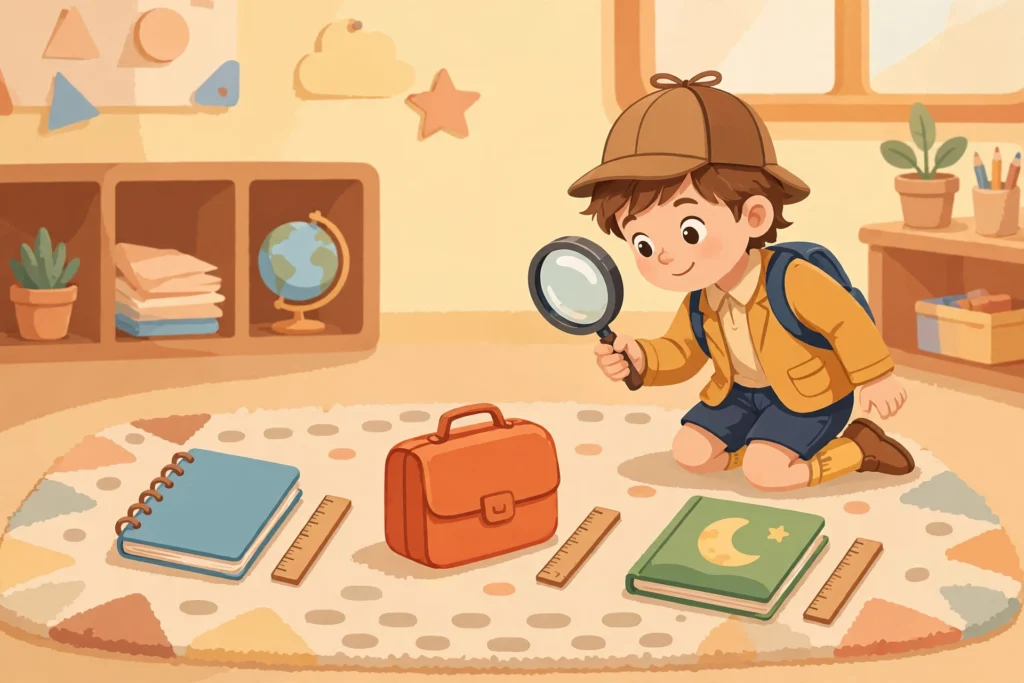
Turn your classroom into a measurement lab with the Foot-Long Hunt. Each student needs a ruler and a recording sheet with three columns: My Guess, Measured, and Yes or No. Give everyone two minutes to walk around and write down five objects they think are about one foot long, with a guess for each.
Then comes the measuring round. Students return to each object, line up the ruler from end to end, and read the inches. Anything between 11 and 13 inches counts as foot-long, because estimating is about getting close, not perfect. Winners are not the fastest hunters but the students whose guesses land closest to twelve inches.
Finish with a class chart on the board. List every object that earned a Yes and count them up together. Keep the chart up for a week and let students add new finds as they spot them. By Friday, the whole class will know what a foot feels like without ever touching a ruler.
Quick Practice
Question: Jamal says his desk is 3 feet long. How many inches is that?
Worked answer: Each foot holds 12 inches, so 3 feet hold 3 groups of 12 inches. Skip count to find it: 12, 24, 36. The desk is 36 inches long. You can also multiply: 3 times 12 equals 36.
Related Terms
- Inches: an inch is the smaller unit that teams up twelve at a time to make one foot.
- Length: length is the measurement a foot belongs to, and feet give length a number.
Frequently Asked Questions
Is a measurement foot the same as the foot on my body?
No. A measurement foot is always exactly 12 inches. The foot on your body grows as you grow, so it cannot serve as a unit. That is why we use rulers instead of shoes to measure.
How many inches are in a foot?
There are 12 inches in one foot. A standard school ruler shows the whole story, with the numbers running from 0 to 12 across exactly one foot.
How many feet are in a yard?
There are 3 feet in one yard, which is 36 inches. A yardstick is 3 feet long, so it looks like three school rulers lined up end to end.
How do you write foot in short form?
Write ft after the number, like 6 ft. You can also use the little mark that looks like an apostrophe, as in 6′. Both mean the same thing.
Why do we learn feet when the rest of the world uses meters?
The United States still uses feet, inches, and yards in daily life, on road signs, in sports, and in building plans. Learning both systems gets you ready for real life in the US, and meters come along in later grades.
Reading about it is one thing, practising it is another. Our free Measuring Length lesson builds the idea step by step, with slides, a printable worksheet and a full answer key.
Members unlock every lesson in the library, including the full Fractions, Multiplication, Place Value, Addition & Subtraction, Time & Money and Geometry & Shapes units. See the full library


