
You have 12 cookies and 18 candies. You want to make identical gift bags with no leftovers. How many bags can you make? The answer is 6, because 6 is the largest number that divides both 12 and 18 evenly. That number has a name: the greatest common factor.
What Is the Greatest Common Factor?
The greatest common factor (GCF) is the largest number that divides two or more numbers without leaving a remainder. For 12 and 18, the factors of 12 are 1, 2, 3, 4, 6, 12. The factors of 18 are 1, 2, 3, 6, 9, 18. The common factors (in both lists) are 1, 2, 3, and 6. The greatest of these is 6, so GCF(12, 18) = 6.
The word “greatest” matters. Many numbers might divide both (1 always does), but we want the largest. That is what makes the GCF useful: it gives us the biggest possible equal groups, the simplest fraction, the most efficient solution.
What Are 3 Ways to Find the GCF?
Method 1: List the factors. Write all factors of each number, circle the common ones, pick the largest. This is slow but foolproof, and it builds understanding of what factors are. Best for beginners and small numbers.
Method 2: Factor rainbows. Draw arcs connecting factor pairs: for 12, connect 1-12, 2-6, 3-4. Do the same for 18. List all factors from the rainbows, find the common ones, choose the greatest. The visual helps students organize their work.
Method 3: Prime factorization. Break each number into primes: 12 = 2 x 2 x 3, 18 = 2 x 3 x 3. Multiply the primes they share: 2 x 3 = 6. This is fastest for large numbers and reveals the mathematical structure. Teach it after students are comfortable with the first two methods.
Why Does the GCF Matter?
Simplifying fractions depends on it. To reduce 12/18 to simplest form, divide top and bottom by their GCF (6) to get 2/3. Without the GCF, students guess at simplification or leave fractions unsimplified. The GCF gives them a systematic way to always find the simplest form.
It also solves real grouping problems. The cookie-and-candy problem at the start is a GCF problem in disguise. Anytime you need the largest equal groups with no leftovers, whether it is gift bags, teams, or tile arrangements, the GCF is the tool. Recognizing these situations is as important as computing the answer.
What Mistakes Do Students Make?
The most common error is stopping at any common factor instead of the greatest. A student finds that 2 divides both 12 and 18 and declares the GCF is 2. They are not wrong that 2 is common, but they missed 3 and 6. Teach students to keep looking: “Is there a bigger one?” becomes the habit.
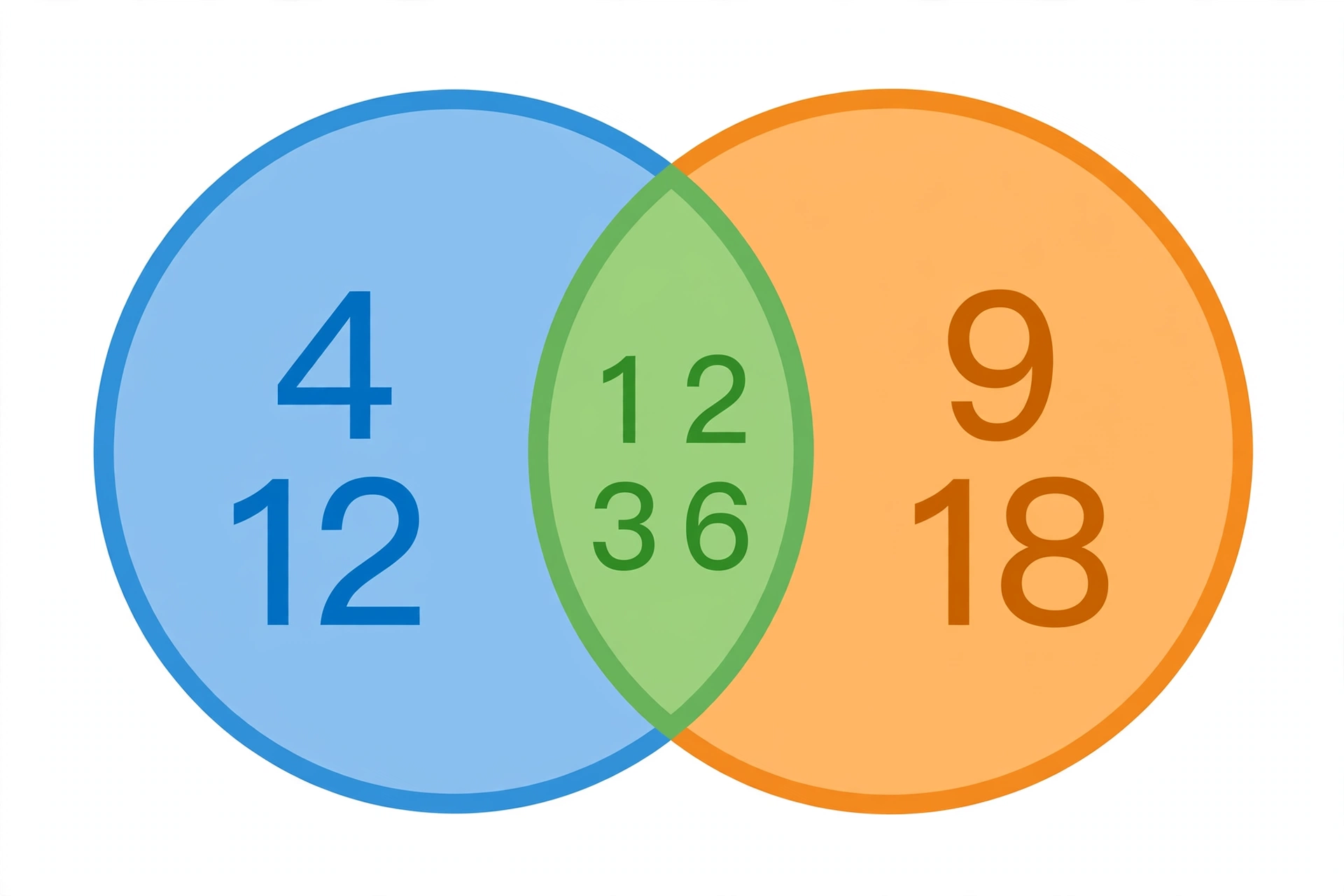
Another mistake is confusing GCF with LCM (least common multiple). Students mix up “greatest” and “least,” or “factor” and “multiple.” Use the Venn diagram: factors live inside the numbers (small), multiples stretch outward (big). The GCF is the biggest of the small; the LCM is the smallest of the big. The visual distinction helps.
How Can You Practice GCF?
Play “GCF War” with cards. Each player flips two cards, finds the GCF of the two numbers, and the higher GCF wins the round. This builds speed and makes factor-listing feel like a game instead of a chore.
Use the gift bag problem with different numbers. Give students 20 stickers and 30 pencils. How many identical bags? (GCF of 20 and 30 is 10.) Change the numbers and let them discover that the method always works. Real contexts make the abstract idea stick.
Try It: Find GCF With Factor Rainbows

Step 1: Pick two numbers. Start with 20 and 30. Write each number at the top of its own space.
Step 2: Draw the rainbows. For 20: draw arcs connecting 1-20, 2-10, 4-5. For 30: draw arcs connecting 1-30, 2-15, 3-10, 5-6.
Step 3: List and compare. Factors of 20: 1, 2, 4, 5, 10, 20. Factors of 30: 1, 2, 3, 5, 6, 10, 15, 30. Common: 1, 2, 5, 10. Greatest: 10.
Step 4: Verify. Can you make 10 identical bags from 20 stickers and 30 pencils? Each bag gets 2 stickers and 3 pencils, with nothing left. The GCF works.
Quick Practice
Question: Find the GCF of 24 and 36. Then use it to simplify the fraction 24/36.
Answer: Factors of 24: 1, 2, 3, 4, 6, 8, 12, 24. Factors of 36: 1, 2, 3, 4, 6, 9, 12, 18, 36. Common factors: 1, 2, 3, 4, 6, 12. GCF = 12. Simplified: 24/36 = 2/3 (divide top and bottom by 12).
Frequently Asked Questions
What is the GCF of two prime numbers?
Always 1. Prime numbers have only two factors (1 and themselves), so the only common factor they share is 1. For example, GCF(7, 11) = 1.
Can the GCF be larger than both numbers?
No. A factor cannot be larger than the number itself (except the number itself). The GCF is always less than or equal to the smaller of the numbers.
How is GCF different from LCM?
GCF finds the largest number that divides into given numbers (used for simplifying fractions). LCM finds the smallest number that given numbers divide into (used for finding common denominators). They are opposites in a useful way.