
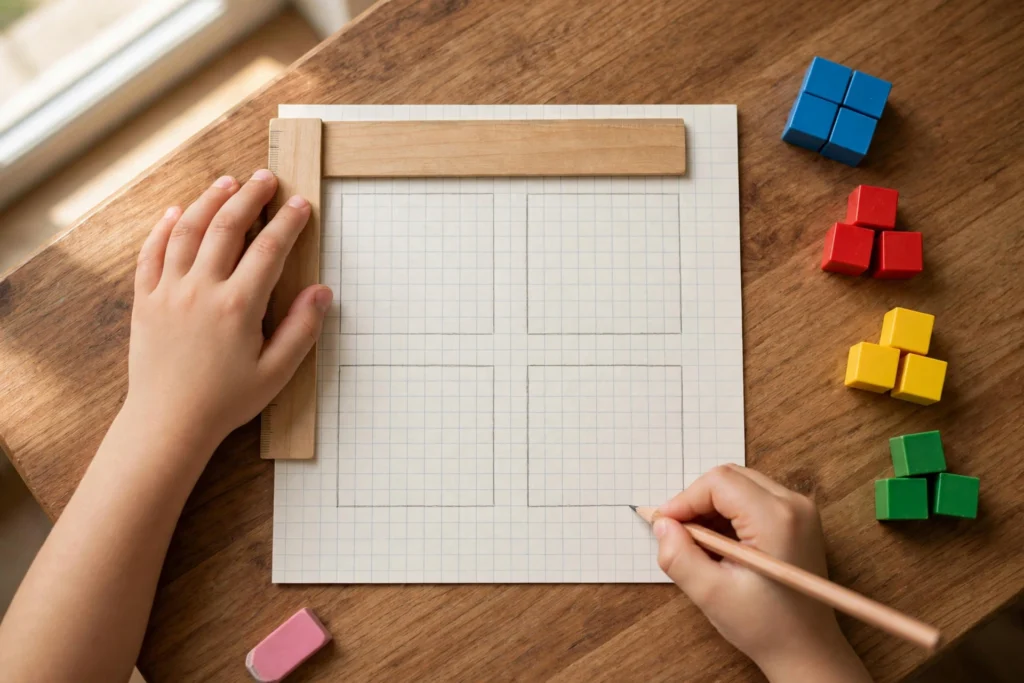
The grid method is a written way to multiply bigger numbers by splitting each number into its place value parts, multiplying the parts inside a grid of boxes, then adding all the boxes together. Instead of one hard calculation, you get several small ones you already know how to do.
How Do You Use the Grid Method? A Worked Example With 23 × 14
Let us work through 23 × 14 slowly. A parent looks at the homework and thinks, that is not how I learned it. The grid usually wins people over, because every step is visible.
Step 1: Partition both numbers. Partitioning means splitting a number into its place value parts. Split 23 into 20 and 3. Split 14 into 10 and 4. Those four parts are all you will multiply.
Step 2: Draw the grid and label it. Write 20 and 3 across the top, and 10 and 4 down the side. Two columns and two rows make four boxes.
| × | 20 | 3 |
|---|---|---|
| 10 | 200 | 30 |
| 4 | 80 | 12 |
Step 3: Fill in each box. Every box answers one small multiplication. Top left: 20 × 10 = 200. Top right: 3 × 10 = 30. Bottom left: 20 × 4 = 80. Bottom right: 3 × 4 = 12.
Step 4: Add the boxes. Add the four answers: 200 + 30 + 80 + 12 = 322. So 23 × 14 = 322. That is the whole method. Partition, draw, multiply each box, then add.
How Do You Multiply a 2-Digit Number by a 1-Digit Number?
Younger pupils meet a smaller grid first, with only one row. Try 47 × 6. Partition 47 into 40 and 7, then put 6 down the side.
| × | 40 | 7 |
|---|---|---|
| 6 | 240 | 42 |
The two boxes give 40 × 6 = 240 and 7 × 6 = 42. Add them: 240 + 42 = 282. So 47 × 6 = 282. A number such as 216 splits into 200, 10 and 6, making three columns.
Why Do Schools Teach the Grid Method?
The grid method teaches what multiplication really does, not just a set of steps. When a child writes 20 × 10 = 200, the place value is out in the open. The 2 in 23 was never just a 2. It was 2 tens all along, and the grid makes that impossible to miss.
It also builds a bridge to later methods. Draw the grid to scale and you have the area model, where each box is part of one big rectangle. Later still, the same layout returns in algebra when pupils multiply pairs of brackets. A child who trusts the grid already knows why there are four products to add.
And if an answer goes wrong, the grid shows exactly which box went wrong. Anyone can point at that box and fix one small fact, instead of redoing a whole page.
What Are the Most Common Grid Method Mistakes?
Most grid errors are small and fixable. These are the ones teachers see again and again.
- Partitioning slips. A child splits 47 into 40 and 7, then writes 4 and 7 on the grid. The tens part must stay 40, because the 4 in 47 means 4 tens.
- A missing box. A 2-digit by 2-digit grid needs four boxes and four products. Three filled boxes means part of the answer is missing.
- Place value slips with zeros. For 20 × 10, some children write 20 or 2000. Check it: 2 × 1 = 2, with two zeros across the parts, so the answer is 200.
- Adding the wrong things. The final step adds the products inside the boxes, not the parts around the edge. Adding 20 + 3 + 10 + 4 gives 37, nowhere near the answer.
- Rushing the final add. Perfect multiplication, careless addition. Add the boxes in pairs, row by row.
Try It: Build a Grid With Paper Strips

You will need four long strips of paper, tape, and a handful of counters, coins, or dried pasta. Lay two strips across a table and two down, so they cross and make four sections, like a giant grid.
Pick a calculation together, such as 13 × 12. Talk about what each section stands for before counting anything: 10 × 10, 3 × 10, 10 × 2, and 3 × 2. Place counters in one section at a time and write each total on a sticky note.
Finish by adding the four sticky note totals: 100 + 30 + 20 + 6 = 156. Then let your child choose the next calculation and teach it back to you. Teaching it back is where the learning sticks.
Printable Practice
The free Grid Method worksheet gives graded practice on two pages, with an answer key on the final page. It starts gently with 2-digit by 1-digit grids, such as 24 × 3, then moves on to 2-digit by 2-digit grids, such as 25 × 13, and finishes with a word problem about chairs in a hall. Every grid is left empty, so children find the part products themselves.
Quick Practice
Question 1: Work out 18 × 4 with a grid.
Answer 1: Partition 18 into 10 and 8. The boxes are 40 and 32, and 40 + 32 = 72. So 18 × 4 = 72.
Question 2: Work out 125 × 3 with a grid.
Answer 2: Partition 125 into 100, 20 and 5. The boxes are 300, 60 and 15, and 300 + 60 + 15 = 375. So 125 × 3 = 375.
Question 3: Work out 32 × 15 with a grid.
Answer 3: The boxes are 300, 150, 20 and 10. Add them: 300 + 150 + 20 + 10 = 480. So 32 × 15 = 480.
Question 4: A hall has 16 rows of 14 chairs. How many chairs are there in total?
Answer 4: The boxes are 100, 40, 60 and 24. Add them: 100 + 40 + 60 + 24 = 224 chairs.
Related Terms
Multiplication, Area Model, Partitioning, Times Tables
Frequently Asked Questions
Is the grid method the same as the box method?
Yes. They are two names for the same approach. Both partition the numbers, multiply the parts inside boxes, and add the products. Schools simply use different names.
When do children learn the grid method in KS2?
Usually in Year 3, starting with a 2-digit number times a 1-digit number. In Year 4 and Year 5 the grids grow to 3-digit by 1-digit and 2-digit by 2-digit work.
Is the grid method the same as the area model?
They are close cousins. Both split a multiplication into part products in a rectangle. In the area model the boxes are drawn to scale, so bigger products get bigger boxes. Grid boxes stay the same size.
What is the difference between the grid method and column multiplication?
Column multiplication compresses the same part products into a tight vertical layout, with carrying. The grid method spreads the products out so each one stays visible, which is why many children learn it first.
Can the grid method work with bigger numbers and decimals?
Yes. Add a column for each extra place value part, so a 3-digit by 2-digit calculation uses six boxes. Decimals work the same way once a child partitions them into whole numbers, tenths and hundredths.
Every topic clicks faster with practice. Our Resource Library has free lesson packs with slides, printable worksheets and full answer keys, ready to download and teach.
Members unlock every lesson in the library, including the full Fractions, Multiplication, Place Value, Addition & Subtraction, Time & Money and Geometry & Shapes units. See the full library


