
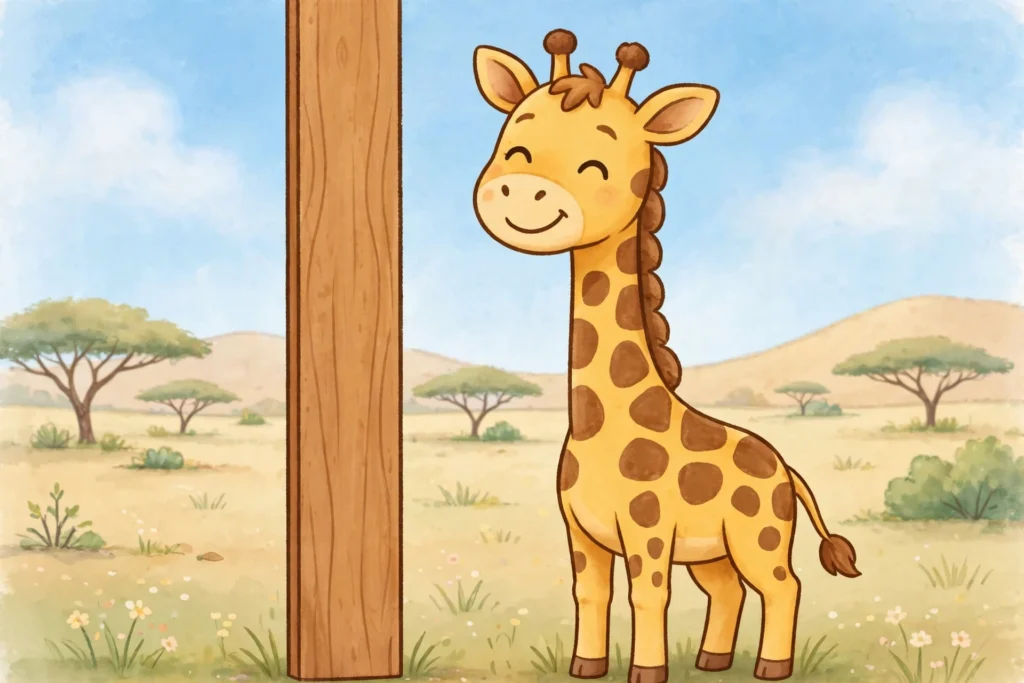
Height is the measure of how tall something is, from its bottom to its top.
What Does Height Mean in Math?
When math talks about height, it means the vertical distance between the lowest point and the highest point of an object. Stand a book upright on a desk and its height is the distance from the desk to the top edge of the book. Lay the same book flat and its height shrinks to the thickness of the pages, because height always runs from bottom to top.
This bottom-to-top idea shows up everywhere. A person’s height runs from the soles of the feet to the top of the head. A building’s height runs from the ground to the roof. A mountain’s height runs from sea level to its peak. In each case, you pick the lowest point, pick the highest point, and measure the space between them.
What Is the Difference Between Height, Length, and Width?
These three words describe the three directions you can measure, and mixing them up is one of the most common slip-ups in measurement lessons. Length tells how long something is from end to end. Width tells how wide it is from side to side. Height tells how tall it is from bottom to top.
Picture a shoebox. Its length is the long side running left to right. Its width is the shorter side running front to back. Its height is the distance from the table up to the lid. Turn the box on its end and the measurements trade jobs: what was the length might become the height. That is fine, because these words describe directions, not fixed sides.
Common Mistake: Kids often call every measurement “length.” If a student says a flagpole has a length of 20 feet, gently ask which direction the 20 feet runs. Bottom to top means it is the height, even if the word “length” slipped out first.
How Do You Measure Height?
Start with the right tool. Short heights, like a pencil or a book, are easy to measure with a ruler in inches or centimeters. Taller objects, like a door or a child, call for a tape measure or a yardstick in feet or meters. For the tallest things, like trees and buildings, people estimate with shadows, photographs, or special tools.
The steps stay the same no matter the size. Place the zero mark of your tool at the bottom of the object. Keep the tool straight up and down, not tilted. Read the number where the top of the object lines up. A tilted ruler gives a tilted answer, so standing it straight is the secret to an honest measurement.
What Units Are Used to Measure Height?
In the United States, height is usually measured in inches, feet, and yards. There are 12 inches in 1 foot and 3 feet in 1 yard. A newborn baby might be 20 inches tall, a second grader about 4 feet tall, and a basketball hoop 10 feet off the ground.
Most of the rest of the world uses the metric system: centimeters and meters. There are 100 centimeters in 1 meter. A door is about 2 meters tall, and a pencil is about 15 centimeters long. Math class gives students practice with both systems so they can read measurements wherever they meet them.
What Is the Height of a Triangle?
In geometry, height takes on a special job. The height of a triangle is the straight-line distance from the base up to the opposite corner, measured square to the base, not slanted. Older students use it to find the area of a triangle: multiply the base by the height and take half.
Solids use height too. A prism’s height is the distance between its two bases, and its volume equals the area of the base times the height. A pyramid’s height runs from the pointed top straight down to the base. Same word, same bottom-to-top idea, just applied to fancier shapes.
Try It: Height Hunt

Hand each pair of students a tape measure or a strip of adding-machine paper marked in inches. Their mission: hunt down five objects, measure each one’s height, and record the results.
- Find five objects around the room: a book, a chair, a desk, a door, and one free choice.
- Measure the height of each object from its bottom to its top, keeping the tape straight up and down.
- Write each object and its height on a recording sheet.
- Order the five objects from shortest to tallest and lay the sheets on the floor in that order.
- Compare with another pair. Did you both put the objects in the same order? If not, measure again together and settle it like scientists.
This activity takes about fifteen minutes and gets the whole class moving. For a follow-up, ask students to predict which object is tallest before measuring, then check their predictions.
Quick Practice
A bookshelf is 4 feet tall and a desk is 3 feet tall. How much taller is the bookshelf than the desk? Subtract the shorter height from the taller one: 4 – 3 = 1. The bookshelf is 1 foot taller than the desk.
Related Terms
- Length – the end-to-end measurement of an object
- Inches – a small unit often used to measure height
- Width – the side-to-side measurement of an object
Frequently Asked Questions
Is height always vertical?
In everyday measuring, yes. Height runs from bottom to top. In geometry, height can also mean the perpendicular distance from a base to the opposite point, which is the “straight up” direction for that shape even if the shape is tilted on the page.
Can a flat shape have a height?
A flat shape drawn on paper has length and width, and we usually do not say it has height. But triangles are the friendly exception: geometry gives every triangle a height, measured square to its base, because that measurement is needed to find the area.
What is the difference between height and altitude?
In elementary math they mean nearly the same thing: how high something is. Pilots and geographers use “altitude” for height above sea level or above the ground. In math class, “height” is the word you will see.
Why does height matter in math?
Height shows up in area and volume formulas, in graphs, and in real-world problem solving, from building furniture that fits through a door to designing playground equipment that is safe. Learning to measure it well is a skill students use for life.
Reading about it is one thing, practising it is another. Our free Measuring Length lesson builds the idea step by step, with slides, a printable worksheet and a full answer key.
Members unlock every lesson in the library, including the full Fractions, Multiplication, Place Value, Addition & Subtraction, Time & Money and Geometry & Shapes units. See the full library


