
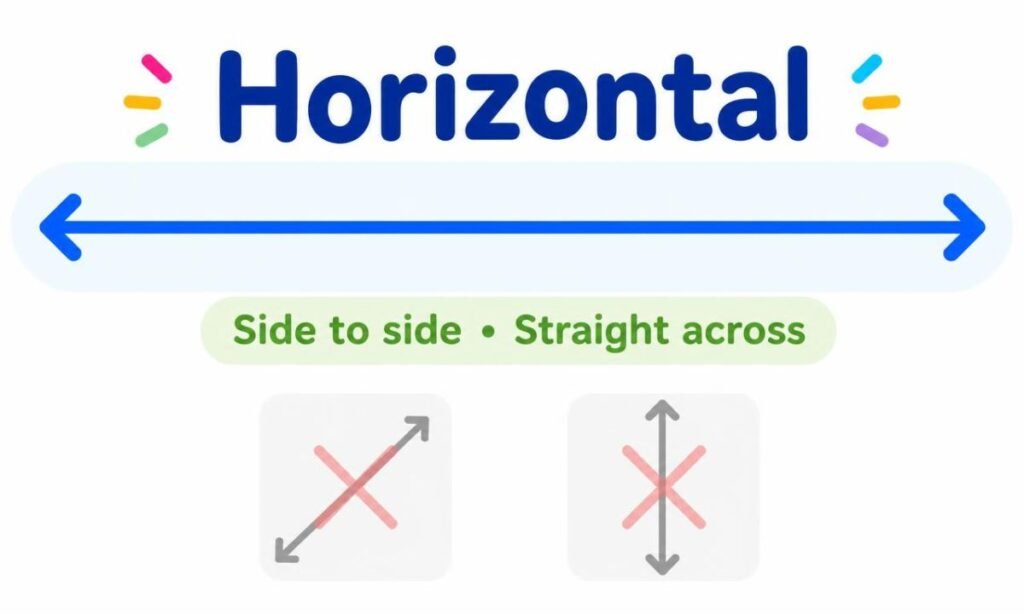
Horizontal means side to side or straight across. A horizontal line does not slant up or down.
Think about the horizon. When you look far away, the place where the sky seems to meet the land stretches across from side to side. That is where the word horizontal comes from.
A horizontal line may point from left to right or from right to left. The important idea is its position. It does not have to be moving.
Plain Text
Horizontal: ←────────→
How Can You Recognize a Horizontal Line?
Use this quick check:
1.Does the line go across from side to side?
2.Does it stay level instead of leaning up or down?
3.Does it look parallel to the horizon?
If the answer is yes, the line is horizontal.
You can find horizontal examples in many places:
•The top edge of a desk
•A shelf
•The edge of a whiteboard
•A row of blocks placed side by side
•A line drawn across a piece of paper
•The horizon in a landscape picture
A horizontal object can be still. For example, a shelf is horizontal even when nothing is moving on it.
Horizontal, Vertical, and Diagonal
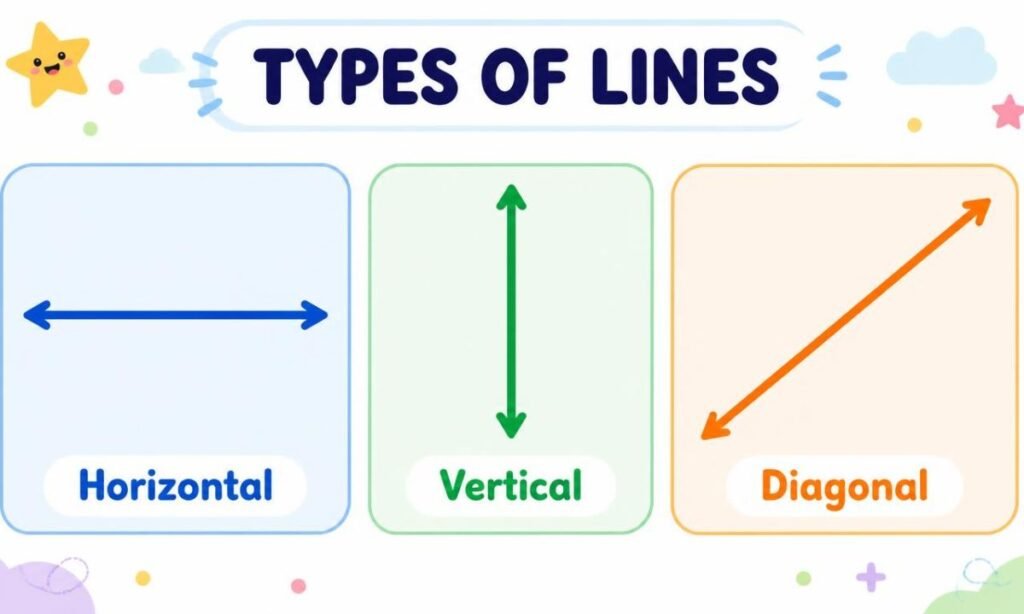
Horizontal, vertical, and diagonal describe three different directions.
| Direction | What it does | Everyday example |
| Horizontal | Goes side to side | The edge of a table |
| Vertical | Goes up and down | A door frame |
| Diagonal | Slants between directions | A line from one corner of a square to another |
Here is a simple visual comparison:
Plain Text
Horizontal: ───────── Vertical: │ │ Diagonal: /
Horizontal and vertical lines meet to form a right angle when they cross. A right angle measures 90 degrees. A diagonal line does not stay level or upright because it slants.
Horizontal in Shapes and Everyday Math
Horizontal helps us describe parts of shapes. A rectangle has a top side and a bottom side that are horizontal when the rectangle is drawn in the usual position. A square also has horizontal top and bottom sides in that position.
Some triangles have a horizontal base. A line segment inside a drawing may also be horizontal. The word describes the direction of the side or segment, not the name of the shape itself.
Horizontal and vertical also help us describe where objects are arranged. For example, a row of three counters is arranged horizontally when the counters sit side by side. A stack of three counters is arranged vertically when the counters sit one above another.
Horizontal on a Number Line and Graph
A number line is often drawn horizontally:
Plain Text
0 ─── 1 ─── 2 ─── 3 ─── 4
This drawing helps show that the numbers are ordered from left to right. The number line is horizontal in this picture, but the main purpose of a number line is to show numbers and the distances between them.
Older elementary students also see horizontal in a coordinate plane. The x-axis usually runs horizontally, while the y-axis usually runs vertically.
Plain Text
y ↑ │ ──────────┼──────────→ x │ │
When students graph points, the horizontal direction helps them move left or right from the origin. This connects the everyday meaning of horizontal with coordinate geometry.
Try This Horizontal Direction Activity
Horizontal Hunt
Ask a child to find three objects in a room that have a horizontal edge or position. A table, windowsill, and shelf might work.
Next, ask the child to find one vertical object and one diagonal object. A door frame might be vertical, while the slanted side of a book stand might be diagonal.
Have the child draw one example of each direction. For every drawing, ask:
How do you know this is horizontal, vertical, or diagonal?
The child should explain the answer using words such as side to side, up and down, or slanted.
For a second activity, draw several lines with different directions. Have the child sort them into three groups: horizontal, vertical, and diagonal.
Common Mistake: Horizontal Does Not Mean “Moving Left”
A horizontal line does not have to move from left to right. It can point in either direction, and it can remain still.
For example, the top edge of a book is horizontal when the book is lying flat. The book does not need to move. Its edge is horizontal because it runs straight across.
A number line is often drawn horizontally, but a number line can be turned on a page and still represent numbers. Its direction on the page is not what gives the numbers their meaning.
Quick Practice
A drawing shows three lines:
1.A line across the top of a rectangle
2.A line from the bottom-left corner to the top-right corner
3.A line running from the top of the rectangle to the bottom
Which line is horizontal? How do you know?
Answer: The line across the top of the rectangle is horizontal because it runs side to side without slanting.
Frequently Asked Questions About Horizontal
Is horizontal up and down?
No. Horizontal means side to side or straight across. Vertical means up and down.
Is a horizontal line always pointing to the right?
No. A horizontal line can point left or right. Its position is horizontal as long as it runs straight across without slanting.
Is the x-axis horizontal?
Usually, yes. In the standard coordinate-plane drawing, the x-axis runs horizontally and the y-axis runs vertically.
What is the opposite of horizontal?
Vertical is the opposite orientation. Diagonal is a different direction because it slants.
Can a shape have a horizontal line of symmetry?
Yes. If the top and bottom parts of a shape match when the shape is folded across a horizontal line, that line is a horizontal line of symmetry.