
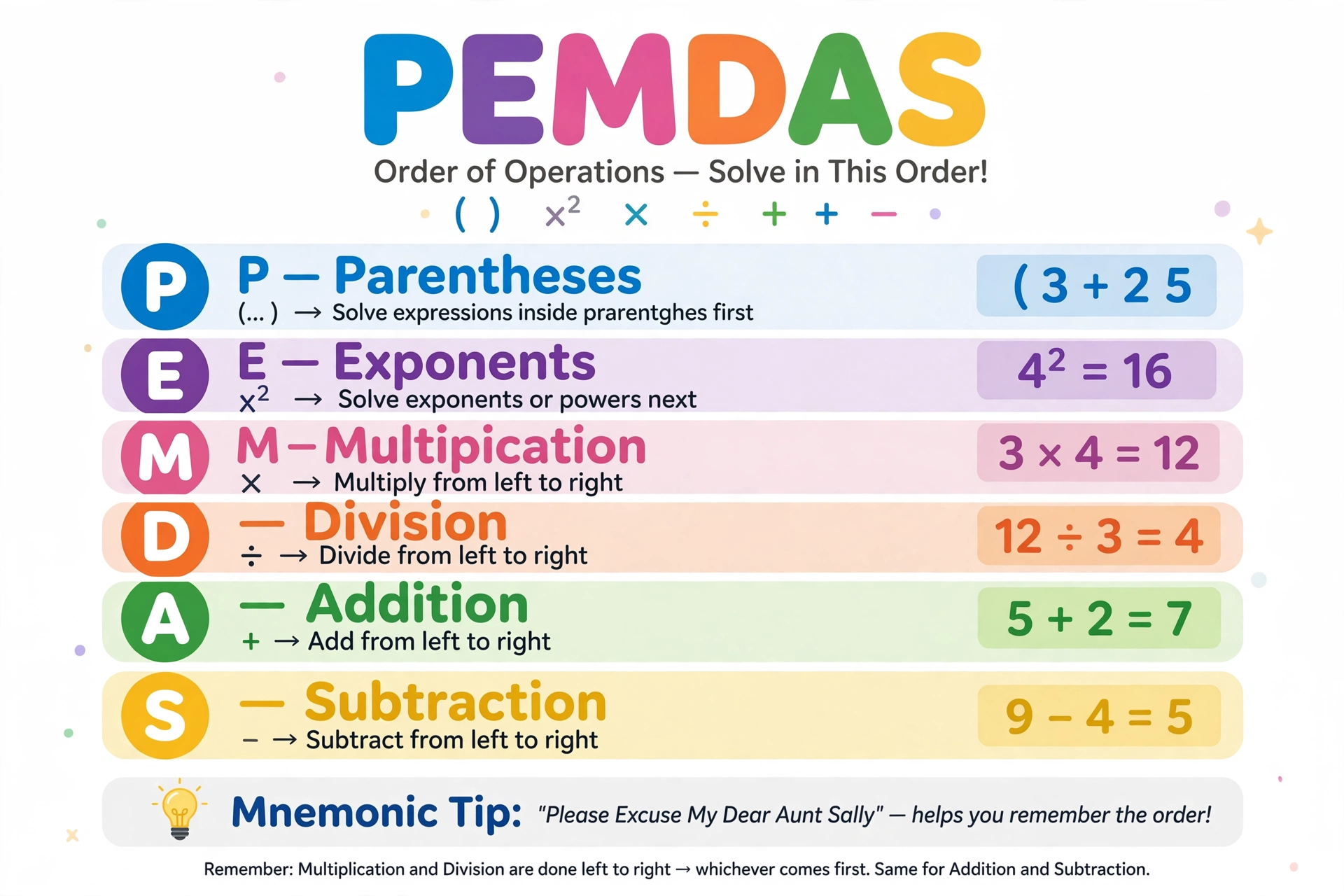
What is 3 + 4 × 2? If you add first, you get 14. If you multiply first, you get 11. Which is correct? Eleven. The order of operations tells us to multiply before adding. Without agreed rules, math would be chaos.
What Is the Order of Operations?
The order of operations is the agreed sequence for evaluating expressions: Parentheses, Exponents, Multiplication and Division (left to right), Addition and Subtraction (left to right). Remember PEMDAS: Please Excuse My Dear Aunt Sally.
These are not arbitrary. They reflect mathematical structure. Multiplication is repeated addition, so it takes precedence. Parentheses override the default because they signal “do this first.”
Why Does Order Matter?
Different orders give different answers. In 3 + 4 × 2, adding first gives (3+4)×2=14. Multiplying first gives 3+(4×2)=11. Only one can be correct. The rules ensure everyone gets the same answer, which is essential for communication.
Real formulas depend on it. The area formula, physics equations, computer programs all assume standard order. Without agreement, shared mathematics would be impossible.
What Are Common Mistakes?
Thinking PEMDAS is strictly sequential: doing all multiplication before any division. Actually, multiplication and division have equal precedence, done left to right. In 12 ÷ 3 × 2, divide first (left to right): 4 × 2 = 8. Not 12 ÷ 6 = 2.
Ignoring parentheses is another error. Students see 2 × (3 + 4) and multiply 2×3 first. The parentheses mean add first: 2 × 7 = 14. Parentheses always win.
Try It: Solve With PEMDAS
Step 1: Write 5 + 2 × 3².
Step 2: Exponents first: 3² = 9. Now 5 + 2 × 9.
Step 3: Multiply: 2 × 9 = 18. Now 5 + 18.
Step 4: Add: 23. Check by doing it wrong (left to right) to see the difference.
Quick Practice
Question: Evaluate 10 – 2 × 3 + 4.
Answer: Multiply first: 2×3=6. Now 10-6+4. Left to right: 4+4=8.
Frequently Asked Questions
Does PEMDAS mean multiply before divide?
No. They have equal precedence, done left to right. Same for addition/subtraction. The acronym is misleading; the left-to-right rule fixes it.
When is order of operations taught?
Typically 5th grade, though simple two-operation expressions appear earlier. Full PEMDAS with exponents is upper elementary.
Why not just use parentheses for everything?
You could, but it would be cluttered. The default order handles common cases; parentheses are for exceptions. It is a balance of clarity and conciseness.