

An oval is a closed 2D shape that looks like a stretched circle or an egg. It is round all the way around, with no straight sides and no corners.
What Is an Oval Shape?
Say the word “oval” out loud and picture an egg. That picture is the definition. The word oval comes from the Latin word “ovum,” which means egg. Any flat shape that looks like the outline of an egg gets called an oval.
Ovals belong to the family of 2D shapes, the flat shapes that have length and width but no thickness. Circles, squares, triangles, and rectangles are its neighbors. The oval stands out because it is completely curved. Run your finger around it and you never hit a straight part or a sharp corner.
Here is an honest math fact: “oval” is an everyday word, not a strict geometry term. Geometers use it loosely for any closed curve that looks like a squashed circle. The precise math name for a stretched circle is an ellipse. In elementary school, “oval” is the word everyone uses, and that is just fine.
What Are the Properties of an Oval?
Every oval shares a short list of traits. First, it is closed. The curve joins up with itself, with no gaps or open ends. Second, it is curved all the way around. There are no straight sides like a square has. Third, it has no vertices, which is the math word for corners. An oval is smooth everywhere.
An oval also has one flat face. When you draw an oval on paper, the whole inside of the curve is its face. And many ovals have a line of symmetry: fold the shape in half and the two halves match. An egg-shaped oval folds neatly along its long middle line.
One more trait helps in shape sorting games. An oval is convex, a fancy way of saying it bulges outward everywhere and never caves in. If you wrap a rubber band around an oval, the band hugs the curve at every point.
What Is the Difference Between an Oval and a Circle?
Circles and ovals look like cousins, and they are, but one test separates them. A circle is the same distance from its center to its edge in every direction. Every radius of a circle is equal. An oval breaks that rule. It is longer in one direction than the other, so its distance from center to edge changes as you go around.
Try this at circle time. Hold up a paper plate and a paper egg cutout. Spin the plate. It looks the same from every angle. Spin the egg cutout. It looks long, then narrow, then long again. The plate is a circle. The egg cutout is an oval. That spinning test shows the difference better than any definition.
Quick Answer: A circle is perfectly round with every point the same distance from the center. An oval is a stretched circle, longer one way than the other, like an egg. Both are closed 2D shapes with no corners, but only the circle is perfectly round.
Is an Oval the Same as an Ellipse?
Not exactly. An ellipse is a precise math shape with a strict rule: for any point on an ellipse, the sum of its distances to two fixed points, called foci, stays the same. That rule gives the ellipse its exact stretched-circle form. Planetary orbits follow ellipses, which is why the word shows up in science books.
An oval is looser. It describes the general egg-like look without the strict rule. All ellipses look like ovals, but not every oval is a perfect ellipse. An egg is a great example: one end is pointier than the other, so it is oval-shaped but not a true ellipse. In elementary math, students can treat the two words as friendly neighbors and learn the strict difference later.
Where Do We See Ovals in Real Life?
Ovals hide in plain sight. Eggs are the classic example, and the word itself points there. Watermelons, footballs, and many leaves have oval outlines. Look at faces: most human faces are oval-shaped, longer than they are wide.
The classroom is full of ovals too. The number zero is often written as an oval. Clock faces are usually circles, but many mirrors and picture frames are ovals. Race tracks viewed from above make giant ovals. Once children learn the shape, they start spotting it everywhere, and shape hunts become a favorite warm-up.
Try It: The Egg Hunt
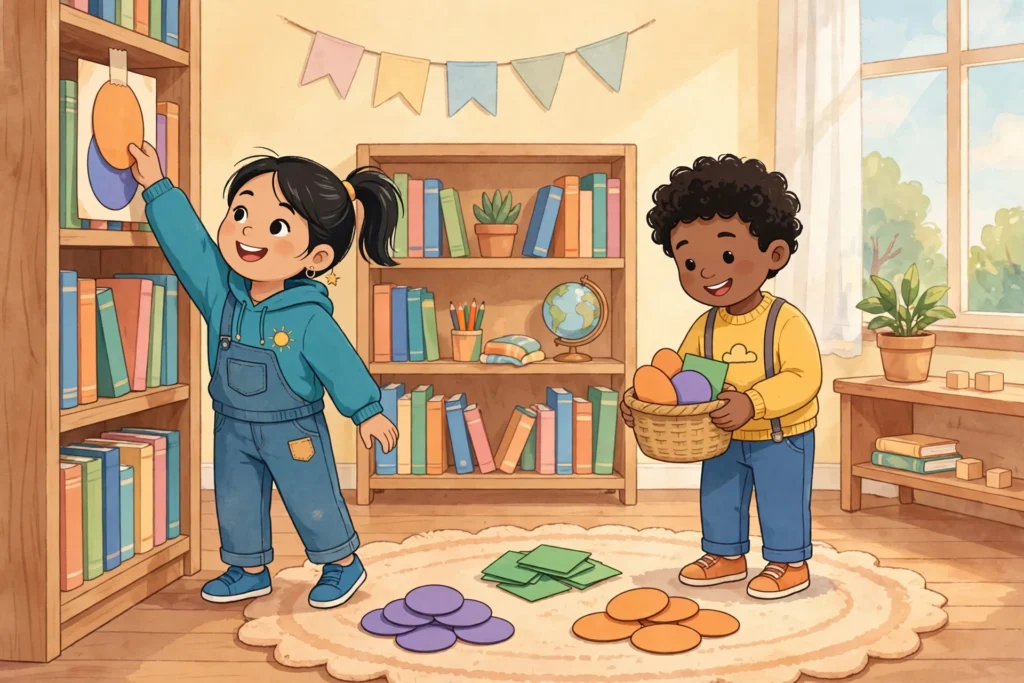
You need paper, scissors, crayons, and tape. This activity takes about 20 minutes and works indoors or on the playground.
Cut out 12 paper ovals in different sizes and colors. Also cut out 6 non-ovals: circles, squares, triangles, rectangles, a heart, and a star. Hide all 18 shapes around the room while students close their eyes.
Send the hunters out with one job: bring back only the ovals. When everyone returns, spread the finds on the rug. Sort them together. For each shape, ask the class: is it round all the way around with no straight sides and no corners? If yes, it stays in the oval pile. If no, it moves out.
End with the tricky round: hold up a circle and an oval side by side. Ask which is which and how they know. The answer you want names the stretch: the oval is longer one way, like an egg, while the circle is the same all around. Tape the oval pile into a class collage titled with the shape’s name.
Quick Practice
Which of these is an oval: a shape with four straight sides, a shape like a stretched circle, or a shape with three corners?
The stretched circle is the oval. The four-sided shape is a quadrilateral, like a square or rectangle. The three-cornered shape is a triangle. Only the stretched circle is curved all around with no straight sides and no corners.
Frequently Asked Questions
What is an oval in simple words?
An oval is a flat shape that looks like an egg or a stretched circle. It is round all the way around with no straight sides and no corners.
Does an oval have any sides or corners?
No. An oval has no straight sides and no corners, which mathematicians call vertices. Its edge is one smooth, continuous curve.
What is the difference between an oval and an ellipse?
An ellipse is a precise math shape with a strict distance rule. An oval is the everyday word for anything egg-shaped or like a stretched circle. All ellipses look like ovals, but not all ovals are perfect ellipses.
Where does the word “oval” come from?
It comes from the Latin word “ovum,” which means egg. The shape is named for the egg because an egg’s outline is the most familiar oval in nature.
Reading about it is one thing, practising it is another. Our free What Are 2D Shapes? lesson builds the idea step by step, with slides, a printable worksheet and a full answer key.
Members unlock every lesson in the library, including the full Fractions, Multiplication, Place Value, Addition & Subtraction, Time & Money and Geometry & Shapes units. See the full library


