
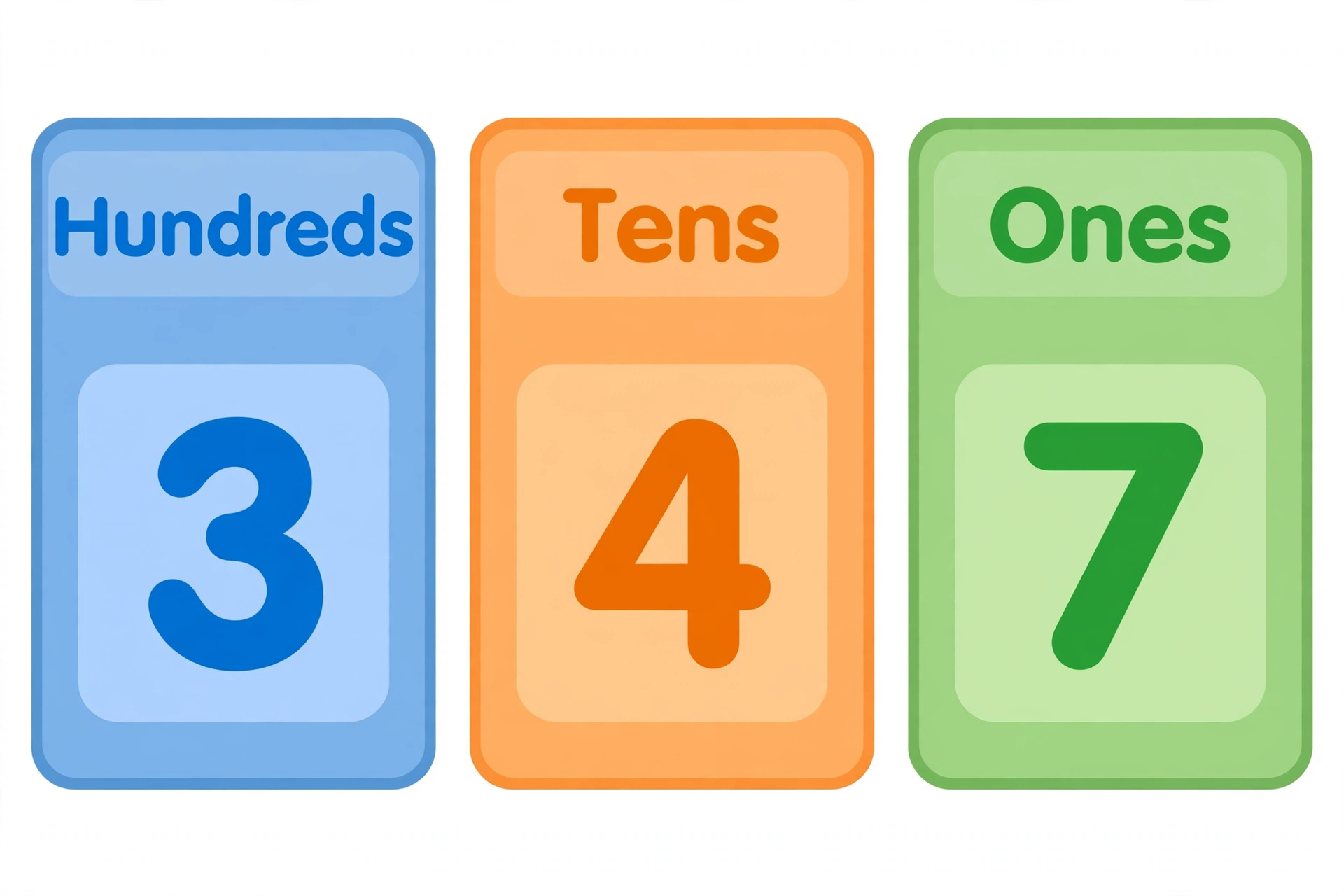
Write 347. Now write 743. Same digits, completely different numbers. What changed? Only the positions. That is place value: the system where a digit’s location determines its worth. The 4 in 347 means forty. The 4 in 743 means four hundred. Position is everything.
What Is Place Value?
Place value is the principle that a digit’s value depends on where it sits in a number. In our base-ten system, each position is worth ten times the one to its right. The ones place holds ones. The tens place holds tens. The hundreds place holds hundreds. The pattern continues infinitely in both directions.
This is why 5 can mean five, fifty, or five hundred. The digit never changes. The place changes everything. Students who grasp this understand the logic behind our entire number system.
Why Is Place Value Fundamental?
Every multi-digit operation depends on it. Adding 245 and 38 requires aligning by place value: ones with ones, tens with tens. Without this understanding, students line up digits from the left and get nonsense answers. Place value is the grammar of arithmetic.
It also enables estimation and mental math. A student who knows that 347 is 3 hundreds, 4 tens, and 7 ones can quickly see it is close to 350. They can break it apart, round it, compare it. Place value turns numbers from mysterious symbols into transparent quantities.
How Do You Teach Place Value?
Start concrete. Use base-ten blocks to build numbers: 2 flats, 4 rods, 7 cubes for 247. Students see and feel the different values. Then connect to the written form: “We built 2 hundreds, 4 tens, 7 ones. We write 247.”
Use place value mats with columns labeled Hundreds, Tens, Ones. Students place digit cards in the columns to build numbers. Moving a 5 from the ones column to the tens column changes 5 to 50. The physical move makes the abstract idea visible.
Ask “what is it worth” constantly. Point to the 6 in sixty-four and ask. Point to the 6 in sixty and ask. The repeated question trains students to see value, not just digits.
What Mistakes Reveal Confusion?
Writing 307 as 37 is classic. Students hear “three hundred seven” and write the digits they hear, omitting the zero. They do not yet understand that the tens place must be marked even when empty. The zero is not nothing. It is a placeholder holding the position.
Reading 45 as “forty-five” but thinking the 4 means four shows digit-focused thinking. Ask “How many tens?” If they cannot answer, they need more work with blocks and trading. The goal is to see 45 as 4 tens and 5 ones, not as the digits 4 and 5.
Try It: Build Numbers With Place Value Cards
Step 1: Set up. Give each student a place value mat (Hundreds, Tens, Ones columns) and digit cards 0-9.
Step 2: Build. Call out “Build 352.” Students place 3 in hundreds, 5 in tens, 2 in ones.
Step 3: Change one digit. “Move the 5 to the ones place.” Now it is 325. What changed? What stayed the same?
Step 4: Challenge. “Build the largest 3-digit number. Build the smallest. Build a number with 0 tens.”
Quick Practice
Question: In the number 5,280, what is the value of the 2? What is the value of the 8?
Answer: The 2 is in the hundreds place, so it is worth 200. The 8 is in the tens place, so it is worth 80.
Frequently Asked Questions
When is place value taught?
Tens and ones in first grade, hundreds in second, thousands in third. The concept deepens each year as numbers get larger and decimals are introduced.
Why do students struggle with zeros in place value?
Zero as a placeholder is abstract. Students see “nothing” and want to skip it. Physical mats where they must place a 0 card in the empty column help make the placeholder concrete.
How does place value connect to decimals?
The pattern continues to the right: tenths, hundredths, thousandths. Each is one-tenth the place to its left. Students who understand whole-number place value transfer the pattern easily.