
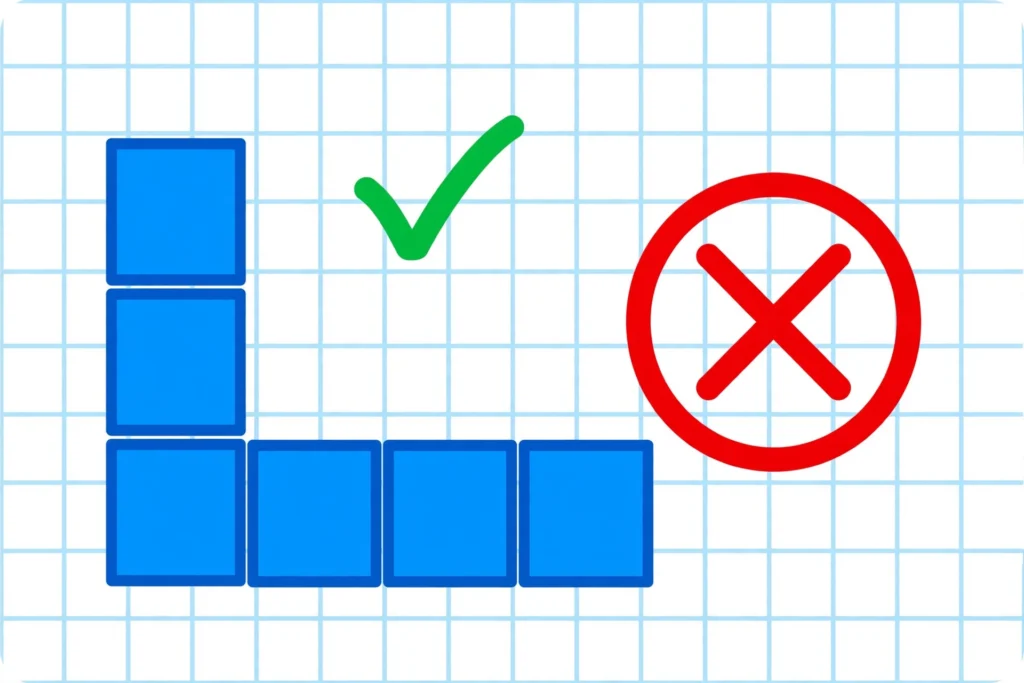
A rectilinear figure is a flat shape whose edges are all straight line segments. If every edge is straight and none of them curve, the figure is rectilinear.
What Makes a Figure Rectilinear?
The name gives the whole game away. “Recti” means straight and “linear” means line, so rectilinear means made of straight lines. Grab a ruler and trace the edge of any shape. If your ruler can sit flat against every single edge, the shape is rectilinear. If any edge bends away from the ruler, the shape is not.
Squares, rectangles, and triangles all pass the ruler test, so they are rectilinear figures. So are stars, arrows, and zigzag shapes, as long as their edges are straight. A circle fails the test because its edge curves the whole way around. An oval fails too, and so does any shape with even one curved side.
A rectilinear figure can be open or closed. An open one might look like a zigzag line that never connects back to its start. A closed one loops all the way around and encloses a space. When a rectilinear figure is closed, it has a special name: a polygon. That means every polygon is a rectilinear figure, but not every rectilinear figure is a polygon.
Is a Circle a Rectilinear Figure?
No, and this is one of the most common mix-ups in class. A circle has no straight edges at all. Its boundary is one smooth curve, so it fails the ruler test completely. The same goes for a semicircle, an ellipse, and any shape with a rounded corner.
Here is a sorting game I play with my students. I hold up shape cards one at a time, and the class gives a thumbs up for rectilinear or a thumbs down for not. The tricky cards are the ones that look straight at first glance: a heart (curved top), a shape with one rounded corner, a half circle. Students learn fast that a single curve is enough to knock a shape out of the rectilinear club.
What Is the Difference Between a Rectilinear Figure and a Polygon?
Think of it like rectangles and squares. Every square is a rectangle, but not every rectangle is a square. In the same way, every polygon is a rectilinear figure, but not every rectilinear figure is a polygon. The extra rule for polygons is that the figure must be closed and simple, meaning its edges do not cross over each other.
An open zigzag is rectilinear but not a polygon, because it never closes. A figure-eight made of straight segments is rectilinear but not a polygon, because its edges cross. A triangle, a pentagon, and an L-shape are both rectilinear figures and polygons, because they are closed, flat, and built only from straight segments.
Did You Know: the word rectilinear comes from Latin words that mean “straight line.” Two thousand years ago, Roman builders used the same idea when they laid out streets and fields with straight edges.
How Do You Find the Area of a Rectilinear Figure?
This is where rectilinear figures earn their place in math class. Many of them, like L-shapes and T-shapes, have no single area formula. The trick is to split the shape into rectangles, find each rectangle’s area, and add them up. Mathematicians call this decomposing the figure.
Take an L-shape. Draw one line across the corner of the L to cut it into two rectangles. Measure each rectangle’s length and width, multiply to get each area, and add the two areas together. The total is the area of the whole L-shape. It does not matter where you draw the dividing line, as long as the pieces are rectangles. Every fair split gives the same total area, which is a lovely thing for students to test on their own.
This same strategy shows up in real life. Floor plans are often L-shaped or T-shaped. Garden beds, playgrounds, and building footprints come in rectilinear shapes too. Finding the area of each rectangular part and adding them up is exactly how painters, carpet layers, and landscapers plan their work.
Try It: Build an L-Shape

Hand each pair of students 20 square tiles and a sheet of grid paper. Their mission: build an L-shape using exactly 12 tiles, then trace it onto the grid paper. Once the shape is traced, they draw a line to split it into two rectangles and label each rectangle’s length and width.
Now comes the math. For each rectangle, students multiply length times width to find its area, then add the two areas. The sum should be 12 square units, matching the 12 tiles they started with. If the numbers do not match, something went wrong in the measuring, and the tiles give them a way to check their work.
For the grand finale, ask each pair to split their L-shape a different way and find the area again. One pair might cut the L horizontally and another vertically, but both should land on 12 square units. That moment, when two different splits give the same answer, is when the idea of decomposing truly sticks.
Quick Practice
Question: An L-shaped figure is split into two rectangles. Rectangle A is 5 cm long and 4 cm wide. Rectangle B is 3 cm long and 2 cm wide. What is the total area of the L-shape?
Worked answer: First find the area of each rectangle. Rectangle A: 5 times 4 equals 20 square centimeters. Rectangle B: 3 times 2 equals 6 square centimeters. Add them together: 20 plus 6 equals 26. The total area of the L-shape is 26 square centimeters.
Related Terms
- Decompose: breaking a shape into smaller parts, the key strategy for finding the area of a rectilinear figure.
Frequently Asked Questions
Does a rectilinear figure have to have right angles?
No. Rectilinear only means the edges are straight. A triangle has no right angles in most cases, yet it is still a rectilinear figure. The L-shapes and T-shapes in textbooks have right angles because they split neatly into rectangles.
Can a rectilinear figure be three-dimensional?
No. Rectilinear figures are flat, two-dimensional shapes. Solid objects like cubes and pyramids are described with different words, even though their faces are made of straight edges.
Is a star a rectilinear figure?
Yes, if all of its points are made with straight line segments. A classic five-pointed star drawn with straight strokes passes the ruler test on every edge.
How is a rectilinear figure different from a curvilinear figure?
A rectilinear figure uses only straight edges, while a curvilinear figure includes curved edges. A circle is curvilinear. A shape that mixes straight and curved edges is also curvilinear, because it is not made only of straight segments.
Why do we learn about rectilinear figures?
They are the shapes we use to find area in the real world. Rooms, gardens, and playgrounds are often rectilinear, and splitting them into rectangles is the standard way to measure how much paint, carpet, or grass they need.
Every topic clicks faster with practice. Our Resource Library has free lesson packs with slides, printable worksheets and full answer keys, ready to download and teach.
Members unlock every lesson in the library, including the full Fractions, Multiplication, Place Value, Addition & Subtraction, Time & Money and Geometry & Shapes units. See the full library


