
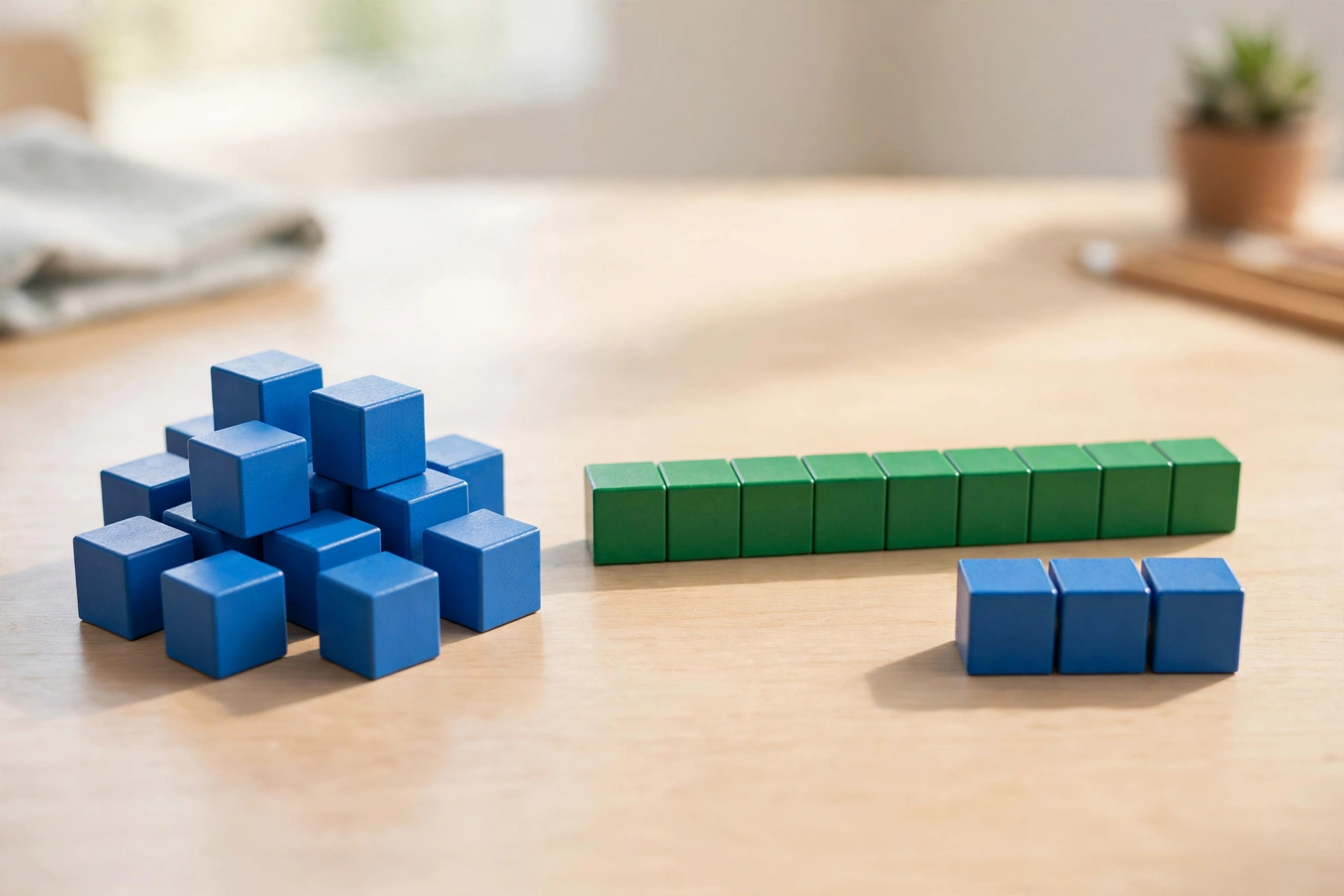
Add 28 and 35. You get 13 ones in the ones place, but a place can only hold 9. What do you do? You trade 10 ones for 1 ten. That trade has a name: regrouping. It is the engine that makes multi-digit arithmetic work.
What Is Regrouping?
Regrouping means changing the form of a number without changing its value, usually by trading between place values. Ten ones become one ten (carrying in addition). One ten becomes ten ones (borrowing in subtraction). The total stays the same; the grouping changes.
Older terms were “carrying” and “borrowing.” Regrouping is more accurate because you are not borrowing (you do not give it back) or carrying (to where?). You are re-grouping: forming new groups of ten. The modern term reflects the actual mathematics.
How Does Regrouping Work in Addition?
Add 47 and 28. In the ones place: 7 plus 8 is 15. But you cannot write 15 in the ones place. So regroup: trade 10 ones for 1 ten. Write 5 in the ones place, add 1 ten to the tens column. Now add tens: 1 plus 4 plus 2 is 7. The answer is 75.
The key insight is that 15 ones equals 1 ten and 5 ones. They are the same amount in different form. Students who see this with blocks (physically trading 10 cubes for a rod) understand why the written steps work, instead of just memorizing them.
How Does Regrouping Work in Subtraction?
Subtract 42 minus 28. In the ones place: 2 minus 8 cannot be done (with whole numbers). So regroup: trade 1 ten for 10 ones. Now you have 12 ones. Twelve minus 8 is 4. In the tens place: 3 tens (after trading one away) minus 2 tens is 1 ten. The answer is 14.
The trade is the same as in addition, just reversed. One ten becomes ten ones. The value does not change: 42 is still 42, just grouped as 3 tens and 12 ones instead of 4 tens and 2 ones. Flexibility in grouping is the whole idea.
What Mistakes Do Students Make?
Forgetting to adjust the tens after regrouping is most common. A student trades 1 ten for 10 ones but forgets to reduce the tens digit. They calculate with the original tens, getting an answer that is 10 too high. Teach them to cross out and rewrite immediately: the trade and the adjustment happen together.
Regrouping when unnecessary is another issue. Students see a subtraction problem and regroup automatically, even when the top digit is larger. They turn 85 minus 23 into a regrouping problem, creating extra work and extra error chances. Teach them to check first: “Do I need to regroup?”
Try It: Regroup With Blocks
Step 1: Build 53. Use 5 ten-rods and 3 ones.
Step 2: Subtract 28. Try to take 8 ones from 3 ones. You cannot. Trade 1 ten for 10 ones.
Step 3: Complete. Now you have 4 tens and 13 ones. Take 8 ones (leaves 5), take 2 tens (leaves 2). Answer: 25.
Step 4: Connect. Show the written work beside the blocks. Each written step matches a physical trade.
Quick Practice
Question: Add 67 and 48. Show where regrouping happens and explain the trade.
Answer: Ones: 7+8=15. Regroup 10 ones as 1 ten. Write 5, carry 1. Tens: 1+6+4=11. Regroup 10 tens as 1 hundred. Answer: 115. Two regroups.
Frequently Asked Questions
Is regrouping the same as carrying?
Yes, “carrying” is the old term for regrouping in addition. “Borrowing” was the old term for subtraction. Regrouping is the modern, more accurate term for both.
When do students learn regrouping?
Addition with regrouping typically in second grade, subtraction with regrouping in second or third. The concept builds on solid place value understanding.
Why do students struggle with regrouping?
Usually because place value is shaky. If they do not see that 1 ten equals 10 ones, the trades seem like magic tricks. Strengthen place value first, then regrouping makes sense.