
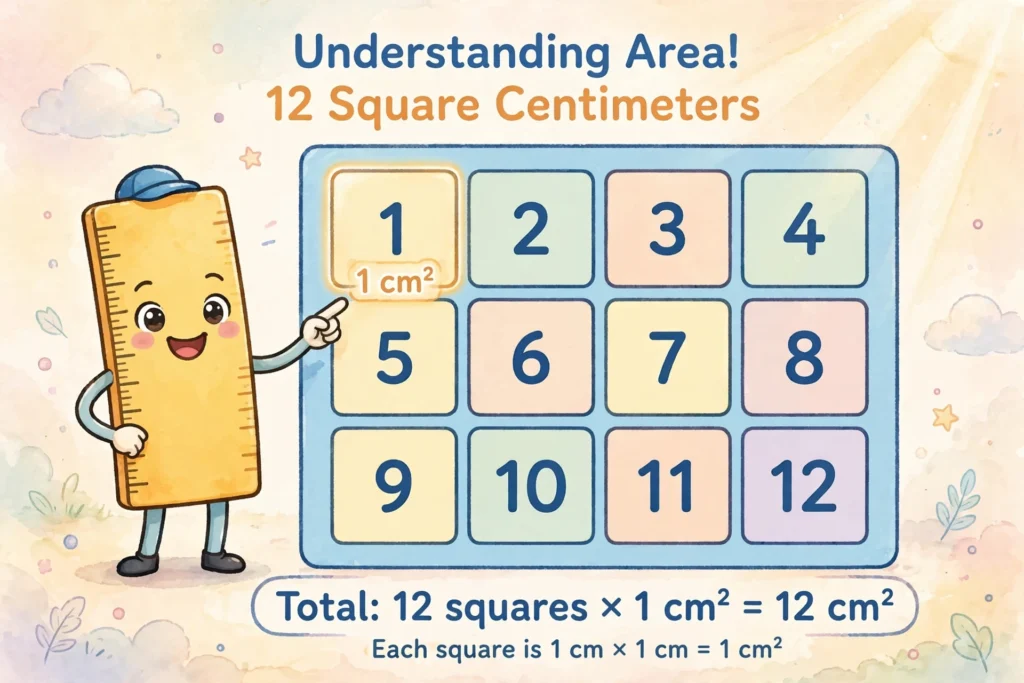
Square units are the units we use to measure area. One square unit is the area of a square whose sides are each one unit long. To find area, you count how many of those little squares fit inside a shape.
What Is a Square Unit?
A square unit is exactly what the name says: a square, used as a unit. Take one unit of length, say one centimeter. Build a square with four sides that are each one centimeter long. The space inside that square is one square centimeter, written 1 cm². It is the measuring tile for area.
Every square unit works the same way. One square inch is a square with one-inch sides. One square foot is a square with one-foot sides. One square meter is a square with one-meter sides. The unit of length decides the size of the square, and the little 2 floating above the unit reminds you that area covers two dimensions at once.
How Do You Count Square Units to Find Area?
Start by tiling. Cover the shape with same-size squares, count the squares, and the total is the area. Mrs. Coleman gives her third graders rectangles drawn on grid paper. The children color each square and number it as they go: 1, 2, 3, all the way to the last one. A rectangle that holds 15 squares has an area of 15 square units.
Counting works for any shape, even curvy or jagged ones. Lay a transparent grid over the shape and count the full squares. Half squares and partial squares get estimated and combined.
Rectangles offer a shortcut. A rectangle that is 4 units long and 3 units wide holds 4 squares across and 3 rows down. Instead of counting one by one, multiply: 4 × 3 = 12 square units. Multiplication is counting in bunches, and area is where that bunching first pays off.
Why Is Area Measured in Square Units?
Length measures one direction, so it uses plain units like inches or meters. Area covers a flat surface, which stretches in two directions: across and down. You need a unit that covers flat space, and a square is the simplest flat tile. It stacks neatly, leaves no gaps, and every side is the same length.
The little 2 in cm² tells the story. It means the unit is used twice, once for each direction. Centimeters times centimeters gives square centimeters. That is why you can never answer an area question with just “12 centimeters.” The units must match the two-dimensional job, or the answer is wrong.
Did You Know: A square foot is about the size of a large floor tile or a square piece of notebook paper folded in half. Builders buy flooring and paint by the square foot because it tells them exactly how much flat surface they must cover.
What Are Examples of Square Units?
Children meet several square units in elementary school. Square inches show up on small crafts and worksheets. Square centimeters appear in science, where rulers are metric. Square feet measure rooms, rugs, and gardens. Square meters handle bigger spaces like classrooms and playgrounds.
The same area can wear different units. A desk might measure 24 square inches or a fraction of a square foot. The number changes, but the amount of surface stays the same. This is why math problems always name the unit. “24” alone means nothing. “24 square inches” tells you exactly how much space the desk covers.
How Are Square Units Different from Regular Units?
Regular units measure length, a one-direction distance. Inches, feet, and meters answer “how long?” or “how tall?” Square units measure area, a two-direction surface. Square inches, square feet, and square meters answer “how much flat space?”
Mixing them up is the most common area mistake in elementary math. A child measures a 5-inch by 4-inch rectangle and answers “20 inches.” The number 20 is right, but the unit is wrong. Twenty inches is a length, like a piece of string. The rectangle covers 20 square inches of surface. Always ask yourself: am I measuring a line or a surface? Lines take plain units. Surfaces take square units.
Try It: Tile the Rectangle

You need paper, scissors, a ruler, and crayons. Cut out at least 30 small squares that are each one inch on every side. These are your square-inch tiles.
First, draw a rectangle that is 5 inches long and 3 inches wide. Lay your tiles inside it in neat rows, with no gaps and no overlaps. Count the tiles as you place them. You should fit exactly 15 tiles. The area of your rectangle is 15 square inches.
Now predict before you tile. Draw a rectangle that is 6 inches long and 4 inches wide. Before placing a single tile, guess how many tiles it will take. Then tile it and count. You should land on 24 square inches. Ask your child or students: do you see a faster way than counting? Six tiles across and four rows down is 6 × 4, which is 24.
Finish with a mystery shape. Draw an L-shape or a blob on paper and tile it as best you can, combining partial tiles into whole ones. The count will not be exact, but it will be close. That is how real surveyors and builders estimate the area of odd shapes, one square unit at a time.
Quick Practice
Question: A rectangle is 7 cm long and 3 cm wide. What is its area, and what are the correct units?
Answer: Multiply 7 × 3 = 21. The area is 21 square centimeters, written 21 cm². The unit is squared because area covers two dimensions.
Related Terms
- Array – rows and columns that show why area equals length times width.
- Length – the one-direction measure that square units are built from.
- Width – the second direction that turns length into area.
- Inches – a unit of length behind the square inch.
Frequently Asked Questions
What does the little 2 mean in cm²?
The little 2, called an exponent, shows that the unit is used in two dimensions. Cm² means centimeters times centimeters. It is a shorthand way of saying “square centimeters.”
Can you measure area without square units?
Not honestly. Every area answer must name the size of the square being counted. Even when people say “the room is 200 square feet,” the square foot is doing the work. Without it, 200 is just a number.
Is a square unit always a perfect square?
By definition, yes. A square unit is always a square with equal sides of one unit. When a shape cannot be tiled perfectly, we estimate partial squares, but the unit itself stays a perfect square.
How big is one square meter?
One square meter is a square with one-meter sides, roughly the size of a small kitchen table top. It holds 10,000 square centimeters, because each side holds 100 centimeters and 100 × 100 = 10,000.
Why do we multiply length times width for area?
Multiplication counts the tiles in bunches. A rectangle with length 4 and width 3 holds 4 tiles in each row and 3 rows. Multiplying 4 × 3 counts all 12 tiles at once instead of one by one.
Reading about it is one thing, practising it is another. Our free What Are 2D Shapes? lesson builds the idea step by step, with slides, a printable worksheet and a full answer key.
Members unlock every lesson in the library, including the full Fractions, Multiplication, Place Value, Addition & Subtraction, Time & Money and Geometry & Shapes units. See the full library


