
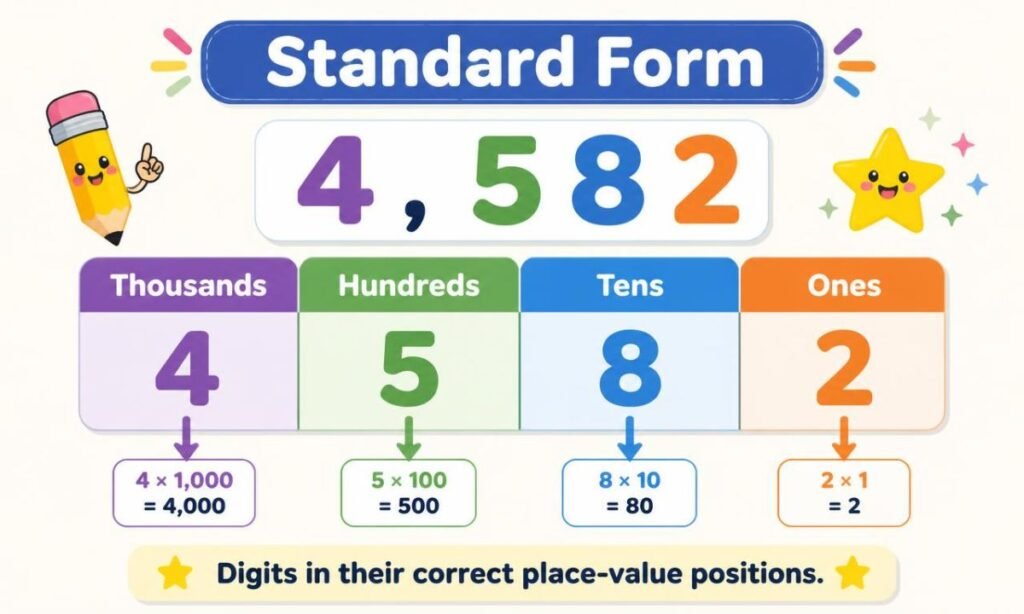
What Is Standard Form?
Standard form is the usual way to write a number using digits in their correct place-value positions.
Examples include:
- 27
- 406
- 1,235
Each digit has a value based on its position. In 406, the 4 means 4 hundreds, the 0 means 0 tens, and the 6 means 6 ones.
Standard form helps us write numbers quickly and clearly. It is the form you see when you read a price, count objects, record a score, or write a measurement.
This article uses the US elementary math meaning of standard form. In later math classes, the phrase can mean other things, such as scientific notation or the standard form of an equation.
See How Place Value Builds a Number
Place value tells what each digit is worth. In a base-ten number, each place is worth ten times as much as the place to its right.
Look at 406:
| Hundreds | Tens | Ones |
|---|---|---|
| 4 | 0 | 6 |
The number has:
- 4 hundreds, or 400
- 0 tens, or 0
- 6 ones, or 6
So:
406 = 400 + 0 + 6
The zero is important. It shows that there are no tens and keeps the 6 in the ones place. Without the zero, 46 would mean 4 tens and 6 ones. That is a different number.
Standard Form, Expanded Form, and Word Form
The same number can be written in several ways. Each form shows the number differently.
| Number form | Example |
|---|---|
| Standard form | 582 |
| Expanded form | 500 + 80 + 2 |
| Word form | five hundred eighty-two |
Standard form uses digits together. Expanded form separates the value of each digit. Word form spells the number with words.
All three examples above name the same amount.
How to Write Standard Form
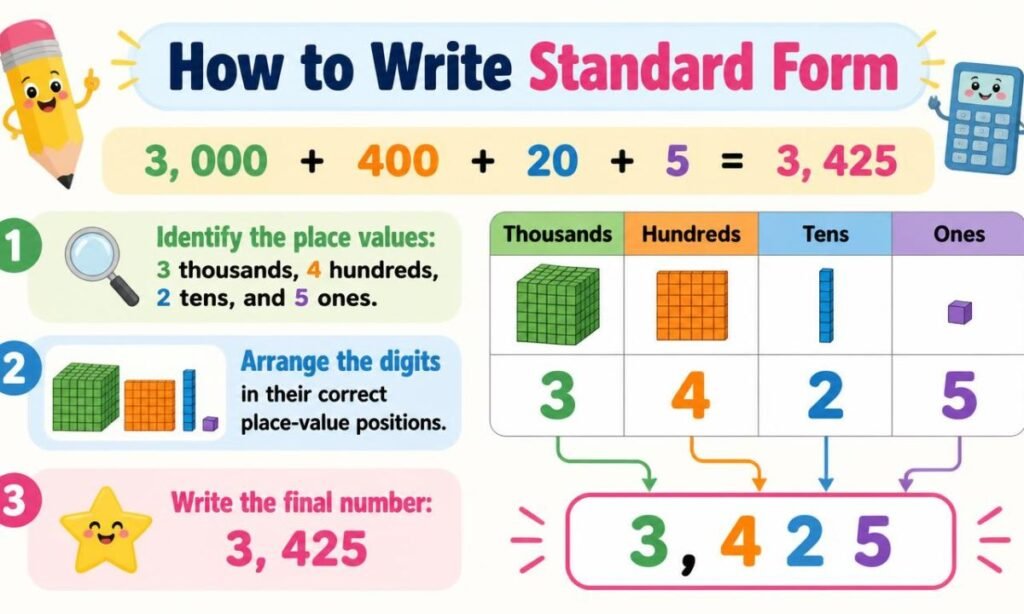
From Expanded Form to Standard Form
To change expanded form into standard form:
- Find the value in each place.
- Write the digits in order from greatest place to smallest place.
- Keep a zero when a place has no value.
Example:
600 + 20 + 9 = 629
The parts are 6 hundreds, 2 tens, and 9 ones, so the standard form is 629.
Now look at an example with an empty place:
700 + 0 + 4 = 704
There are 7 hundreds, no tens, and 4 ones. The zero holds the tens place, so the answer is 704, not 74.
From Word Form to Standard Form
To change word form into standard form, listen for the place-value words.
Example:
three hundred forty-eight
- three hundred means 3 in the hundreds place
- forty means 4 in the tens place
- eight means 8 in the ones place
The standard form is 348.
Now try a number with no tens:
nine hundred two
- nine hundred means 9 in the hundreds place
- no tens are named
- two means 2 in the ones place
The standard form is 902.
The zero is needed because the number has an empty tens place.
A Quick Way to Check Your Answer
You can check a standard-form answer in two ways.
First, read the number aloud. For example, 507 reads “five hundred seven.”
Next, break it apart by place value:
507 = 500 + 0 + 7
The words and the expanded form both match 507, so the answer is correct.
This check helps catch missing zeros and misplaced digits.
Common Mistake: Forgetting a Zero
Students sometimes leave out a zero when a number has no value in one place.
Compare these numbers:
- 405 means 4 hundreds, 0 tens, and 5 ones.
- 450 means 4 hundreds, 5 tens, and 0 ones.
- 455 means 4 hundreds, 5 tens, and 5 ones.
The zero marks an empty place. It also keeps the other digits in the correct positions.
For example:
four hundred five = 405
It is not 45. The number 45 means 4 tens and 5 ones, which is much smaller than 405.
Try These Standard Form Practice Questions
Write each number in standard form.
- 300 + 40 + 8
- six hundred one
- 900 + 0 + 7
- eight hundred sixty-two
Answers
- 348
- 601
- 907
- 862
For an extra check, explain why six hundred one is written 601, not 61. The answer is that the zero holds the tens place. The 6 must stay in the hundreds place, and the 1 must stay in the ones place.
What Does “Standard Form” Mean in Higher Math?
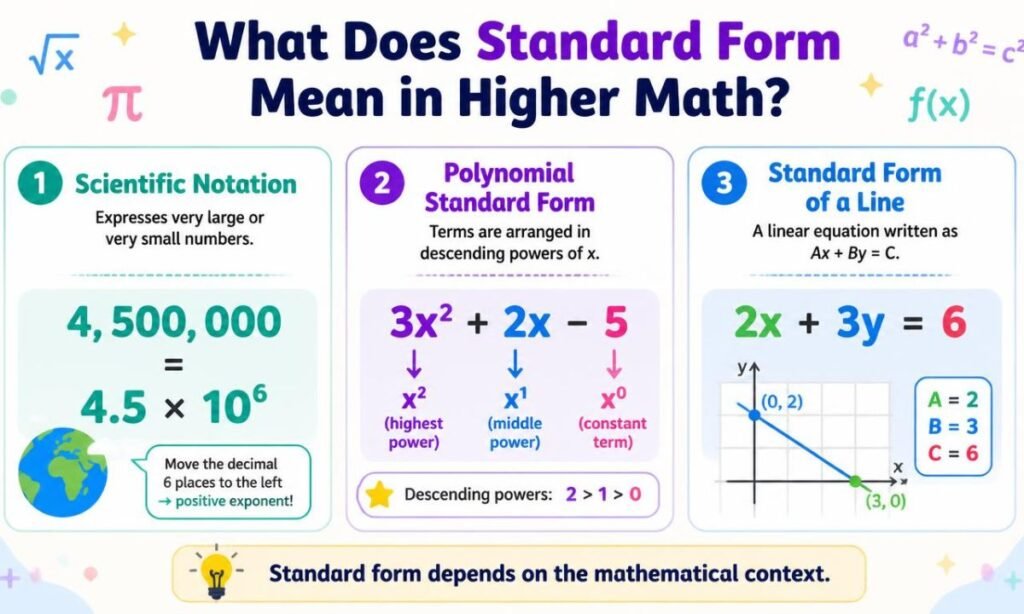
In US elementary math, standard form usually means writing a whole number with ordinary digits. For example, 728 is the standard form of 700 + 20 + 8.
In higher-level math, the phrase can have other meanings. A lesson about scientific notation may use “standard form” for numbers such as 3 × 10⁴. Algebra classes may use “standard form” for a particular type of equation.
Those meanings are different from the elementary place-value meaning. When working with young students, identify the grade level and the number form being discussed.
Frequently Asked Questions
What is standard form in math?
Standard form is the usual way to write a number with digits. For example, 526 is the standard form of 500 + 20 + 6.
What is the difference between standard form and expanded form?
Standard form writes the digits together, as in 734. Expanded form shows the value of each digit, as in 700 + 30 + 4.
Is standard form the same as word form?
No. Standard form uses digits, while word form spells out the number. For example, 218 is standard form, and two hundred eighteen is word form.
Why does a number sometimes need a zero?
A zero shows that a place has no value and keeps the other digits in the correct positions. In 603, the zero means 0 tens.
What is the standard form of 500 + 7?
The standard form is 507. The zero holds the tens place.
Standard form makes numbers easier to read, write, compare, and use. When you place each digit according to its value, even numbers with zeros become clear.