

In math, thick describes an object that takes up a lot of space from one surface to the opposite surface.
What Does Thick Mean in Math?
Thick is a measurement word. When mathematicians say something is thick, they mean the distance from one surface to its opposite is large. A brick is thick. A dictionary is thick. A pancake fresh off the griddle is thick. Each one stretches a good distance from its top to its bottom, or from its front to its back.
Think of thickness as the smallest of an object’s three big measurements. A door has a length (how tall it is), a width (how wide it is), and a thickness (how deep it is from front to back). The thickness of a door is much smaller than its length, but it is still a real measurement that matters. Builders need to know it, movers need to know it, and math students meet it whenever they compare objects.
Quick Answer: In math, thick describes how much space an object takes up from one surface to the opposite surface. More space between the surfaces means thicker. Less space means thinner.
What Is the Difference Between Thick and Thin?
Thick and thin are opposites, like big and small or hot and cold. A thick object has a large distance between its opposite sides. A thin object has a small distance between them. Hold a wooden block in one hand and a sheet of paper in the other, and the difference is obvious before you measure a thing.
Math also gives these words a middle ground. Objects are not just thick or thin. They can be thicker, thickest, thinner, or thinnest. Line up five crayons from the skinniest to the fattest and you can point to the thin one, the thick one, and the thickest of all. Comparing in steps like this is one of the earliest math skills children practice, long before rulers enter the picture.
Mrs. Alvarez, a kindergarten teacher, keeps a “thick or thin” basket on her shelf. It holds a marker, a pencil, a rope, a ribbon, a book, and a postcard. When a new student joins the class, she hands them the basket and asks them to sort it. No numbers, no rulers, just eyes and hands. The sorting takes two minutes and teaches the vocabulary better than any worksheet.
What Are Some Examples of Thick and Thin Objects?
Thick objects are everywhere once you start looking. Books, bricks, walls, mattresses, winter coats, and tree trunks all count as thick. Each one fills a lot of space between its opposite surfaces. A mattress you sink into is thick. A wall that blocks sound is thick.
Thin objects surround them just as often. Sheets of paper, ribbons, threads, leaves, crackers, and credit cards all count as thin. Each one stretches far in length or width but barely rises from its bottom surface to its top. A cracker snaps because it is thin. A thread slides through a needle because it is thin.
The same object can be thick in one direction and thin in another, which is where the thinking gets interesting. A sheet of notebook paper is thin from top to bottom but long from top edge to bottom edge. A jump rope is thin across but long end to end. Asking “thick in which direction?” turns a simple word into a real measurement question.
How Do You Measure Thickness?
Young students start by comparing, not measuring. They hold two objects side by side, stack them, or press them together and decide which is thicker. A stack of ten sheets of paper is thicker than one sheet. A marker laid next to a pencil shows the thicker one instantly. These direct comparisons build the concept before any numbers appear.
Older students measure thickness with real units. Inches and centimeters both work. A picture book might be 2 inches thick. A single sheet of paper is thinner than 1 millimeter, which is why scientists sometimes stack 100 sheets and measure the stack, then divide by 100 to find one sheet’s thickness. That trick turns a measurement too tiny to see into one you can actually read.
Thickness matters in the real world more than kids expect. Carpenters pick thick boards for shelves that must hold weight. Cooks learn that a thick steak needs more time on the grill than a thin one. Engineers design phone screens thin enough to fit in a pocket but thick enough to survive a drop. Every one of those decisions starts with the same math word.
Try It: The Thick and Thin Sort
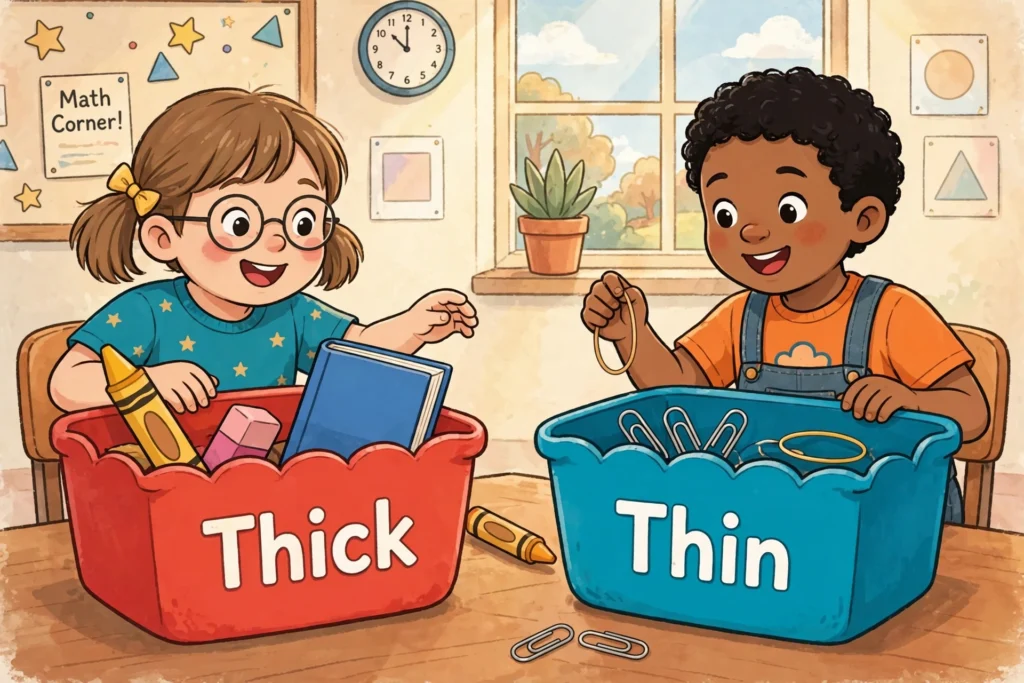
Grab two bins or draw two big circles on paper. Label one “Thick” and the other “Thin.” Now hunt around the room and collect ten small objects: a crayon, an eraser, a paper clip, a book, a ruler, a rubber band, a glue stick, a sheet of paper, a block, and a coin.
Pick up each object and decide which pile it belongs in. Does it take up a lot of space from one side to the other, or barely any? Drop it in the matching bin. When all ten objects are sorted, take the thick pile and arrange it from thinnest to thickest. Do the same with the thin pile. You just ordered two sets, which is the first step toward measuring.
For a challenge round, find the thickest object in the whole classroom and the thinnest. Defend your choices out loud. The debate about whether the class dictionary beats the teacher’s binder is where the math vocabulary locks in for good.
Quick Practice
Question: Sort these four objects into thick and thin: a brick, a sheet of paper, a hardcover book, and a piece of thread. Then name the thickest one.
Worked answer: Thick: the brick and the hardcover book, because both take up a lot of space from one surface to the opposite. Thin: the sheet of paper and the piece of thread, because barely any space sits between their surfaces. The thickest is the brick, since its top-to-bottom distance is larger than the book’s.
Related Terms
- Length: the longest measurement of an object
- Width: how wide an object is from side to side
- Inches: a unit you can use to measure thickness
Frequently Asked Questions
What does thick mean in measurement?
Thick means the distance between an object’s opposite surfaces is large. It answers the question “how much space does this take up from one side to the other?”
What is the opposite of thick in math?
Thin. A thin object has only a small distance between its opposite surfaces, like a sheet of paper or a ribbon.
How is thickness different from length and width?
Length, width, and thickness are three directions you can measure. Length is usually the longest, width goes side to side, and thickness is often the smallest, the distance from front to back or top to bottom of something flat.
Can something be thick and long at the same time?
Yes. A tree trunk is thick across and tall along its length. Thickness and length measure different directions, so an object can be large in both.
Every topic clicks faster with practice. Our Resource Library has free lesson packs with slides, printable worksheets and full answer keys, ready to download and teach.
Members unlock every lesson in the library, including the full Fractions, Multiplication, Place Value, Addition & Subtraction, Time & Money and Geometry & Shapes units. See the full library


