Volume is the amount of space a three-dimensional object takes up. We measure volume by counting how many unit cubes fit inside the object.
How Do You Find the Volume of a Box?
Start with a shoebox and a bag of small cubes, all the same size. Line the bottom of the box with cubes until the floor is covered. Say the box floor holds 4 cubes across and 3 cubes deep. That bottom layer holds 12 cubes.
Now stack a second layer on top, then a third. If the box is 2 cubes tall, you have 2 layers of 12, which is 24 cubes in all. The volume of the box is 24 cubic units. Nothing about this is magic. You counted cubes in one flat layer and multiplied by the number of layers.
That layer idea is the whole secret of volume. Area tells you how many squares cover the bottom. Volume tells you how many cubes fill the box, which is the bottom area times the height. Once you see the layers, the formula makes perfect sense.
What Is Volume Measured In?
Volume is measured in cubic units. A cubic unit is just a tiny cube that is 1 unit long on every edge. When the edge is 1 centimeter, the cube is one cubic centimeter, written cm3. When the edge is 1 inch, it is one cubic inch. A cubic meter is a cube 1 meter on each edge, big enough for a small child to sit inside.
The word cubic always signals three dimensions. Length is one dimension, measured in plain units. Area is two dimensions, measured in square units. Volume is three dimensions, measured in cubic units. Saying the unit out loud keeps the three ideas separate: centimeters for length, square centimeters for area, cubic centimeters for volume.
What Is the Difference Between Volume and Capacity?
Volume and capacity are close cousins, and kids mix them up all the time. Volume is the amount of space an object itself takes up. Capacity is how much a container can hold inside it.
Picture a fish tank. The volume of the tank includes the glass walls and the water together, all the space the tank occupies on the table. The capacity of the tank is how much water you can pour into it, usually measured in liters or gallons. For most classroom purposes the two numbers are nearly the same, but the ideas point in different directions: volume looks at the object, capacity looks at what fits inside.
Liquid volume gets its own units. We measure water, milk, and juice in cups, pints, quarts, and gallons, or in milliliters and liters. A water bottle that holds 500 milliliters has a capacity of 500 milliliters, and the space it takes up in a lunchbox is its volume.
What Is the Volume Formula for a Rectangular Prism?
A rectangular prism is the math name for a box shape. Its volume formula is short and sweet:
Volume = length x width x height
Take a box that is 5 units long, 3 units wide, and 2 units tall. Multiply step by step: 5 x 3 = 15, which is the number of cubes in the bottom layer. Then 15 x 2 = 30, which adds the second layer. The volume is 30 cubic units.
A cube is a special box where every edge is the same. If each edge is 4 units, the volume is 4 x 4 x 4 = 64 cubic units. Try saying that as a story: the bottom holds 16 cubes, and there are 4 layers, so 16 four times is 64. The formula never replaces the picture. It just writes the picture in numbers.
Common Mistake: Volume and area are not the same thing. Area covers a flat surface and is measured in square units. Volume fills a three-dimensional space and is measured in cubic units. If your answer has squares, you found area. If it has cubes, you found volume.
Try It: Box Fill Challenge
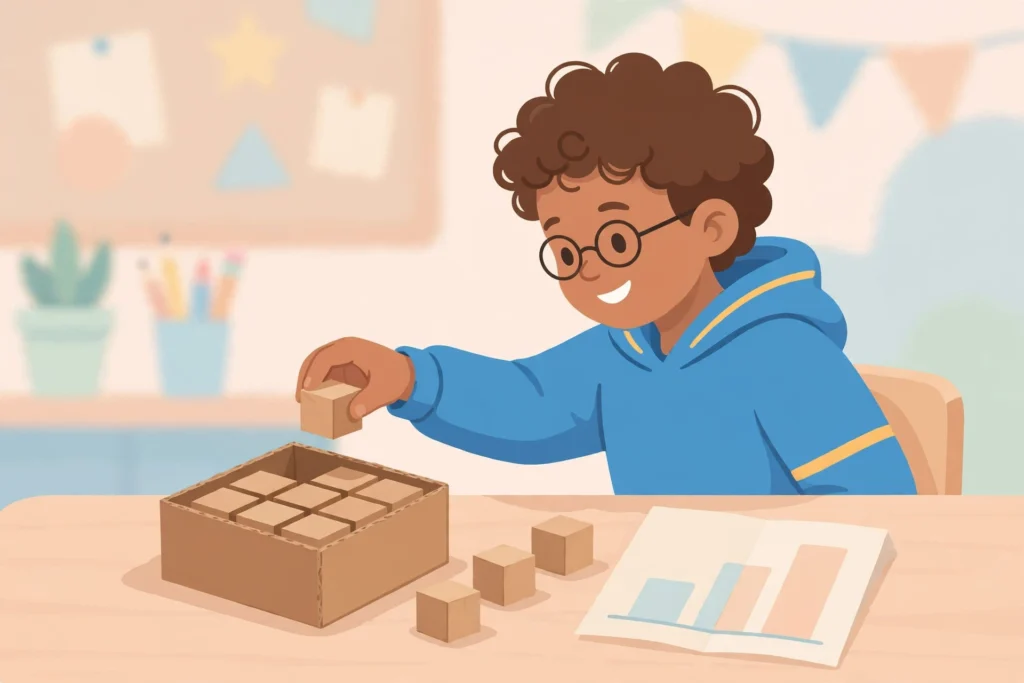
Find a small box, like a cracker box or a tissue box, and a set of counting cubes or sugar cubes. Measure the inside of the box in cube lengths: how many cubes fit across the bottom, how many fit front to back, and how many layers fit to the top.
Fill just the bottom layer and count. Write that number down. Now predict the full volume before you fill the rest. Multiply your bottom-layer count by the number of layers. Then fill the box and check your prediction. When the count matches, you have just used the volume formula without writing a single formal equation.
For a bonus round, find two boxes with the same bottom area but different heights. Predict which holds more, then test it. The taller box wins every time, because volume grows with height when the base stays the same.
Quick Practice
Question: A gift box is 3 centimeters long, 2 centimeters wide, and 4 centimeters tall. What is its volume?
Answer: Use Volume = length x width x height. First find the bottom layer: 3 x 2 = 6 cubic centimeters of cubes in one layer. There are 4 layers, so 6 x 4 = 24. The volume of the gift box is 24 cubic centimeters.
Related Terms
Frequently Asked Questions
What is a unit cube?
A unit cube is a cube with edges 1 unit long. It is the building block of volume, the way a unit square is the building block of area. Counting unit cubes inside a shape gives its volume in cubic units.
What is the volume of a cube with edges 5 units long?
Multiply 5 x 5 x 5 = 125. The volume is 125 cubic units. The bottom layer holds 25 cubes and there are 5 layers.
Can you measure the volume of water?
Yes. Water takes the shape of its container, so you can measure its liquid volume in cups, liters, or gallons. Scientists also measure the volume of odd-shaped solid objects by dunking them in water and seeing how much the water level rises.
Is volume the same as weight?
No. Volume measures space, weight measures heaviness. A huge empty cardboard box has a large volume but weighs almost nothing. A small lead weight has a tiny volume but feels heavy. Big space does not always mean big weight.
Reading about it is one thing, practising it is another. Our free What Is Area? lesson builds the idea step by step, with slides, a printable worksheet and a full answer key.
Members unlock every lesson in the library, including the full Fractions, Multiplication, Place Value, Addition & Subtraction, Time & Money and Geometry & Shapes units. See the full library