
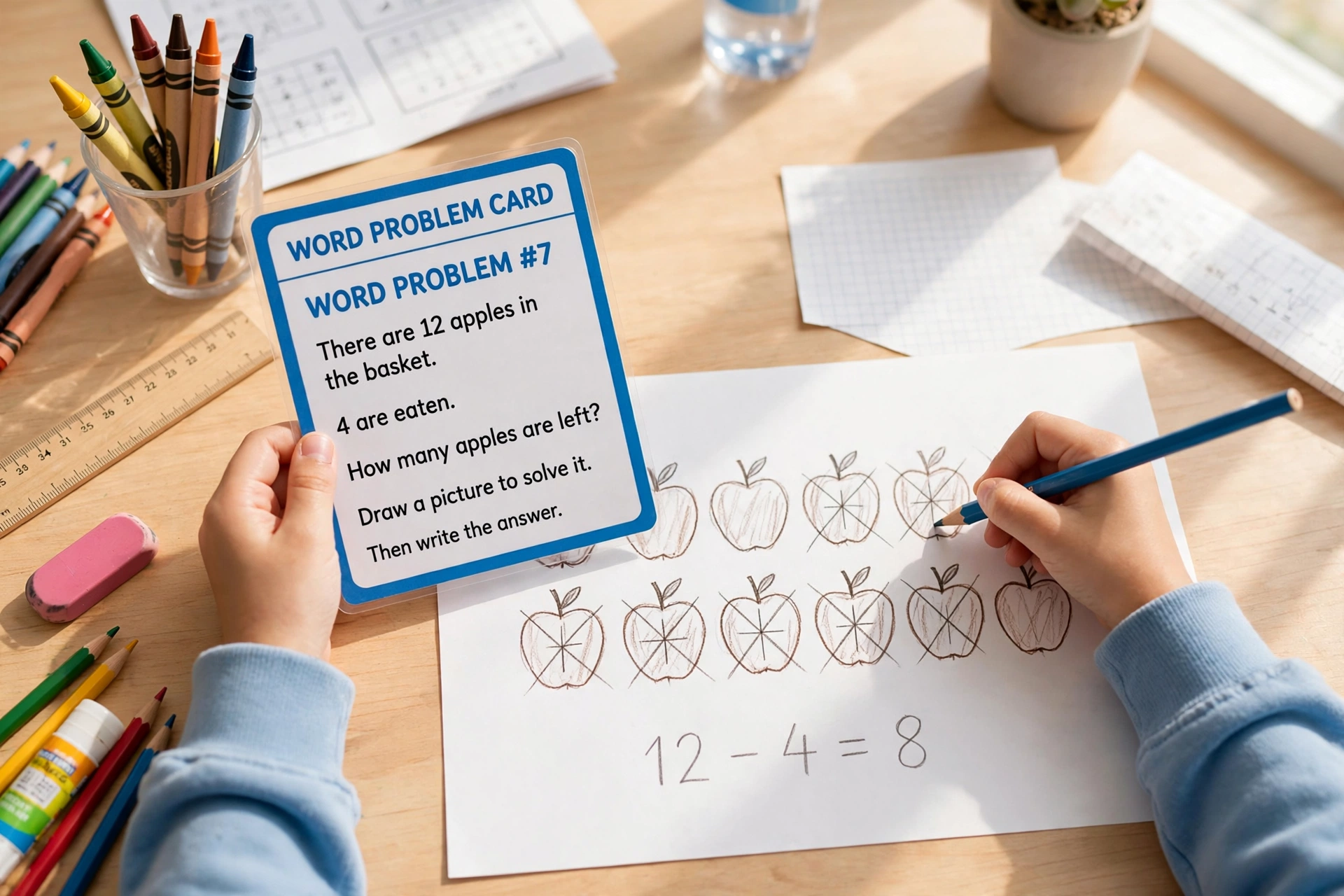
There are 7 birds in a tree. Three more join. How many now? That is a word problem: mathematics wrapped in a story. Students must understand the situation, decide the operation, then calculate. It is harder than 7 + 3, and far more valuable.
What Is a Word Problem?
A word problem presents mathematics as a narrative or real-life scenario. Instead of “8 – 3 = ?”, you get “You have 8 cookies. You eat 3. How many left?” The math is the same; the packaging differs. Students must extract the numbers and relationships from text.
Word problems test comprehension as much as computation. A student might know 8 – 3 = 5 but fail the cookie problem because they did not understand “eat” means subtract. The challenge is translation: words to math.
Why Are Word Problems Important?
Real life does not come as equations. When you shop, cook, or build, you face situations requiring math. Word problems train students to mathematize reality: see the numbers in the story, model the situation, solve, then interpret.
They also reveal understanding. A student who can compute but not solve word problems has procedural skill without conceptual grasp. Word problems are the true test of whether math makes sense.
How Do You Solve Word Problems?
Step 1: Understand. Read twice. Retell in your own words. What is happening? What are we trying to find?
Step 2: Plan. Draw a picture or diagram. Choose the operation. Estimate a reasonable answer.
Step 3: Solve. Calculate carefully. Show your work.
Step 4: Check. Does the answer make sense? Put it back in the story. Seven birds plus three is ten. Reasonable.
What Strategies Help?
Draw it. Bar models, number lines, or simple sketches make the relationships visible. A picture is worth a thousand words, especially in math.
Act it out. Use counters to represent the story. Physically joining or separating makes the operation obvious.
Look for structure, not keywords. “Altogether” usually means add, but not always. Understanding the story beats memorizing clue words.
Try It: Solve Word Problems
Step 1: Read: “A farmer has 15 cows. He buys 9 more. How many now?”
Step 2: Act it out with counters. Start with 15, add 9.
Step 3: Draw a bar model. One bar for 15, one for 9, total unknown.
Step 4: Solve: 15 + 9 = 24. Check: does 24 make sense? Yes, more than 15.
Quick Practice
Question: “Sara has 42 stickers. She gives 18 to her brother. How many does she keep?” What operation? Solve it.
Answer: Subtraction (giving away). 42 – 18 = 24. She keeps 24 stickers.
Frequently Asked Questions
Why do students struggle with word problems?
Usually reading comprehension, not math. They cannot parse the story or identify the operation. Building language skills helps as much as math practice.
Should students use keywords?
As a starting point, not a rule. “In all” often means add, but stories can trick. Teach understanding first, keywords as a backup.
How many steps should young students show?
At least the equation and answer. Pictures and explanations are better. The goal is visible thinking, not just correct answers.