Multiplying 2-Digit by 1-Digit

Multiplying 2-Digit by 1-Digit lesson cover for Grades 3-4

Big multiplications stop being scary when students can see the two small ones hiding inside. This Grades 3-4 lesson teaches multiplying 2-digit by 1-digit the way schools teach it: split the 2-digit number into tens and ones (23 = 20 + 3), multiply each part, and add the partial products. A 23-slide deck builds the … Read more

Multiplying by 10, 100 and Multiples of 10

Multiplying by 10, 100 and Multiples of 10 lesson cover for Grades 3-4

“Just add a zero” works until it doesn’t – and it never tells a child why. This free Grades 3-4 lesson teaches multiplying by 10 and 100 the place-value way: digits move one place for ×10 and two places for ×100, the zeros are place holders, and multiples split apart (6 × 30 = 6 … Read more

Times Tables Strategies

Times Tables Strategies lesson cover for Grades 3-4

Rote chanting is not the only way into the tables – and for many children it is the slowest. This free Grades 3-4 lesson teaches times tables strategies instead: anchor facts (the 2s, 5s, 10s and the squares), skip counting with honest jump-tracking, doubling and double-double for the 4s and 8s, the 9s finger trick … Read more

What Is Multiplication?

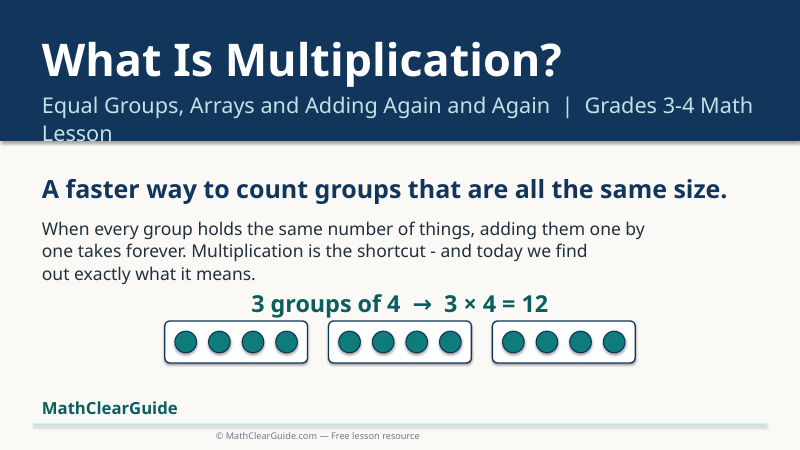
What Is Multiplication? lesson cover for Grades 3-4

Wondering how to explain what is multiplication so it really means something? This free Grades 3-4 lesson builds the idea from equal groups, with drawn plate models, dot arrays and number-line jumps that show why 3 × 4 is just 4 + 4 + 4 in a hurry. It names factors and product in kid-friendly … Read more

Fractions as Decimals

Fractions as Decimals lesson cover for Grade 4

Decimals stop being mysterious the moment students see they are fractions wearing a different costume. This Grade 4 lesson includes a 23-slide deck that builds the swap step by step: tenths on bars, hundredths counted on 10×10 grids, the place value of every decimal digit, number lines and money models, with the one-digit hundredths slip … Read more

Fraction of a Whole Number

Fraction of a Whole Number lesson cover for Grade 4

Multiplying a fraction by a whole number clicks when students can see copies: three jumps of 1/4 land on 3/4, and four copies of 2/3 regroup into 2 2/3. This Grade 4 lesson includes a 23-slide deck that builds both meanings step by step — repeated addition of unit fractions, jumps on the number line, … Read more

Mixed Numbers and Improper Fractions

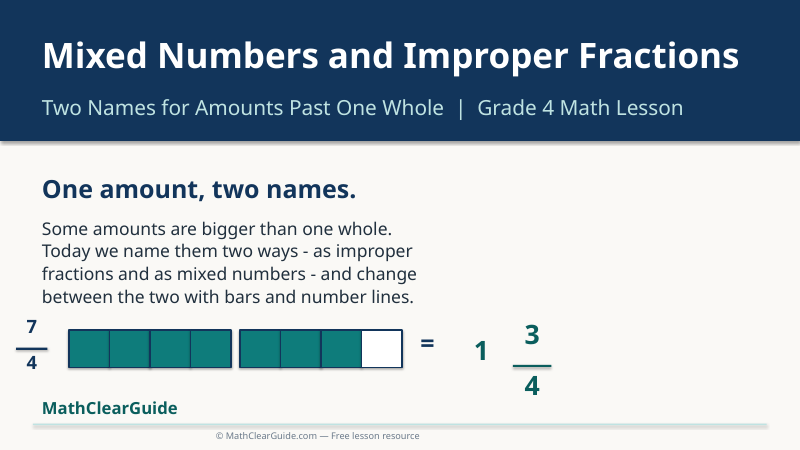
Mixed Numbers and Improper Fractions lesson cover for Grade 4

Amounts greater than one whole click when students can group pieces into wholes — and break wholes back into pieces. This Grade 4 lesson includes a 23-slide deck that builds both directions step by step: grouping improper fractions into mixed numbers with multi-bar models, counting past 1 on a number line, un-grouping wholes for the … Read more

Subtracting Fractions with Like Denominators

Subtracting Fractions with Like Denominators lesson cover for Grade 4

Subtracting fractions clicks when students watch pieces being taken away from the very same whole — the count drops, the piece size never changes. This Grade 4 lesson includes a 23-slide deck that builds the rule step by step: take-away bar models with crossed-out pieces, counting back on the number line, subtracting from 1 whole … Read more

Adding Fractions with Like Denominators

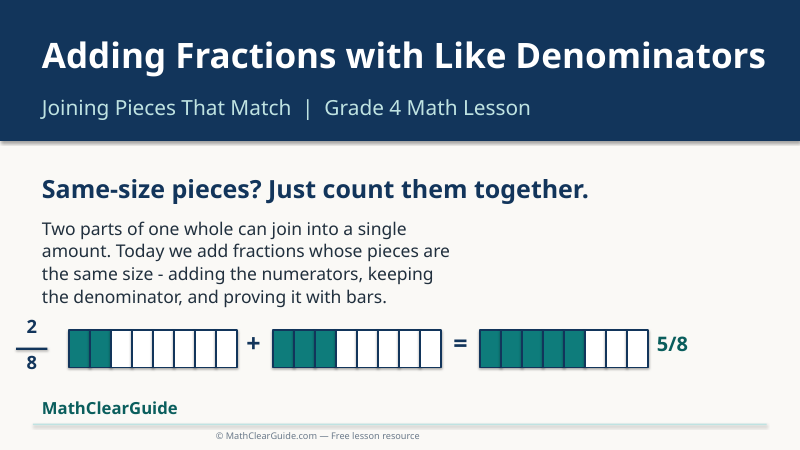
Adding Fractions with Like Denominators lesson cover for Grade 4

Adding fractions clicks when students see that only the count of pieces changes — never their size. This Grade 4 lesson includes a 23-slide deck that builds the rule step by step: join-the-pieces bar models, number-line jumps, pairs that make exactly 1, and a gentle first look at sums greater than 1, with the classic … Read more

Ordering Fractions

Ordering Fractions lesson cover for Grade 4

Ordering fractions makes sense when students can watch the amounts line up. This Grade 4 lesson includes a 23-slide deck that builds ordering step by step — same-denominator sets first, then splitting a set at the benchmark 1/2, then placing fractions on a 0-to-1 number line — with drawn bar models proving every position, ascending … Read more