Scientific Notation Grade 8: Very Large and Very Small Numbers Lesson Pack with Worked Key (8.EE.A.3)

Grade: 6-8 | Topic: Number Sense | Badge: 🔒 MEMBERS ONLY
Teach scientific notation the way Grade 8 expects it: as a way to write very large and very small numbers short, to estimate them, and to say how many times as much one is than the other. 23 slides, 13 pages, 49 problems, and a filled in key that shows the counted moves and the expansion check for every conversion.
What is inside:
- 23 teaching slides: the distance to the nearest star as the hook, five worked examples and five follow ups, comparing by exponent first, the standard’s own population example, estimating with one digit, and a spot the error example
- How Many Times task cards: 8 cards, each holding two real quantities in mixed forms, with two trap cards where the bigger exponent wears the smaller first factor, and where two numbers are equal in different coats
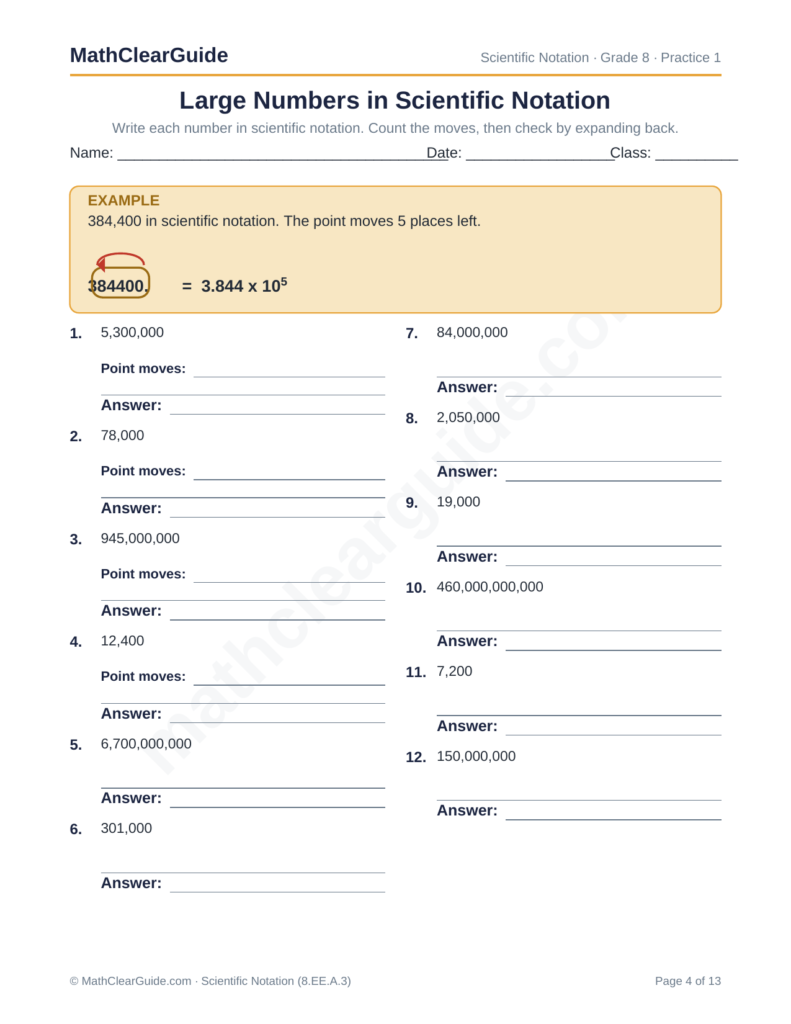
- Practice 1: 12 large numbers to write in scientific notation, with the digit circling example box at the top and the moves counted on the printed count line of the first four
- Practice 2: 10 problems, small numbers to write in scientific notation and short forms to read back in full, with the negative exponent named as Lesson 2 ground being spent
- Practice 3: 10 compare and order problems, sets of three and four quantities in mixed forms, then how many times as much questions, with a challenge strip whose answer is itself a power of ten beyond a thousand
- Practice 4: 8 real quantities, distances in the solar system, masses of animals and cells, the width of a hair and the length of a virus, each written, compared or estimated as the problem asks
- A filled in key for every page, showing the counted moves for every conversion on the first page of each kind and the expansion check beside it
- A Keep Going page inside the PDF with links to the rest of the unit and the Worksheet Generator tool
The skill: pupils write very large and very small numbers in scientific notation, read them back in standard form, compare them by exponent first and first factor second, and answer how many times as much one is than the other. The remember box on every practice page works one problem of each kind in full, and the key prints the same steps, so the form is taught, practised and marked the same way.
Standards: CCSS 8.EE.A.3. 8.EE.A.3: “Use numbers expressed in the form of a single digit times an integer power of 10 to estimate very large or very small quantities, and to express how many times as much one is than the other.”
Also good for: Grade 8 science classes in the weeks when powers of ten arrive in measurements, and Grade 7 advanced groups ready for the form after integer operations.
Formats: 23 slides (PPTX), worksheet PDF in colour and in black and white, 13 pages each.
Levels: one core level throughout. Practice 3’s challenge strip stretches the top end, and the card traps catch the comparing errors early.
Use it for: a first scientific notation lesson, small group intervention, homework, or review before operations in scientific notation begin.
One honest line before you buy: this unit teaches integer exponents and scientific notation in Grade 8. Square and cube roots wait for their own Grade 8 unit, solving equations is taught in full in our Algebra 1 Solving Equations unit, and no page here repeats the Grade 6 exponents work, which teaches whole number powers only.
Members: this is a members only lesson of the Exponents and Scientific Notation unit (Grade 8). The free lesson of the unit is Powers and Exponent Rules.
Look Inside