
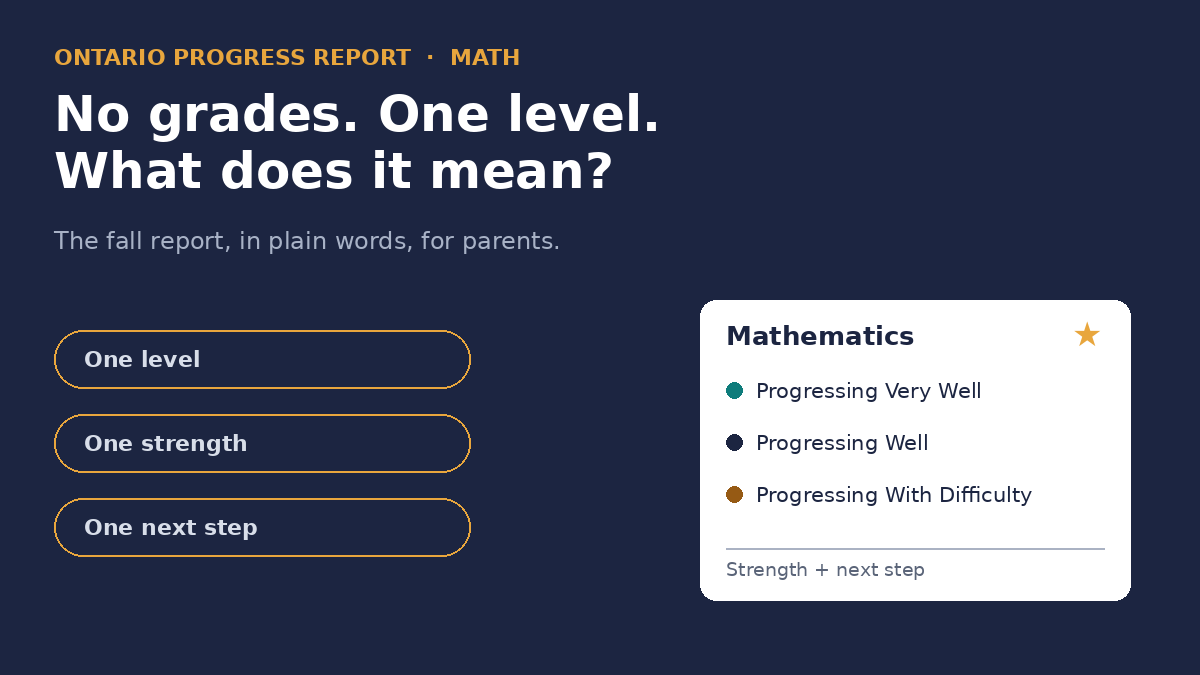
The report came home in the backpack. You open it, look for the grade in math, and there is no grade at all. There is one level, a short comment, and a lot of questions in your head. Is my child fine? Behind the level? What do we do now? This post answers those questions in plain words. Start with the free parent guide: five pages, ending with a fill-in page for your child’s next step.
One level tells you where your child stands. The comment tells you what happens next.
Get the free guide here:
The Three Levels at a Glance
| Level | What it means in math | What it does not mean |
|---|---|---|
| Progressing Very Well | Meeting the goals for this point in the year, with confidence | Perfect work, or a top mark |
| Progressing Well | On track, growing the way teachers expect | Nothing left to work on |
| Progressing With Difficulty | Needs more time and more support to reach the goals | Failing, or a lost year |
Every child gets one of these levels, and every child also gets a next step. The next step is not a warning. It is the plan. The three sections below show what each level sounds like in a real math comment, so you can match the words on your child’s report.
Progressing Very Well
This level means the learning is strong for this point in the year. The comment often names a skill your child uses with ease, plus a harder next step. It might sound like this: counts by 2s, 5s and 10s with ease, and the next step is counting by 25s. For an older child it may name fast facts and a move to bigger problems. The right response is simple: say well done, and ask what the challenge work looks like. If facts are already fast, the free Multiplication Chart helps your child check harder facts at home.
The free guide explains this level in plain words.
Progressing Well
This is the level most children get, and it is a good place to be. It means on track. The comment names a strength that is still growing, and a next step that is close. It might sound like this: adds and takes away using a number line, and the next step is recalling the facts without the line. Five minutes of counting or fact practice a day beats one long session on the weekend. Ask the teacher which skill to practise first, and write it on the last page of the free guide.
That fill-in page sits at the end of the free guide.
Progressing With Difficulty
This level means your child needs more time and more support. It is not a fail, and it is not a surprise the school is hiding. It is the school telling you early, while there is lots of year left to change it. The comment should name what is hard in plain words, such as counting a set of objects with one-to-one matching. Ask two things at the interview: what support happens at school, and what one thing should happen at home. Then check the gap yourself with the free Math Placement Test, which shows grade by grade which skills to look at first.
A hard level in November is a head start, not a verdict. There is a whole year left to move it.
The free guide has five questions to take to that interview.
The Five Strands
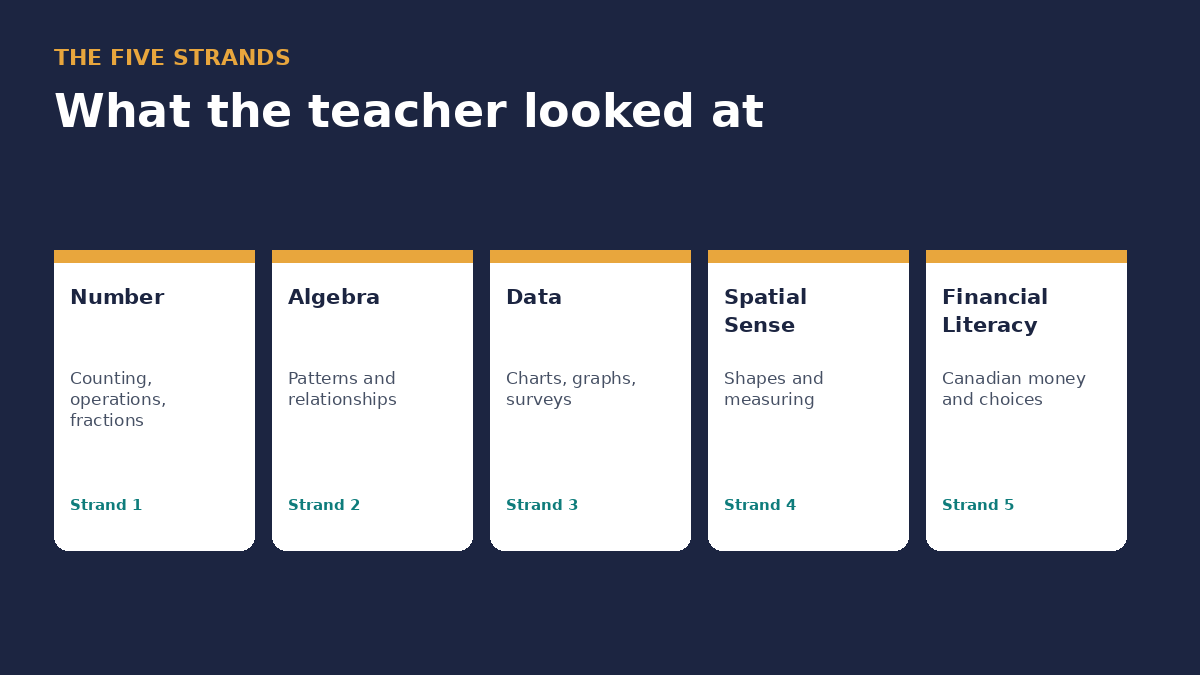
Math on the report is one subject, but the comment points at one of five areas, called strands. Number is counting, operations and fractions. Algebra is patterns and missing numbers. Data is charts, graphs and surveys. Spatial Sense is shapes and measuring. Financial Literacy is Canadian money and simple choices about spending and saving. When you know the strand, the comment makes sense at once, and home help gets easy to pick. Short extra sheets from the free Worksheet Generator match most strands in a few clicks.
The free guide gives one home habit for every strand.
Which One Do You Need
| Free Parent Guide | Paid Comment Bank | |
|---|---|---|
| Made for | Parents | Teachers |
| What it holds | The levels in plain words, 5 questions, home habits, a fill-in next step page | 60 ready comments, every strand at every level, both grade bands |
| Pages | 5 | 16, plus black and white and editable text versions |
| Cost | Free with an email signup | Members |
Parents start with the free guide. Teachers who are writing the reports start with the bank. Many families meet in the middle: the parent reads the guide before the interview, and the teacher writes the comment from the bank.
The Free Parent Guide
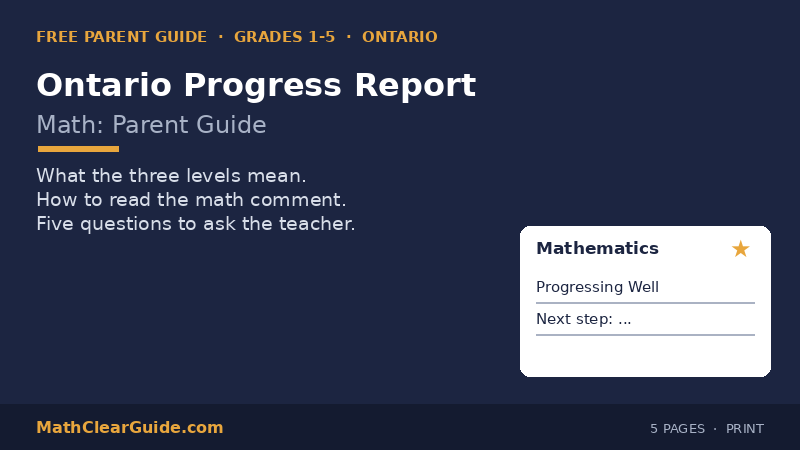
The guide is five pages. Page one explains what a Progress Report is and why there are no grades on it. The next pages walk through the three levels, the five strands, and the questions worth asking. The last page is the one parents keep: a fill-in page for the strength, the next step, what home will do, and the next check date. Print it before the interview and take it with you.
Get it here:
The Paid Comment Bank
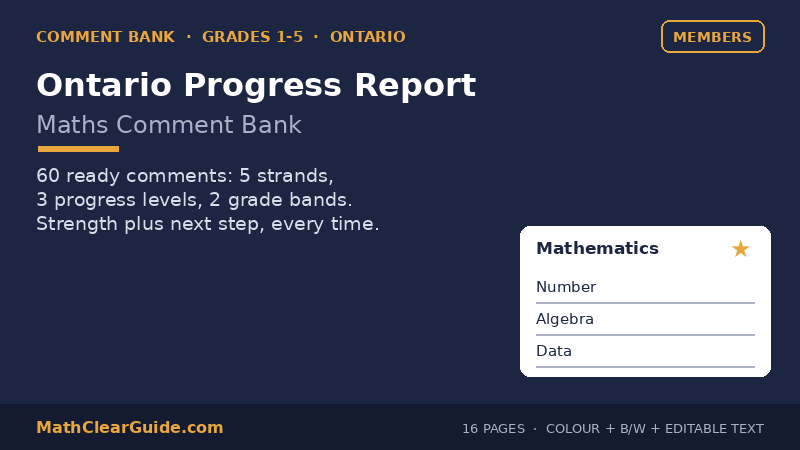
Teachers, this one is yours. The bank holds 60 ready comments in a full grid: 5 strands, 3 progress levels, and 2 grade bands, Grades 1-2 and Grades 3-5. Every comment is one strength plus one next step, in the language of Growing Success, ready to adapt in under a minute. It comes as a colour print PDF, a black and white print PDF, and an editable text version you can copy and paste. A personalise page shows the small edits that make a bank comment sound like your own writing.
See the full bank here:
Common Questions
Is the parent guide really free? Yes. It is free with an email signup, like every free resource in the library.
Which grades does this fit? Grades 1 to 5. The guide speaks to all five grades at once, and the bank splits its comments into Grades 1-2 and Grades 3-5.
Is this only for Ontario? Yes. The levels, the strands and the wording are Ontario’s. Other provinces use different reports and different words.
Can teachers edit the comments? Yes. The bank includes a plain text file made for copying and editing.
How do I print the guide? Print all five pages, or only the last page to fill in after the interview. Every page reads well in black and white.
The report is the start of the talk, not the end of it. Get the free guide by email, unlock the full bank if you write the reports, and take your questions to the interview. The Parent Teacher Conference Math Kit in the same library helps you plan that talk.
Read the comment twice: once for the strength, once for the step. Both halves are good news.
Every topic clicks faster with practice. Our Resource Library has free lesson packs with slides, printable worksheets and full answer keys, ready to download and teach.
Members unlock every lesson in the library, including the full Fractions, Multiplication, Place Value, Addition & Subtraction, Time & Money and Geometry & Shapes units. See the full library


