
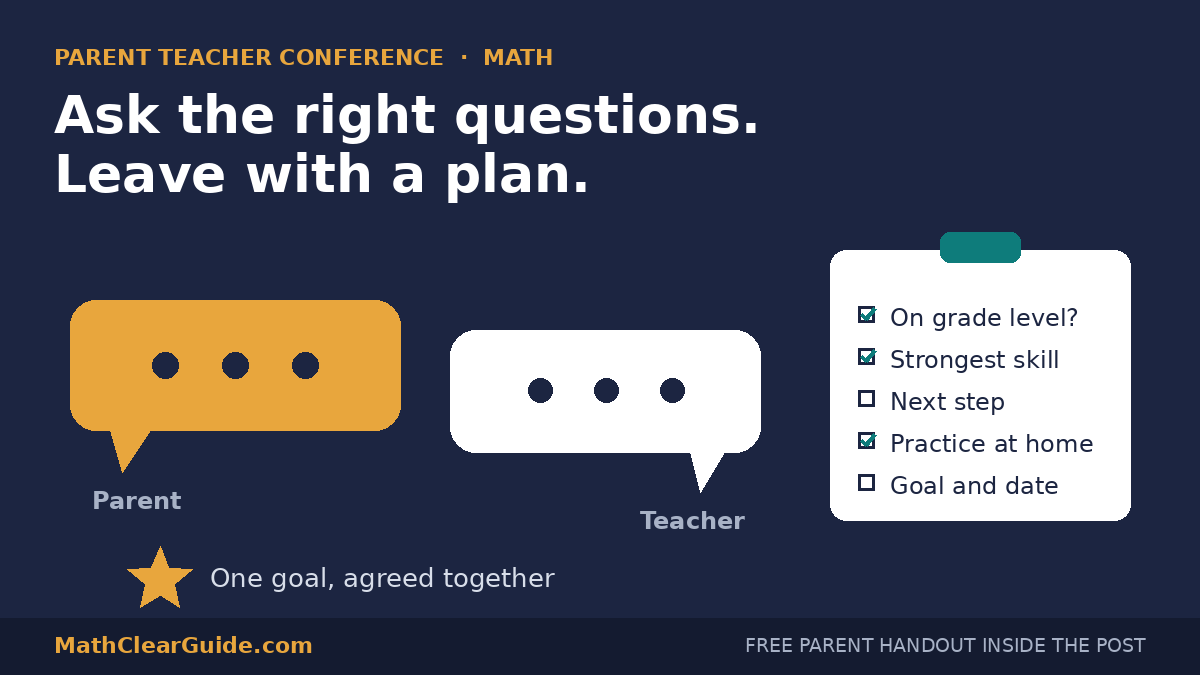
The conference is this week. You get about ten minutes with the teacher, and you want to leave with a clear plan, not just the words doing fine. Most parents hear the level and miss the skill, and the skill is the part you can help with at home. This post gives you the math questions that matter, grade by grade, and the small home habits that match them. Start with the free parent handout. It holds all eight questions on one page, and the last page is space for your child’s goals, ready to fill in at the meeting.
A good meeting ends with a plan, not just a level.
Get it here:
What to Ask for Grades 1 and 2
In grades 1 and 2, math is counting, place value, and adding and taking away, first to 20 and then to 100. Ask if your child is on grade level, and ask the teacher to name the skill, not just the level. A good answer sounds like this: she counts by 5s and 10s, and now we are adding two digit numbers. Also ask which skill is hardest right now, and what to practice at home. Five minutes a day is enough at this age, and the habits are simple ones: count real things out loud, build numbers with tens, measure things around the house, and play short fact games.
The free handout lists all eight questions for this age: free parent handout.
What to Ask for Grades 3, 4 and 5
From grade 3 up, math turns on three things: times table facts, fractions, and word problems with more than one step. Ask which of these is hardest for your child right now, and ask for an example from class work, not just a score. A good answer is plain: the facts are strong, and fractions on a number line are the next step. Then agree on one goal and a date to check it, so the talk turns into a plan. At home, short bursts work best at this age: tables said out loud, fractions in the kitchen with real food, one long division a day, and one real life problem a week.
The free handout lists all eight questions for this age too: free parent handout.
The Free Parent Handout

The free parent handout puts the whole meeting on five pages. The first page is the eight questions, each with one line on what a good answer sounds like. The next two pages give five ways to help at home for grades 1 and 2, and five for grades 3, 4 and 5. Every habit names a free tool or a free lesson that does the heavy lifting, so you are never stuck for what to do on a Tuesday night. The last page is for your child’s math goals, filled in at the meeting and kept on the fridge where you see it every day.
Get it here:
Ten minutes is short. One good question and one clear goal are worth more than a long talk.
The Full Teacher Kit
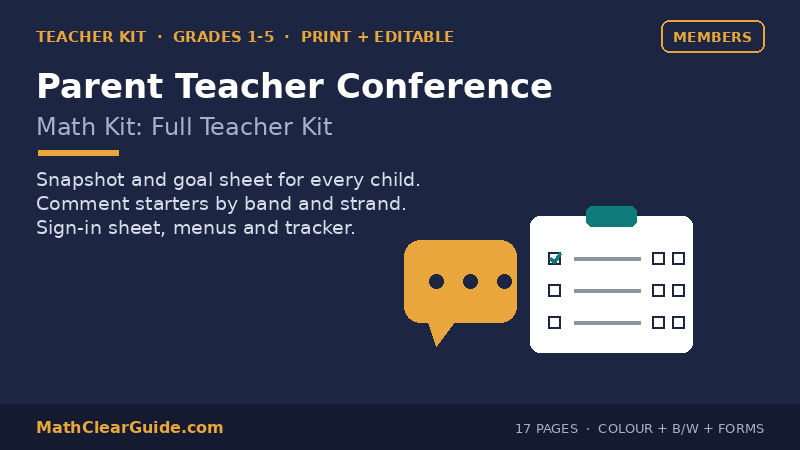
Teachers sit on the other side of the same table, often with a whole class of meetings packed into two days. The full teacher kit holds the teacher side of this post. There is a snapshot sheet for every child, with tick boxes by skill, one for grades 1-2 and one for grades 3-5, and a goal sheet that matches it. The kit also holds the words for the meeting. The comment starters are grouped by grade band and strand, and each one gives a strength, a next step, and one home action, ready to say out loud. A sign-in sheet, two home-support menus, a conference notes page, a note to send home, and a next steps tracker close the kit. It comes in colour, in black and white, and as editable forms you can type into.
Members get the full kit here:
Which Kit Fits Your Grade
| Question | Free Parent Handout | Full Teacher Kit |
|---|---|---|
| Who is it for? | Parents | Teachers |
| How many pages? | 5 pages | 17 pages, plus black and white and editable forms files |
| Best for | One child, one meeting | A whole class, every meeting |
| Grades | 1 to 5, habits split by band | 1 to 5, sheets split by band |
Parents only need the handout. Teachers who run the meetings need the kit, and the two match page for page.
Start free: free parent handout · Teachers: full teacher kit
One Snapshot, Two Levels

The same snapshot idea works in both bands, but the skills change with the child. For a grade 2 child, the sheet asks about counting by 5s and 10s, tens and ones, and adding to 100. For a grade 5 child, it asks about division facts, fractions on a number line, and multi step word problems. The lower band keeps the numbers small and the steps few, so a young child’s sheet fills in fast and the talk stays warm. That is the point of levels in this kit: the same form, at the right size for the child in front of you.
See the full kit here: full teacher kit
After the Conference: Check the Gaps at Home
A goal only helps if you check it, and the first check is knowing where the gaps are. If you are not sure, the free Math Placement Test checks grade 3, 4 and 5 skills with 15 questions and shows the weak spots at the end. For daily practice, the Multiplication Chart and the Fraction Calculator check work in seconds, the Long Division Calculator shows every step of a hard sum, and the Worksheet Generator prints fresh practice with a key. Words on the report can confuse too. The free dictionary explains words like sum and product in plain words.
Then set the date and start small: free parent handout
When a family knows the one goal, home practice does half the work.
Common Questions
Is the parent handout free? Yes. The handout is free with an email signup, like every free resource in the library.
Which grades does the kit fit? Grades 1 to 5. The snapshot sheets, goal sheets, menus and comments come in grades 1-2 and grades 3-5 versions.
Can I edit the forms? Yes. The teacher kit comes with an editable forms file. Type names, goals and notes on screen, then print.
How do I print it? Print the colour file, or use the black and white file to save ink. A teacher prints one snapshot sheet and one goal sheet per child.
Get the free handout by email, take it to the meeting, and leave with one goal you both believe in. Teachers, join to unlock the full kit.
Every topic clicks faster with practice. Our Resource Library has free lesson packs with slides, printable worksheets and full answer keys, ready to download and teach.
Members unlock every lesson in the library, including the full Fractions, Multiplication, Place Value, Addition & Subtraction, Time & Money and Geometry & Shapes units. See the full library


